
A propeller is the only part of the drive train that touches the water, and a wrong one can make a healthy engine look sick. Many owners only discover this when the boat will not reach the engine's rated speed, or when it over-revs without moving faster. This guide explains propeller pitch and diameter, how to read the numbers on the hub, and how boat propeller selection works in practice.
Think of a propeller like a gearbox you can change. The two numbers stamped on most propellers, diameter first and pitch second, tell you which gear you have.
Propeller Pitch and Diameter: What the Numbers Mean
Propeller pitch is the distance, in inches, that the propeller would move forward in one turn if it were screwing through a solid. Diameter is the width of the circle the blade tips make. A lower pitch behaves like a low gear: strong acceleration, easy planing and a better time under heavy loads, but a lower top speed. A higher pitch behaves like a high gear: more top speed, but it takes more from the engine to get going.
Both numbers come from the engine, the gear ratio and the boat. Use the combinations approved for your engine and ask a technician who knows your boat before you change.
Wide-Open-Throttle RPM: The Test That Matters
Every engine maker publishes a rated speed range for wide-open throttle. With a normal load aboard, fuel for the day, the motor trimmed correctly and clean water, the tachometer at wide-open-throttle rpm should land inside that range.
- Revs above the range (over-revving): the propeller is too light for the load, and a higher pitch is usually the cure.
- Revs below the range (lugging): the propeller is too heavy, and the engine cannot reach its power, so the pitch is usually too high. This is hard on the engine over time.
Test with the load you carry most often, and again with a heavy load, to see how much the boat's behavior changes.
Aluminum vs Stainless Propeller
An aluminum propeller costs less and tends to be more forgiving when it hits something. Stainless steel is stiffer and holds its shape under load, which can improve performance, and it costs more. Neither is better for everyone: choose by how you use the boat and what a replacement would cost after a strike. Three-blade and four-blade versions trade differently between speed, hole shot and holding the bow up.
Cavitation, Ventilation and Other Symptoms
Not every performance problem is a pitch problem. Propeller ventilation means air is pulled down to the blades, often in tight turns or when the motor sits too high, and the revs rise suddenly. Cavitation involves vapor bubbles forming on the blade, often from a damaged or poorly shaped blade. Both can look like a wrong-size propeller, so inspect it before you buy another.
- Rpm rises but the boat does not speed up: a possible spun hub; see spun prop hub signs and when to re-hub a propeller.
- Dinged, bent or cupped blades: read when a damaged propeller can be fixed.
- Vibration through the hull on an inboard: the shaft, cutless bearing or alignment may be at fault, as explained in inboard vibration, cutless bearing wear and shaft alignment.
Before You Change the Propeller
Check the basics first: that the hull is clean, the trim is correct and the engine is healthy. A fouled bottom and a tired engine can both hide behind a wrong-looking tachometer reading. Then choose a replacement based on the wide-open-throttle result rather than guesswork.
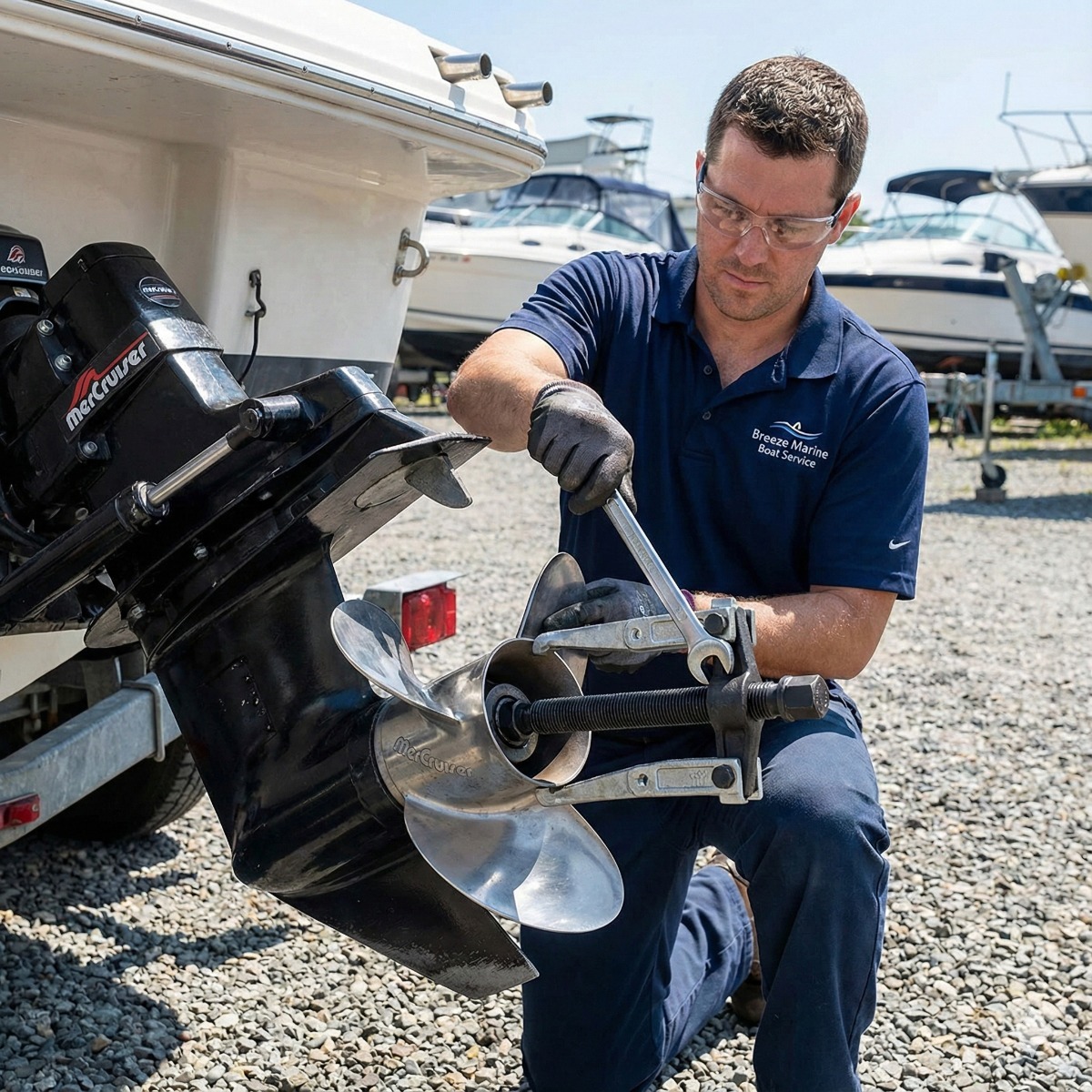
A bent or damaged blade is worth fixing, and our propeller repair service restores balance and thrust where a repair is practical. If the hub has slipped, propeller pulling and re-hubbing is the usual route. On a boat with an inboard shaft, prop shaft alignment and cutless bearing replacement addresses the cause of many vibrations.
Propeller Selection FAQ
Can I change only the pitch?
Yes, and that is the most common change. A different pitch moves the engine's rpm, while a different diameter must fit the lower unit and the hull. Keep the engine's approved rpm range as the goal.
Should I carry a spare propeller?
It is a good idea, along with a propeller wrench and spare hardware. Our guide to spare parts and tools to carry on your boat lists what else to pack.
Why does my boat vibrate at one speed only?
A bent blade, a damaged hub or a worn shaft bearing are the usual suspects. Have the propeller checked first because it is the easiest part to test.