
An inboard boat should run smoothly at every speed. When a deep rumble, a buzz through the deck or a shudder at certain RPMs develops, the drivetrain is telling you something. Inboard vibration usually comes from one of three places: the propeller, the shaft and its bearings, or the alignment between engine and shaft. This guide explains how the cutless bearing and alignment fit into that picture, what the repairs involve, and how to check the basics yourself.
How an Inboard Drivetrain Fits Together
The engine and transmission sit on flexible mounts. The transmission output flange bolts to a shaft coupling, which connects to the propeller shaft. The shaft passes through a stuffing box or dripless seal in the hull, runs aft through one or more struts, and carries the prop on its tapered end. Inside each strut is a water-lubricated bearing, commonly called a cutless bearing: a bronze or composite shell lined with grooved rubber that lets seawater flow through and lubricate the shaft.
For everything to run smoothly, the transmission flange must line up precisely with the shaft, the shaft must be straight, and the bearings must hold it without excessive play.
Cutless Bearing Wear
Every propeller shaft bearing wears over time. Sand and silt in the water, long periods sitting still, marine growth on the rubber and misalignment all speed up wear. As the rubber wears, clearance increases, the shaft moves within the strut, and vibration follows.
How to check it
With the boat hauled out, grab the shaft next to the strut and try to move it up, down and sideways. A small amount of movement is normal; clear clunking or visible play suggests a worn bearing. Look for rubber pieces protruding from the ends, a bearing that has shifted in the strut, and uneven wear that points to misalignment. A diver can do a similar check in the water.
What cutless bearing replacement involves
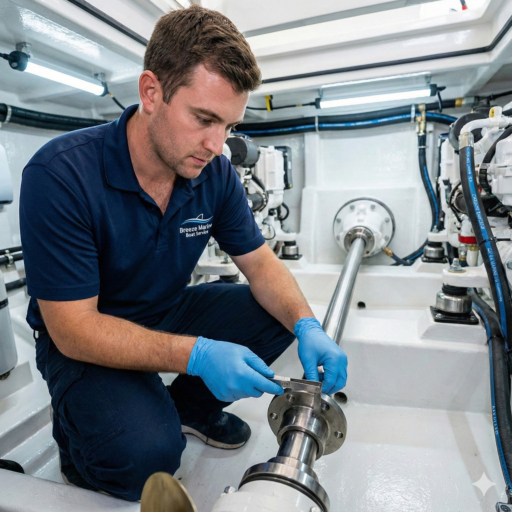
The prop is removed, the coupling is usually separated, and the shaft is withdrawn or slid aft so the bearing is exposed. The old bearing is pressed out of the strut, which may mean carefully cutting it if it has seized, and the new one is pressed in and secured with set screws. The strut itself is inspected for cracks, looseness in the hull and corrosion. Strut bearing replacement is also a good opportunity to check the shaft for straightness and for wear at the bearing and seal surfaces.
Shaft and Engine Alignment
Even new bearings wear quickly if the engine is out of line with the shaft. Prop shaft alignment is measured at the coupling: with the bolts removed, a technician checks the gap between the two coupling faces all the way around with feeler gauges. The faces should be parallel within a few thousandths of an inch, and the shaft should sit centered on the transmission flange. The engine is then moved on its adjustable mounts until the readings are within specification.
Why in-water alignment matters
A hull changes shape slightly when it goes back in the water and when tanks and gear are loaded. That is why final engine alignment should be checked after the boat has been afloat for a while and loaded roughly as it will be used. An alignment done on the hard is a useful starting point, but in-water alignment is the check that counts.
Signs of engine misalignment
- Vibration that changes with RPM but is not cured by a new or repaired prop
- A stuffing box that runs hot or drips more than usual, or a dripless seal that wears quickly
- Rapid cutless wear, often worse on one side
- Cracked or collapsed engine mounts
- Leaks at the transmission output seal
Engine misalignment also loads the transmission bearings and can eventually damage the gearbox itself.
Don't Overlook the Prop and Shaft
A bent prop from striking debris causes vibration that feels very similar to bearing or alignment problems, and a bent shaft will do the same even when alignment is perfect. A shaft can be checked on rollers with a dial indicator and straightened or replaced if needed. Tackling alignment, bearings, shaft and prop together is the reliable way to get a smooth drivetrain.
What Owners Can Do
- Note when the vibration starts: at a certain RPM, in forward only, or all the time.
- Check the engine mounts for cracked rubber and loose nuts.
- Look at the coupling bolts for looseness and at the stuffing box or seal for excessive leaking or heat.
- Have a diver inspect the prop, shaft and strut for fishing line, rope or heavy growth.
- Keep a record of when the current bearing was installed.
When to Call a Technician
Vibration that appears suddenly after striking something should be checked before any long run, because a damaged strut or bent shaft can get worse quickly. Persistent vibration without a clear cause is worth a professional inspection. Our prop shaft alignment and cutless bearing replacement service covers bearing work, coupling checks and alignment so the drivetrain runs smoothly again.
Drivetrain Vibration FAQ
How long does a cutless bearing last?
It varies with use, water conditions and alignment. Many owners inspect it at every haul-out and replace it when play becomes noticeable rather than on a fixed schedule.
Can alignment be done without hauling out?
Yes, and it is actually best checked with the boat afloat. Bearing work usually requires a haul-out, although divers can sometimes change a bearing in the water in specific situations.
Why did the vibration return after a new bearing?
The most common reasons are misalignment that was not corrected, a bent shaft or a damaged prop. All three should be checked whenever a bearing is replaced.


