Topping up coolant every few trips without ever finding a puddle is a frustrating and common problem on boats with freshwater cooling. The coolant is going somewhere, and the most likely destinations are hidden: out through the exhaust via a failed heat exchanger, into the engine, or evaporating from a leak that only opens when the system is hot and pressurized. Pressure testing is the standard way to find these leaks before they lead to boat engine overheating.
How a Closed-Loop System Works
Many inboard and larger engines use a closed-loop system. Coolant circulates through the engine block, manifolds and a heat exchanger. Seawater passes through the other side of the heat exchanger, carrying heat away without ever touching the engine's internal passages. A pressure cap keeps the coolant under pressure, which raises its boiling point. Any weakness in hoses, seals, the exchanger or the cap lets coolant escape.
Where Hidden Leaks Hide
Heat exchanger
A heat exchanger leak is one of the most common hidden causes. Internal tubes corrode or crack, allowing coolant to pass into the seawater side and out the exhaust. You may see no drips at all. Signs include coolant loss with no visible leak, a sweet smell at the exhaust, or, if the pressure difference reverses, seawater contaminating the coolant.
Leaks that only open under heat
Hose clamps, gaskets and pump seals can seal when cold but seep once the engine is hot and pressurized. Coolant evaporates off hot surfaces before it drips, leaving only faint crusty residue.
Internal engine leaks
A failing head gasket or cracked head can push coolant into cylinders or oil. Milky oil, white exhaust smoke with a sweet smell or bubbles in the coolant are serious warning signs.
The cap itself
A weak cap lets coolant escape to the overflow at lower pressure and lowers the boiling point. It is a small part that is easily overlooked.
How Pressure Testing Works
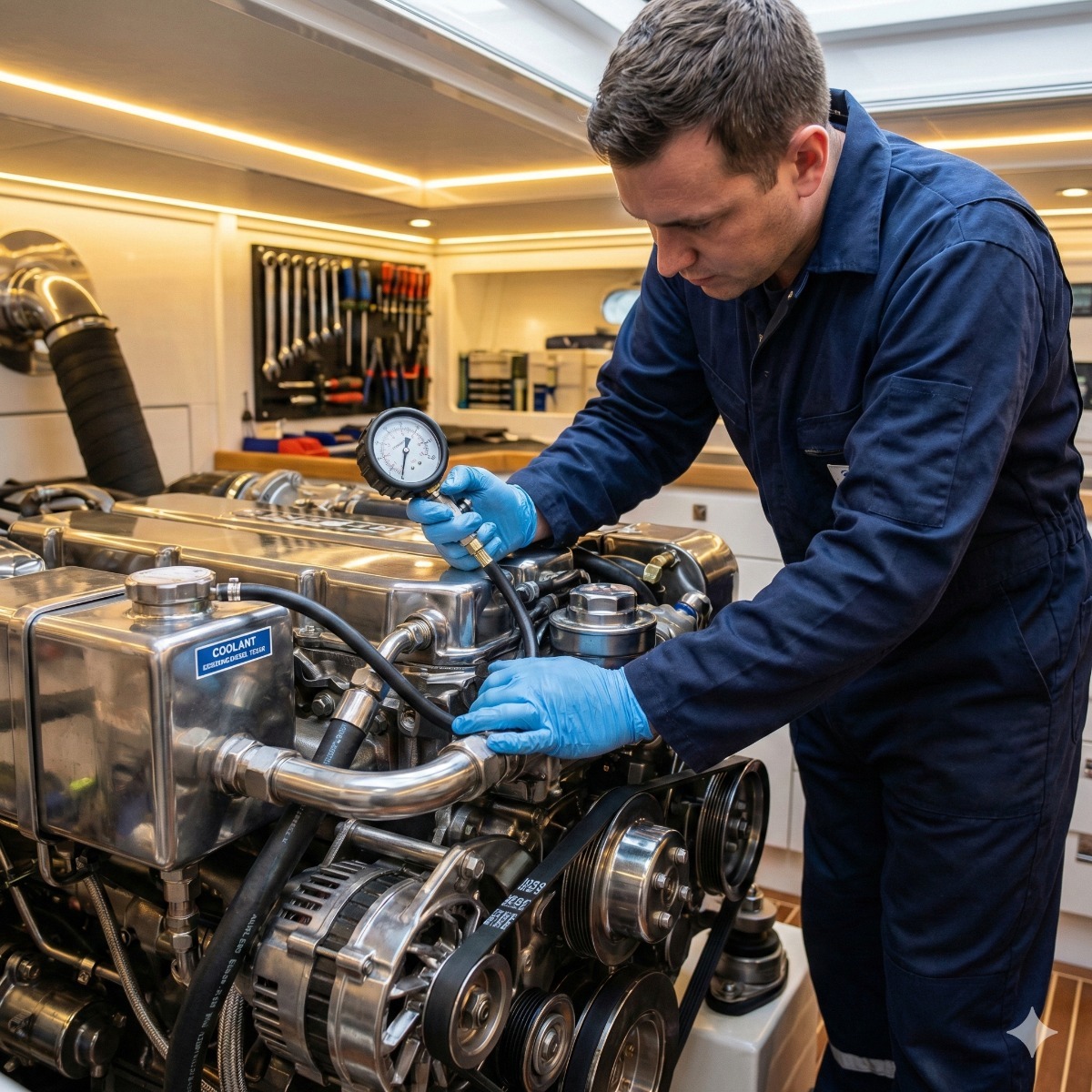
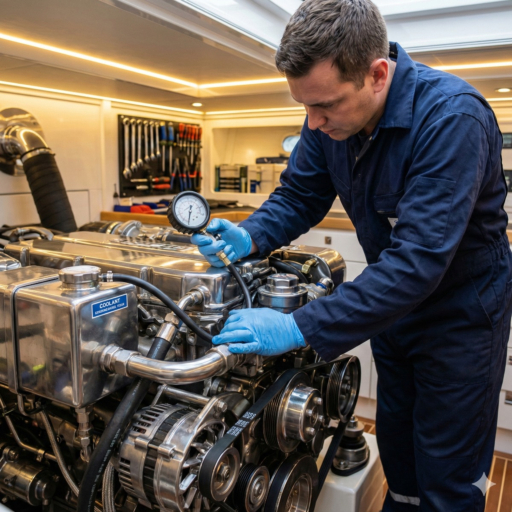
Cooling system pressure testing uses a hand pump and gauge that attach in place of the cap. With the engine cold, the system is pressurized to its rated pressure and the gauge is watched. A steady reading suggests a tight system. A falling reading confirms a leak, and the technician then inspects hoses, fittings, the exchanger and engine surfaces while pressure is applied, often revealing seepage that never appears at rest.
Hydrostatic pressure testing of individual components, such as a removed heat exchanger or oil cooler, isolates them from the rest of the system. The component is sealed, pressurized and sometimes submerged to watch for bubbles. This confirms whether an exchanger needs repair or replacement.
Radiator cap pressure test
A radiator cap pressure test uses an adapter to check that the cap holds its rated pressure and releases correctly. Caps are inexpensive, so a failed cap is simply replaced.
UV fluorescent dye
For stubborn or intermittent leaks, UV fluorescent dye is added to the coolant. After running the engine, a UV lamp makes even tiny traces glow, showing the exact source. Leak detection with dye is especially helpful in cramped engine rooms where hoses and fittings are hard to see.
Symptoms Worth Acting On
- A coolant leak you cannot find, with the reservoir steadily dropping
- Rising temperature under load or on hot days
- Sweet smell around the engine or exhaust
- White residue on hoses, clamps or the heat exchanger
- Milky oil or oily film in the coolant
What an Owner Can Check
- Check coolant level only when the engine is cold; never open a hot cap
- Mark the overflow reservoir level and track how quickly it drops
- Look for dried coolant residue around hoses, the water pump and the exchanger end caps
- Check oil color on the dipstick
- Squeeze hoses when cold, looking for soft, swollen or cracked sections
When to Call a Technician
Any unexplained coolant loss deserves investigation before it turns into an overheat far from the dock. If you see milky oil or white exhaust smoke, stop running the engine and have it checked. Our cooling system pressure testing and leak detection service covers boats in San Pedro, Long Beach and throughout Los Angeles County.
Cooling System Pressure Testing FAQ
Can coolant leak out through the exhaust?
Yes. A leaking heat exchanger lets coolant pass into the seawater side, which exits with the exhaust.
Why test the pressure cap separately?
A weak cap can cause coolant loss and overheating on an otherwise healthy system, and it is quick to test.
Does pressure testing require removing parts?
A system test does not. Testing an individual component such as a heat exchanger usually means removing it.