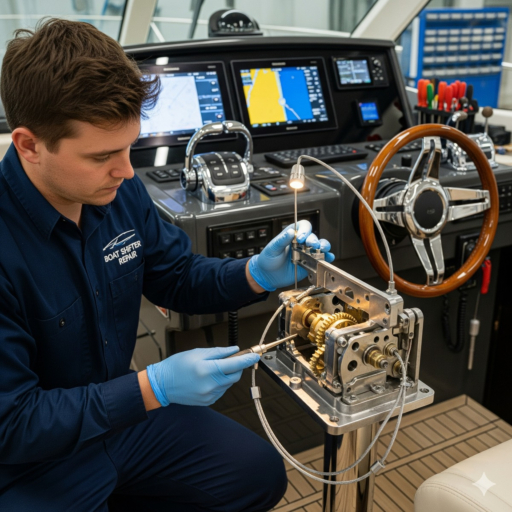
A shifter that fights back is more than an annoyance. When the lever sticks as you come into the dock, you lose the fine control that makes slow-speed maneuvering safe. The good news: a stiff boat shifter or a lazy throttle usually comes down to a short list of worn parts, and methodical checking tells you which one before anything is ordered.
How mechanical throttle and shift controls work
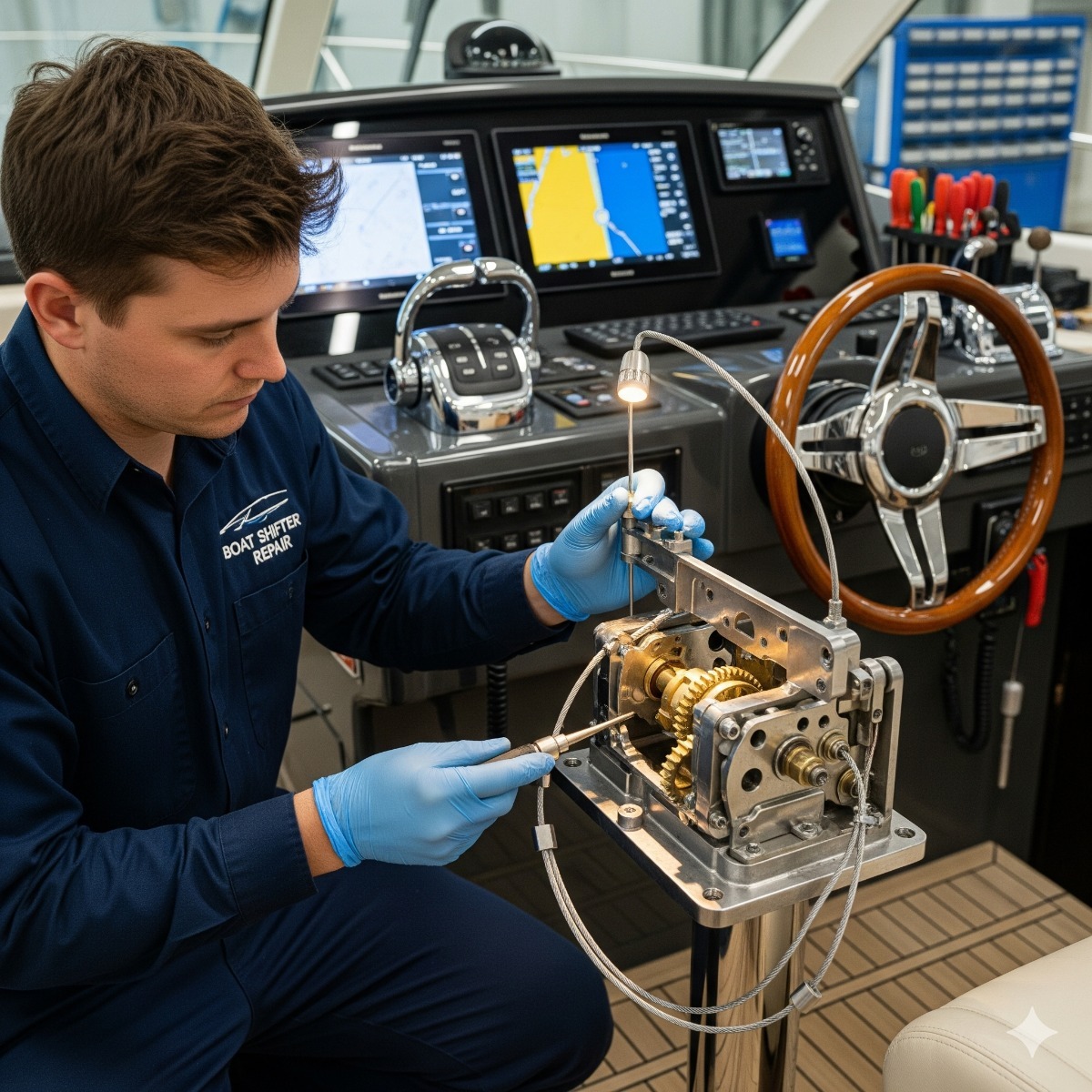
On outboards and sterndrives without digital controls, the helm lever sits in a control box that turns its movement into a push or pull on two cables. One cable runs to the throttle linkage on the engine, the other to the shift lever on the gearcase or transmission. Each cable is a steel core sliding inside a plastic liner and an outer jacket, with threaded ends and adjustable barrels that anchor it at the engine.
These marine control systems are simple, but every part of them lives with salt air, heat and vibration. Liners swell, cores corrode, bushings in the control box wear, and the small switch that stops the engine from starting in gear can drift out of alignment.
Common symptoms and their usual causes
- Lever is hard to move in every position: often a seized cable, especially after weeks of disuse.
- Lever feels loose or sloppy, or will not stay put: worn detents, cams or friction parts inside the control box.
- Gears grind or the drive pops out of gear: the shift cable is no longer moving the gearcase lever through its full travel.
- Engine does not settle back to idle: a sticky boat throttle cable or a misadjusted throttle barrel.
- Engine only cranks after you jiggle the lever: a failing or misaligned boat neutral safety switch.
Cable or control box? Narrowing it down
The most useful test separates the cables from the box. With the engine off, the cable ends are disconnected at the engine and the lever is moved again. If it suddenly feels light, the drag is in the cables or the engine linkage. If it is still heavy with the cables free, the control box is at fault. For a first hint without tools, watch the cable ends at the engine while a helper works the lever: a core that lags or jerks points to the cable.
This matters because a boat shifter replacement is not always needed. Often the real fault is one worn cable that can be renewed on its own.
What an owner can safely check
- Look along the visible cable runs for kinks, tight bends, cracked jackets or rust staining at the ends.
- Check that the cable clamps at the engine are tight and that the barrels are held by their locking hardware.
- Note whether the stiffness changes when the engine is tilted or the wheel is turned, which points to a cable rubbing or bent along its run.
- Try the friction adjustment on the control box, if yours has one; a lever that creeps back may only need more friction.
- Write down the control brand and model so the right parts can be matched.
Avoid spraying lubricant into sealed cable ends; solvents can soften the liner and make the binding worse.
What the repair involves
Replacing a seized throttle cable
A seized or corroded throttle cable cannot be revived, so throttle cable replacement is the fix. The job means measuring the old cable end to end, fitting a new one of the same length and type, routing it along the original path without tight bends and setting the barrel so the engine returns to idle and reaches full throttle at the lever stops.
Shift cable adjustment and new cables
If the shift cable moves freely but gear changes are harsh, a shift cable adjustment at the engine end is the first step. The barrel is set so that neutral at the lever matches neutral at the gearcase, with equal travel into forward and reverse. When the cable itself is stiff or worn, shift cable replacement follows the same routing and setup steps as the throttle side.
Control box rebuild
When the fault is inside the box, a control box rebuild usually means disassembly, cleaning, new bushings or detent parts where they are still made, fresh marine grease and a check of the wiring before reassembly. If parts are no longer available for an older unit, a compatible replacement box is the alternative.
Neutral start switch
The boat neutral safety switch lets the starter work only when the lever is in neutral. When the switch wears or its mounting shifts, the engine may crank only at one particular lever angle. Adjusting or replacing the switch restores reliable starting and keeps the safety function working.
When to call a technician
Get help if the lever jams in gear, if the engine will not return to idle, or if you have to work the lever to get a start. These faults can turn a routine docking into a collision, so fix them before the next trip. If your boat is in the Long Beach area, our shift cable and control box repair service covers seized cables, adjustment and worn control boxes.
Throttle and Shift Cable FAQ
How long do boat control cables last?
There is no fixed lifespan. Cables in salt water, direct sun or tight bends wear sooner, so watch for rising effort at the lever, rust at the cable ends or a lever that no longer returns cleanly.
Should both cables be replaced at the same time?
Not always. Replacing only the seized cable is common, but many owners renew both when they are the same age, since the second one is often not far behind.
Can the engine cause a stiff boat shifter?
Yes. A corroded shift linkage or a gearcase problem can make the lever feel heavy even with healthy cables, which is why disconnecting the cables at the engine is such a useful test.