If your outboard or small inboard ran fine last season and now surges, stalls at idle or refuses to start without the choke, the fuel that sat in it over the layup is the first suspect. Most pump gas contains ethanol, and when it sits in a carburetor for weeks or months it breaks down into a sticky film. Over time that film hardens into ethanol varnish, a deposit that narrows the tiny fuel passages a carburetor depends on. This guide explains why it happens, how to recognize it, what you can safely check yourself and when the carburetor needs professional cleaning or a rebuild.
Why Ethanol Fuel in Boats Causes Varnish
Ethanol fuel in boats creates problems that cars rarely see, because boats often sit unused for long stretches and live in a damp, salty environment. Ethanol absorbs moisture drawn in through the tank vent, and as the fuel ages its lighter parts evaporate. What is left behind in the float bowl and passages is a gummy residue that slowly turns into a hard amber or greenish coating.
A carburetor is especially vulnerable because the small amount of fuel held in its float bowl evaporates completely when the engine is not run. The deposits settle exactly where the smallest openings are: the pilot (idle) jet, the emulsion tubes and the transition ports that feed fuel as the throttle begins to open.
Symptoms of a Varnished Carburetor
Varnish rarely blocks everything at once. It usually restricts the low-speed circuits first, so the symptoms show up at idle and light throttle:
- Hard starting that only improves with the choke on or the primer bulb squeezed.
- Boat engine surging at idle or at a steady low speed, as the engine alternately starves and catches up.
- Stalling when you come off plane or pull the throttle back to neutral.
- A hesitation or bog when you advance the throttle, because the transition circuit is not delivering enough fuel.
- Fuel dripping from the carburetor or a flooded engine, often caused by a sticking float or a gummed carburetor needle and seat.
Clogged pilot jets are the classic cause of an engine that runs at full throttle but will not idle. The main jet is large enough to keep flowing, while the pilot jet, often smaller than a pinhole, is completely blocked.
What an Owner Can Check First
Before blaming the carburetor, rule out the simple things that produce the same symptoms:
- Open the tank vent and make sure the fuel cap is not sealing so tightly that the engine starves under load.
- Inspect the primer bulb and fuel lines for cracks, soft spots or air leaks.
- Check the fuel water separator or inline filter for water and debris.
- Smell the fuel. Stale gas has a sour, lacquer-like odor and often looks darker than fresh fuel.
- Confirm there is a strong spark at each plug.
If those check out and the symptoms point to the low-speed circuits, the carburetor is most likely varnished inside.
Why Spray Cleaners Often Fall Short
Aerosol carburetor cleaner can loosen fresh gum on the surfaces you can see, but hardened deposits deep in drilled passages rarely dissolve from a quick spray. Poking jets with wire can scratch or enlarge the precisely sized orifice, which changes the fuel mixture for good. Many owners clean a carburetor twice, reinstall it and still fight a poor idle, because one hidden passage remains restricted.
How Ultrasonic Carburetor Cleaning Works
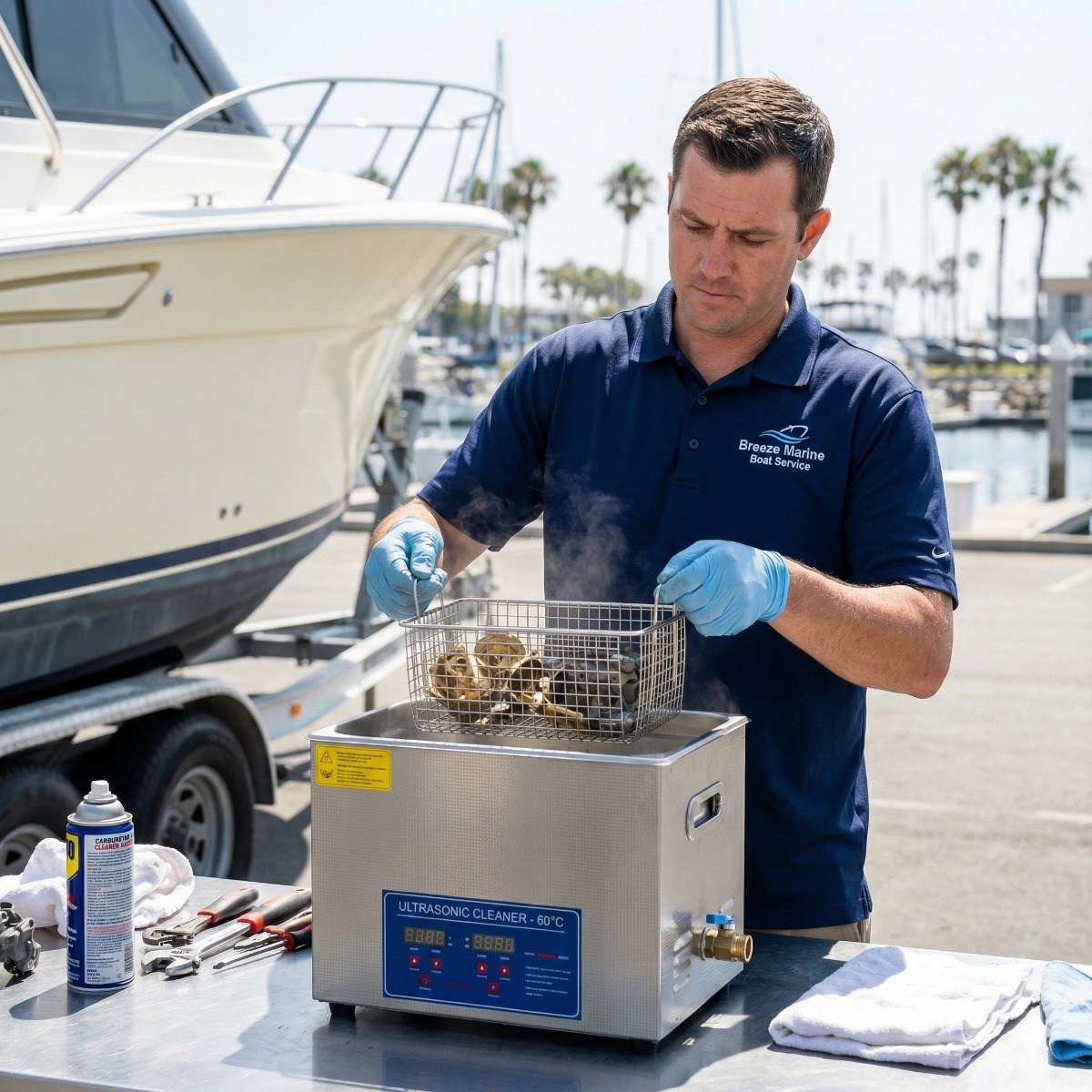
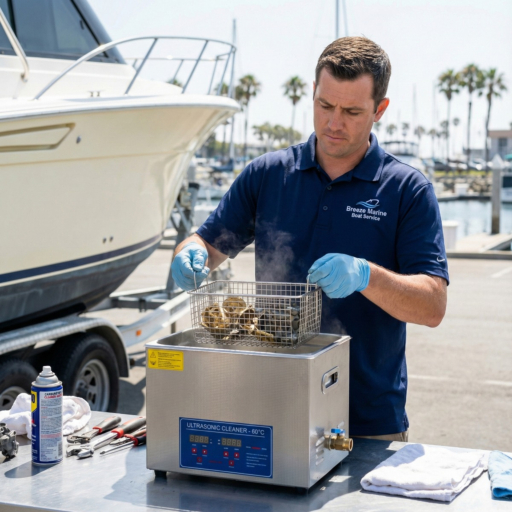
Ultrasonic carburetor cleaning uses a heated bath and high-frequency sound to form and collapse countless tiny bubbles against every surface the liquid touches, including the inside of passages no tool can reach. The carburetor is first stripped of rubber and plastic parts, cleaned in the bath, rinsed and blown dry. Because cleaning alone does not replace worn parts, the work normally continues with a marine carburetor rebuild: new gaskets, O-rings and a needle valve, followed by a float level check and a pressure test of the needle and seat.
If your engine shows the symptoms above, our ultrasonic carburetor cleaning and rebuilding service covers the teardown, the cleaning bath, fresh seals and a bench test, for inboards, outboards and generators.
Cleaning vs. a Full Rebuild
A light film caught early may only need cleaning and new gaskets. A carburetor that has sat for a year or more, leaks fuel or has corroded linkage usually needs a complete rebuild. On engines with more than one carburetor, all of them should be serviced together, and the set must be synchronized afterward so the cylinders share the load evenly. For those engines, an outboard carburetor rebuild service that ends with synchronization is what brings back a smooth idle.
Preventing Varnish Next Season
- Add a marine fuel stabilizer to fresh fuel before any layup longer than a few weeks, and run the engine long enough to draw treated fuel into the carburetor.
- For long storage, many owners run the carburetor dry or drain the float bowl so no fuel is left to evaporate.
- Buy fuel in amounts you will use within a season and keep the tank vent in good condition.
- Run the boat regularly. Engines that are used every few weeks seldom varnish.
Carburetor Varnish FAQ
Can a fuel additive dissolve varnish that is already there?
Additives can help with light deposits, but they cannot reach a jet that is fully blocked, because no fuel flows through it. Hard varnish usually requires disassembly and cleaning.
Why does my outboard run at full throttle but not idle?
That pattern almost always points to the low-speed circuit. The main jet still flows, while clogged pilot jets or transition ports starve the engine at idle.
Is it worth rebuilding an old carburetor?
Usually yes, as long as the body is not cracked or badly corroded. Cleaning the passages and replacing the wear parts restores the original fuel delivery on most carburetors.