Few sounds are as discouraging on a boat as turning the key and hearing a single click, a grinding whir, or an engine that turns over so slowly it never fires. All three point toward the cranking circuit, but they mean different things. Learning to read them helps you describe the problem accurately, avoid replacing the wrong part, and know when the job needs a technician.
How the Cranking Circuit Works
When you turn the key or press the start button, a small current travels through the ignition switch, the neutral safety switch and often a slave relay to the solenoid. The solenoid does two jobs: it closes a heavy contact that sends full battery current to the starter motor, and on most engines it pushes the starter drive gear forward to mesh with the flywheel ring gear. The starter then spins the engine until it fires.
Reading the Symptoms
A single click, then nothing
One firm click usually means the solenoid is receiving its signal and trying to close, but full current is not reaching the motor. Causes include burned solenoid contacts, a low or sulfated battery, a loose or corroded cable, or a starter motor with a dead spot on its commutator. Rapid, repeated clicking almost always points to a battery that is too weak to hold voltage under load.
Grinding or a high-pitched whir
Grinding means the drive gear is not meshing cleanly with the flywheel. The drive may be sticking from corrosion, the starter mounting bolts may be loose, or the ring gear may have damaged teeth. A free-spinning whir with no engagement means the drive is not moving forward at all. Continuing to crank in either case can chew up the ring gear and turn a starter job into a much larger boat engine repair.
Slow, labored cranking
If the engine turns over sluggishly, check the battery first, then the cables. Undersized or corroded cables drop voltage before it reaches the starter. Inside the motor, worn brushes, dry bushings or a dragging armature draw heavy current and spin slowly. Heat soak makes this worse: a starter that cranks fine cold but struggles after a run is often on its way out.
Silence
No click at all usually means the solenoid is not getting its trigger signal. That points upstream toward the key switch, a blown fuse or tripped breaker, a shift lever that is not fully in neutral, or a failed neutral safety switch.
What Owners Can Safely Check
- Measure battery voltage at rest. A healthy 12-volt battery reads about 12.6 volts; below roughly 12.2 volts it is significantly discharged.
- Check voltage while someone cranks. If it collapses below about 9.6 volts, the battery or its connections are the likely problem.
- Inspect both ends of the positive and negative cables, including the engine ground, for green or white corrosion and looseness.
- Confirm the shifter is firmly in neutral and try moving it slightly while turning the key.
- Check the main breaker and any inline fuses near the ignition switch.
Avoid bridging solenoid terminals with a screwdriver on a gasoline boat. A spark in an engine compartment with fuel vapor is dangerous, and bypassing the neutral safety circuit can start an engine in gear. Always run the blower for several minutes before any testing on a marine gas engine.
Why Marine Units Are Different
A marine starter is ignition protected, which means it is built so internal sparks cannot ignite fuel vapor in the engine compartment. Automotive units may share the same bolt pattern, but they lack that protection and corrode quickly in salt air. Boat starters also face moisture, heat and long periods of inactivity.
Repair, Rebuild or Replace
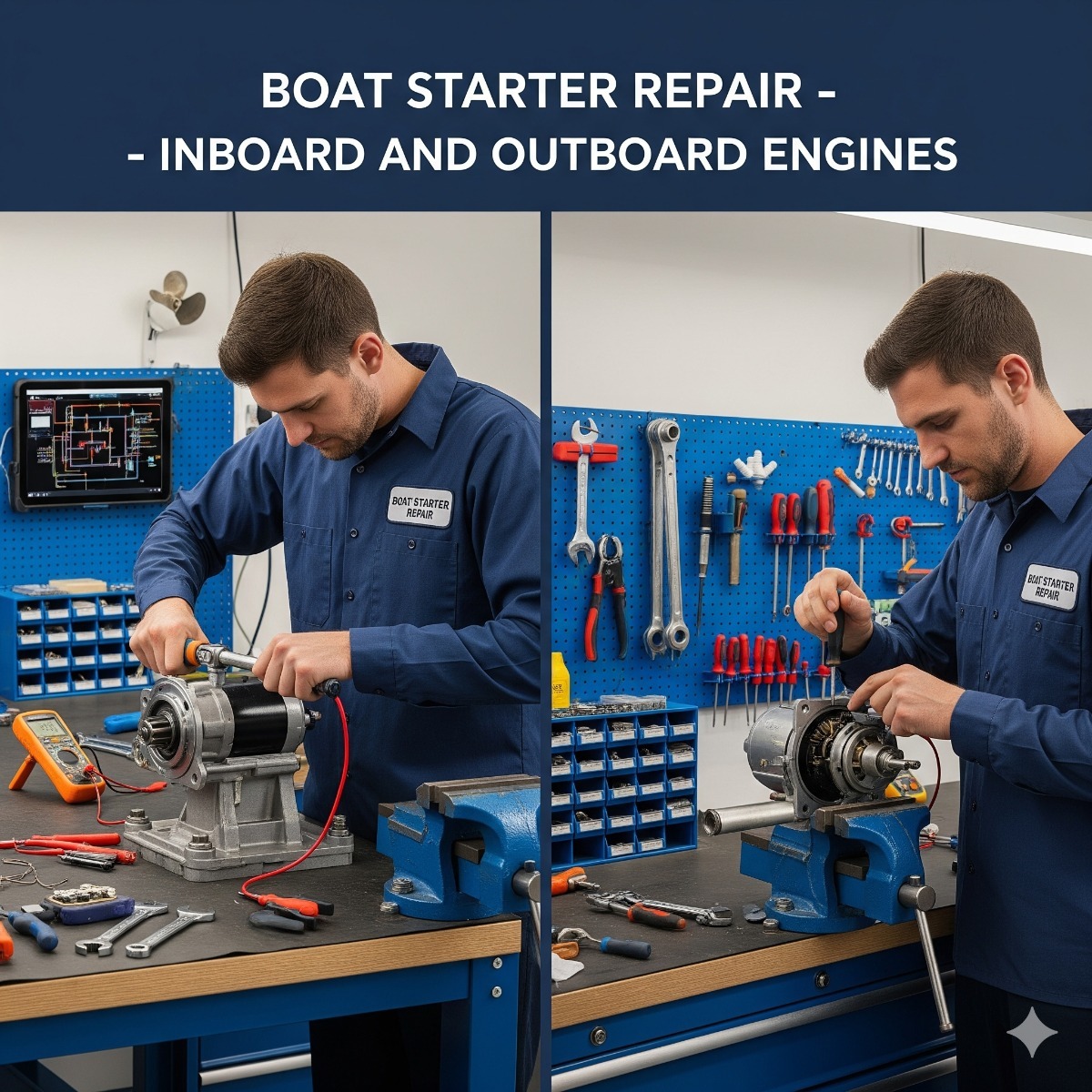
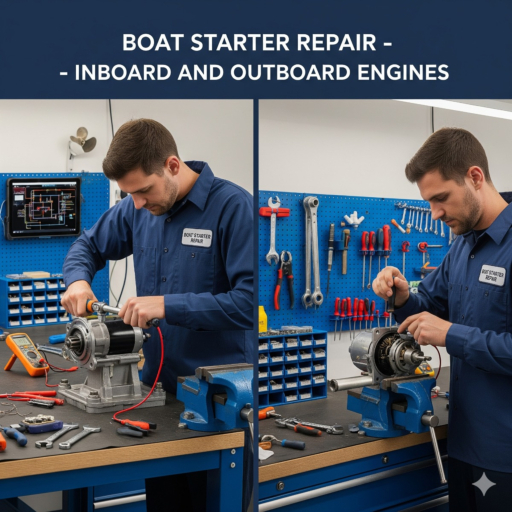
A professional boat starter repair begins with testing rather than guessing. A technician checks the voltage drop across each connection, the current draw during cranking and the solenoid operation before deciding what has actually failed. Sometimes only the solenoid or a cable end is at fault. In other cases the motor can be rebuilt with new brushes, bushings and a drive, and when the housing or armature is badly corroded, a new unit is the practical choice.
The same approach applies whether the problem is on a stern drive, an inboard or an outboard. Outboard repair of the starting system often involves the starter relay under the cowling and the trim wiring nearby, while inboards frequently hide the starter low on the engine where bilge water and spray reach it. On larger vessels, yacht engine repair can include twin engines, dual helm stations and more complex relay systems, but the diagnostic logic stays the same. Starting faults are one of the most common reasons owners book boat motor repair, and they account for a good share of outboard engine repair calls as well.
When to Call a Technician
Call for help if cranking symptoms continue after the battery and cables check out, if you hear grinding, if the starter smells hot or smokes, or if the engine starts only intermittently.
Regular boat motor service that includes cleaning and tightening battery connections prevents many of these problems. When the cranking system does need attention, our starter motor and solenoid service covers testing, rebuilding and replacement for inboard and outboard engines.
Starter Motor FAQ
Can a weak battery damage the starter?
Yes. Low voltage makes the starter draw more current and run hotter, which accelerates wear on brushes and solenoid contacts. Keeping batteries charged and connections clean is cheap insurance.
Is it the starter or the solenoid?
A voltage test at the starter terminal while cranking answers that. If full voltage reaches the motor and it does not spin, the motor is at fault; if voltage is missing, look at the solenoid and wiring.