

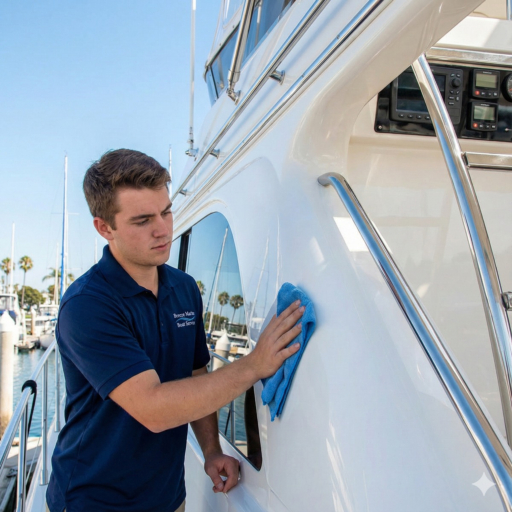
A quick wash-down keeps salt and dust off a boat between trips. A full detail is something else: it restores the gelcoat, protects it for the months ahead, and catches small problems in stainless, vinyl and decals before they turn into repairs. For owners searching Long Beach CA boat detailing, the useful question is not just who can do it, but what a proper detail should include for a boat that lives in salt water under strong Southern California sun.
Wash-Down vs Full Detail
A wash-down is a rinse and soap job: salt, bird droppings and dirt come off, and the boat looks clean for a few days. A full detail goes deeper:
- Thorough cleaning of hull sides, topsides, nonskid and hatches.
- Oxidation removal where the gelcoat has gone chalky.
- Polishing and a protective wax or sealant coat.
- Stainless and metal polishing.
- Vinyl, canvas and seat cleaning and conditioning.
- Care for decals, lettering and registration numbers.
- Interior cleaning of lockers, fish boxes and cabins as needed.
Hull and Topside Polish and Wax
UV is the main enemy of gelcoat in SoCal. Over time it dulls and chalks, especially on horizontal surfaces and on darker colored hulls. A detailer starts by cleaning and assessing the gelcoat: light dullness may need only polish, while heavy oxidation needs compounding first. After polishing comes a protective layer of wax or sealant, which is what actually slows the next round of oxidation.
Nonskid areas should be scrubbed and treated with products made for them, not waxed, because waxed nonskid becomes slippery and dangerous.
Stainless and Metal
Rails, cleats, hinges and windshield frames collect salt, and even good marine stainless shows tea staining, the brown surface rust that appears in salt air. Polishing removes it, and a protectant slows its return. During the detail, look for:
- Pitting or cracks around rail bases and welds.
- Loose fittings or failing sealant at deck penetrations, which can let water into the core.
- Corroded hinges on hatches and lockers.
Vinyl Seats and When Cracks Mean Repair
Marine vinyl lasts much longer when it is cleaned with vinyl-safe products and protected from UV. Harsh cleaners and household solvents strip the protective top layer and speed up cracking. Mildew spots on white vinyl are common on boats kept covered and damp, and should be cleaned with a product that will not damage stitching.
Detailing has limits. If the vinyl has split seams, cracks that go through the surface, or the foam underneath stays wet and soft, cleaning will not fix it. At that point the right search is boat seat upholstery repair near me, because the seat needs recovering or new foam, not polish.
Decals, Lettering and Registration Numbers
Vinyl lettering and decals fade and shrink in the sun, and aggressive compounding can lift edges or burn through them. A careful detailer tapes off or works gently around graphics. Registration numbers must stay legible, so if they are peeling or faded, plan to replace them with marine grade vinyl lettering from a sign shop. Removing old decals leaves a ghost outline where the surrounding gelcoat has faded, which usually needs polishing to blend.
Fishing Boat Specifics
A fishing boat service detail needs extra attention in a few places:
- Fish boxes and livewells. Clean, drain and deodorize, and check that drains and pumps are clear.
- Blood and scale stains. These set quickly on nonskid and gelcoat; enzyme or marine-safe cleaners work better than bleach, which can damage gelcoat and stitching.
- Rod holders and cutting stations. Salt and bait residue build up and corrode fittings.
- Bilge. Fish oil and scales end up in the bilge and can clog the pump and float switch.
A Realistic Detailing Schedule for SoCal
- After every trip: freshwater rinse, especially stainless, windows and vinyl.
- Every few weeks: a proper wash-down with boat soap for a boat used regularly or kept uncovered.
- Two or so times a year: full polish and wax on a boat kept in a slip in the sun; covered boats can go longer.
- Once a year: a close inspection of stainless fittings, sealant, vinyl and decals, which pairs well with routine engine service.
Treat these as starting points; a dark hull in an uncovered slip needs more frequent attention than a white hull under a cover.
Detailing as Part of Boat Marine Service
A detail is also a chance to spot things that need a mechanic or a repair: a weeping deck fitting, a bilge that stays wet, stains that point to a leaking hose. For owners looking for Long Beach CA boat detailing as part of broader boat marine service, it helps when the same team can flag those issues. We are based in San Pedro and work on boats in Long Beach, San Pedro and LA County; our topside polishing and waxing packages describe what a detail covers.
Boat Detailing FAQ
How often should a boat in a Long Beach slip be waxed?
A boat kept uncovered in the sun often needs polish and wax around twice a year. Covered boats and lighter hulls can go longer between full details.
Can detailing remove heavy oxidation?
Moderate oxidation usually comes off with compounding and polishing. Gelcoat that is worn thin or badly chalked may need refinishing instead.
Will polishing damage my decals?
It can if done carelessly. A good detailer works gently around graphics, and very old decals may be better replaced.


