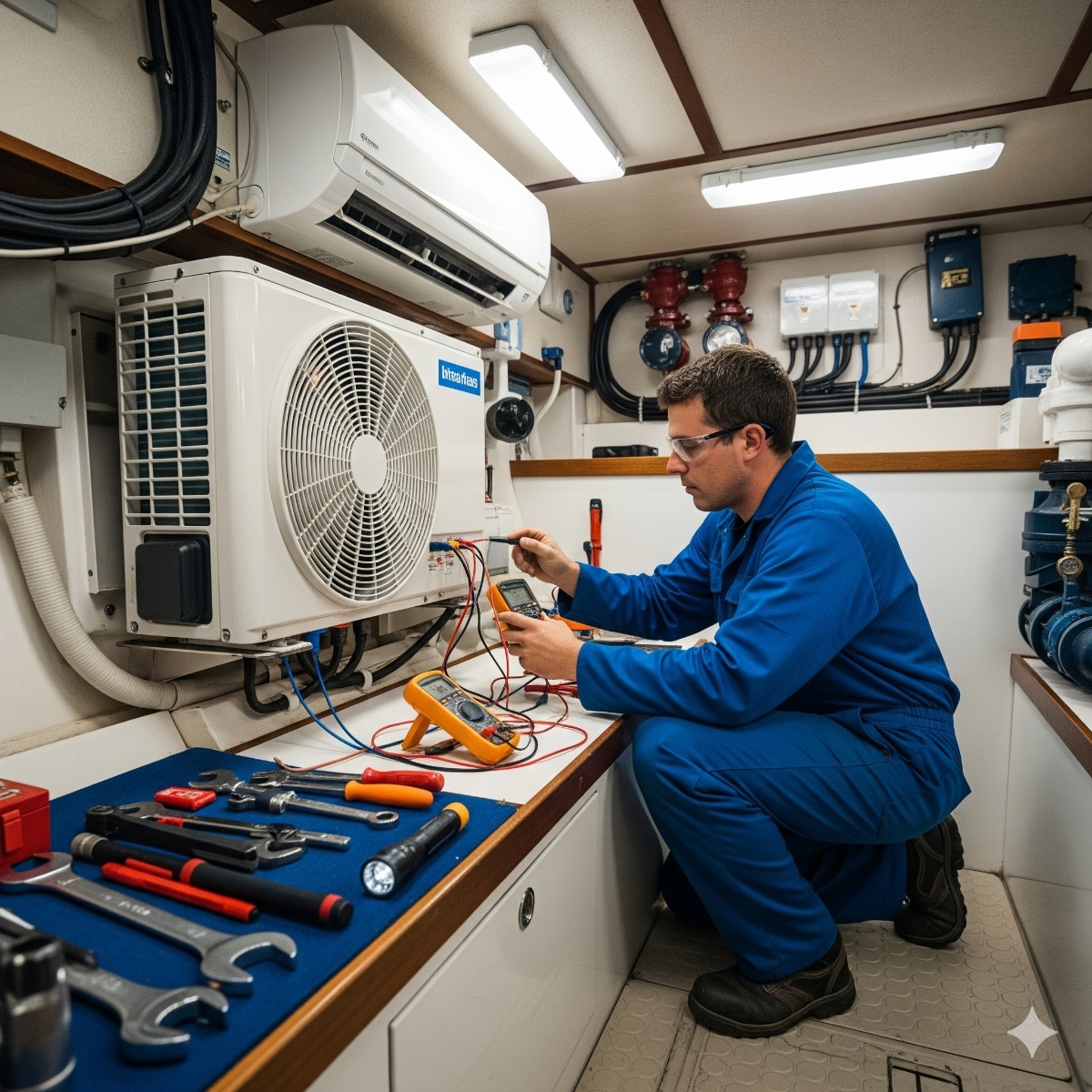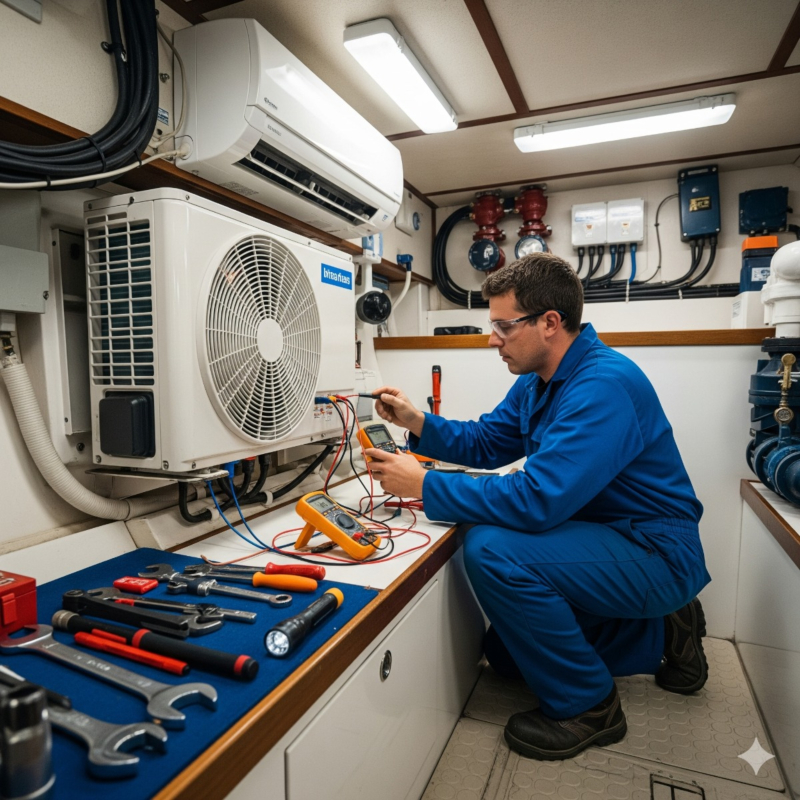
Marine air conditioning works harder in a Long Beach summer than most owners realize. Warm harbor water, sun on the deck and long evenings aboard all push the system toward its limits. Most calls for boat ac repair long beach owners make in July and August trace back to things a seasonal routine would have caught in spring: a clogged strainer, a tired pump, a dirty filter or a blocked drain. This checklist covers what to do before the heat arrives and which signs mean a technician should take a look.
Know which system you have
Most boats in the Long Beach and San Pedro marinas use one of two layouts:
- Self-contained units: each cabin has its own compressor, evaporator and condenser in one package, cooled by seawater pumped through the condenser. Common on small and mid-size cruisers.
- Chilled-water systems: a central chiller cools a freshwater loop that circulates to air handlers in each cabin. Common on larger yachts.
Both depend on steady seawater flow to reject heat. When flow drops, the system loses capacity and eventually shuts down on a high-pressure fault.
The seasonal checklist
1. Seawater strainer
Close the seacock, open the seawater strainer and clean the basket. Check the lid gasket and make sure the lid seals, since an air leak here can cause the pump to lose prime. In a warm summer, check it every few weeks, more often after running through growth or debris.
2. Seawater pump
With the system running, listen to the pump and check the overboard discharge. The pump should run quietly without cycling. Signs of trouble include rattling, a hot pump body, drips from the seal or weak flow.
3. Overboard flow
Look over the side for the discharge. You want a steady, strong stream, not a trickle or intermittent spurts. Weak flow can mean a clogged strainer, a failing pump, growth in the intake or a partially blocked condenser coil.
4. Return-air filters
Remove and clean or replace the return-air filters in each cabin. A clogged filter reduces airflow, lets the evaporator coil ice up and cuts cooling capacity.
5. Condensate drains
Pour a little fresh water into the condensate pan and make sure it drains freely. Blocked drains cause overflow, water stains, musty smells and mildew. If the drain runs to a sump, check that the sump pump switches on and off.
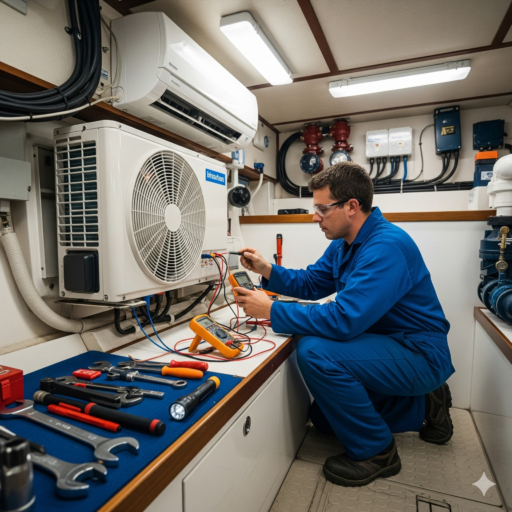
6. Electrical checks
- Look at the shore power cord, inlet and pedestal plug for heat discoloration.
- Check that breakers are not warm and do not trip on startup.
- Watch the display or controller for fault codes when the unit starts.
- Note if the lights dim sharply when the compressor kicks in.
7. Chilled-water extras
On a chilled-water system, check the loop pressure and expansion tank, look for leaks at air handlers and valves, and make sure the circulating pump runs quietly.
What owners can do between visits
- Clean the strainer regularly and keep a spare lid gasket aboard.
- Clean filters monthly during heavy use.
- Keep hatches and curtains closed on sunny days to reduce the load.
- Run the system occasionally in the off-season so seals stay lubricated.
Leave refrigerant circuits, compressor wiring and control boards to a technician.
Signs a technician should look before peak heat
Book boat air conditioning service early if you notice any of these in spring:
- High-pressure or low-pressure faults on startup.
- Warm air even though the fan and compressor are running.
- Ice on the evaporator coil or refrigerant lines.
- Weak seawater discharge even with a clean strainer.
- Short cycling, humming without starting, or tripped breakers.
- Scale or white deposits on the condenser coil outlet.
Condensers slowly scale up from seawater, which reduces heat transfer. Descaling is often part of a proper boat air conditioner repair, and it is easier to do before the hottest weeks than in the middle of them. Booking in spring also keeps you out of the midsummer rush, when searches for boat ac repair long beach peak along with the water temperature.
Getting help in Long Beach and San Pedro
If you searched for marine ac repair near me, marine air conditioner repair near me or marine air conditioner service near me, Breeze Marine Boat Service LLC handles boat a/c repair and seasonal maintenance at slips in Long Beach, San Pedro and across LA County. Many boats here carry Dometic self-contained units, and owners searching for dometic marine service will find that this seasonal routine applies to them too. Our marine air conditioning and refrigeration service covers strainers, pumps, drains, descaling and fault diagnosis. When comparing ac marine services, look for someone who checks seawater flow and electrics, not just refrigerant.
Boat AC FAQ
How often should the seawater strainer be cleaned?
Check it every few weeks in summer and after running through debris or growth. Some slips need more frequent checks.
Why does my unit cool fine at night but not during the day?
Daytime heat load and warmer water reduce capacity. If the unit struggles only on hot days, look first at seawater flow, dirty filters or a scaled condenser before suspecting marine a/c repair on the refrigerant side.
Should I cover the AC unit when not in use?
Close the seacock if the boat will sit for a long period, and keep filters clean. There is no need to cover the unit itself.