Electric harbor cruisers and electric outboards have become a familiar sight around Long Beach, from quiet evening cruises in Alamitos Bay to slow laps through the Naples canals. They are simple to run and need far less routine maintenance than a gas engine, but when something goes wrong the fault can be anywhere in a chain of motor, controller, batteries, charger and throttle. Good electric boat repair starts with understanding how those parts work together, so that nobody replaces an expensive battery bank when the real problem is a corroded cable end.
How an electric boat drive system works
Most small electric boats share the same basic layout, whether the motor is an inboard drive or an electric outboard:
- Battery bank: lead-acid, AGM or lithium batteries wired to the system voltage. It stores all the energy the boat uses.
- Main disconnect and fuse: protects the high-current wiring and isolates the system for service.
- Motor controller: takes the throttle signal and meters current to the motor. It also protects the system by limiting current or shutting down on faults.
- Drive motor: turns the propeller, either directly or through a reduction.
- Throttle: sends a low-voltage signal to the controller, not the drive current itself.
- Charger: refills the bank from shore power, often with settings tied to battery chemistry.
Because every part depends on the others, a symptom at the propeller can start at the charger, and a warning on the display can come from a single loose terminal.
Common faults and what they usually mean
Short range
If the boat no longer lasts a full cruise, the batteries are the obvious suspect, but not the only one. Possible causes include:
- One weak battery dragging down a series string.
- A charger that never finishes its cycle, or is set for the wrong battery type.
- Growth on the hull and propeller increasing the load.
- High resistance connections wasting energy as heat.
Cutouts and sudden loss of power
A motor that stops under load and then restarts usually points to voltage sag or a controller protection event. Weak batteries, undersized or corroded high-current cables, or a failing main contactor can all drop voltage enough to trip the controller.
Charger errors
Fault lights, a charger that will not start, or one that trips the shore power pedestal can come from the shore cord, the inlet, the charger itself, or a battery the charger refuses to charge because it reads as damaged.
Throttle and control problems
Jerky response, no response in one direction, or a motor that runs only at full speed often trace back to the throttle sensor, its wiring or the connector at the controller.
Corroded high-current connections
Salt air is hard on the heavy cables that carry drive current. A lug that looks fine from the outside can be green and powdery inside the crimp. Under load, that resistance turns into heat, voltage drop and eventually a melted terminal. Signs to watch for:
- Warm or discolored cable ends after a run.
- White or green corrosion around battery posts and bus bars.
- Loose terminals or hardware that has backed off.
- Cables chafing where they pass through bulkheads.
What a technician tests before replacing parts
Batteries, controllers and motors are the most expensive components on an electric boat, so the goal is to prove a part has failed before replacing it. A methodical visit usually covers:
- Resting and loaded voltage of each battery, not just the bank as a whole.
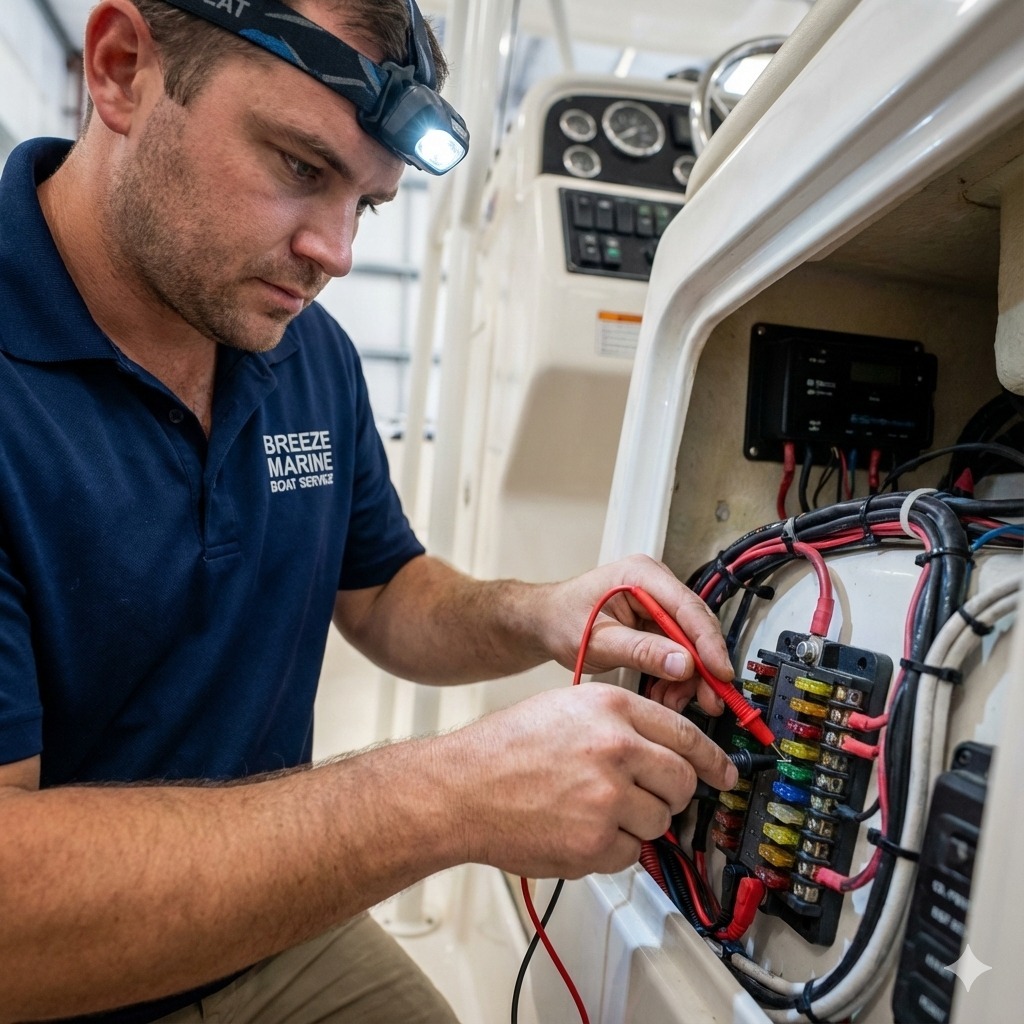
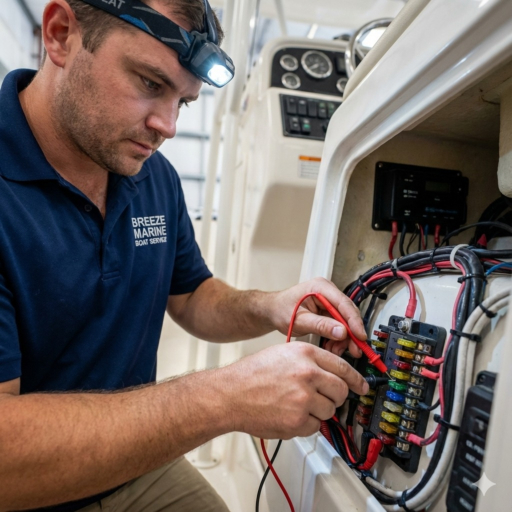
- A voltage drop test across cables, fuses, disconnects and contactors under load.
- Charger output and charging profile against the battery maker's specifications.
- Controller fault codes or display history where the system provides them.
- Throttle signal at the controller input.
- Motor insulation and mechanical checks such as bearings and propeller shaft.
Some brands lock deeper diagnostics or firmware updates to dealers. In that case the right move is to confirm everything around the controller first, then decide with you whether the unit needs to go to an authorized service center.
Electric outboards and small tenders
Electric outboards on tenders and small boats have the same weak spots on a smaller scale: battery connections, charging, throttle cables or tiller controls, and saltwater intrusion into connectors. Owners asking about outboard services electrical work often find the fix is a cleaned and sealed connector or a new battery lead rather than a new motor.
Getting help in Long Beach and San Pedro
If you searched for electric boat repair near me or electric boat motor repair near me, Breeze Marine Boat Service LLC can inspect the electrical side of your boat at the slip in Long Beach, San Pedro or elsewhere in LA County. Our marine electrical repair and troubleshooting service covers wiring, batteries, charging and connections. For proprietary controllers or electric boat motor repair that requires factory tools, we will tell you plainly and help you document the fault for the dealer.
Electric boat FAQ
How do I know if my batteries or my controller are the problem?
Test each battery under load and check voltage at the controller input while the motor runs. If voltage holds steady and the motor still cuts out, the controller or motor becomes more likely.
Can I mix new and old batteries in the bank?
It is generally not recommended. A new battery in a string of aged ones is limited by the weakest unit and may be overcharged or overworked.
How often should connections be checked?
Inspect them at least each season, and any time you notice warm cables, shorter range or new warnings on the display.