
Most boat owners think about engines first and galleys last, until the fridge stops cooling on a Saturday morning or the freshwater pump starts cycling all night. Yet the boat appliances in the galley live a harder life than anything in a kitchen ashore: they run on limited battery power, sit in salt air, get shaken on every wake and often go weeks without use. Here is what usually goes wrong and what you can check yourself.
Why marine appliances are different from household ones
A household fridge or microwave is built for steady 120V power, dry air and a floor that never moves. Purpose-built marine units are designed around the opposite conditions. Better models use stainless or coated fasteners, sealed controls, latches that hold doors shut in a seaway and compressors that tolerate some heel angle. Many run on 12V DC so they work at anchor without a generator.
Putting a residential appliance on a boat is common and sometimes workable on a larger yacht with a solid inverter and shore power, but it brings risks: surge current that trips breakers or strains the inverter, doors that fly open underway, and steel cabinets that rust from the inside. A boat that lives on shore power at a slip in Long Beach has different needs than one that spends weekends at anchor.
Boat fridges: 12V vs AC and why they stop cooling
Boat fridges generally fall into three groups: 12V DC compressor units, AC units that run from shore power or an inverter, and dual-voltage models that switch automatically.
When a fridge runs but does not get cold, the cause is usually one of a few things:
- Condenser airflow. The compressor has to dump heat somewhere. If the condenser coil or fan sits in a closed locker with no ventilation, or is coated in dust and lint, the unit runs constantly and barely cools.
- Voltage drop. DC compressors have a low-voltage cutout. Undersized or corroded wiring can drop enough voltage under load that the control module shuts the compressor off, even though the battery reads fine at rest.
- Thermostat and sensor faults. A failing thermostat or a sensor that has shifted out of position can end the cycle early or keep it from starting.
- Door seals. A torn or flattened gasket lets cold air out and humid air in, which also builds frost quickly.
- Refrigerant loss. Less common than owners expect, and a job for a technician with proper recovery equipment.
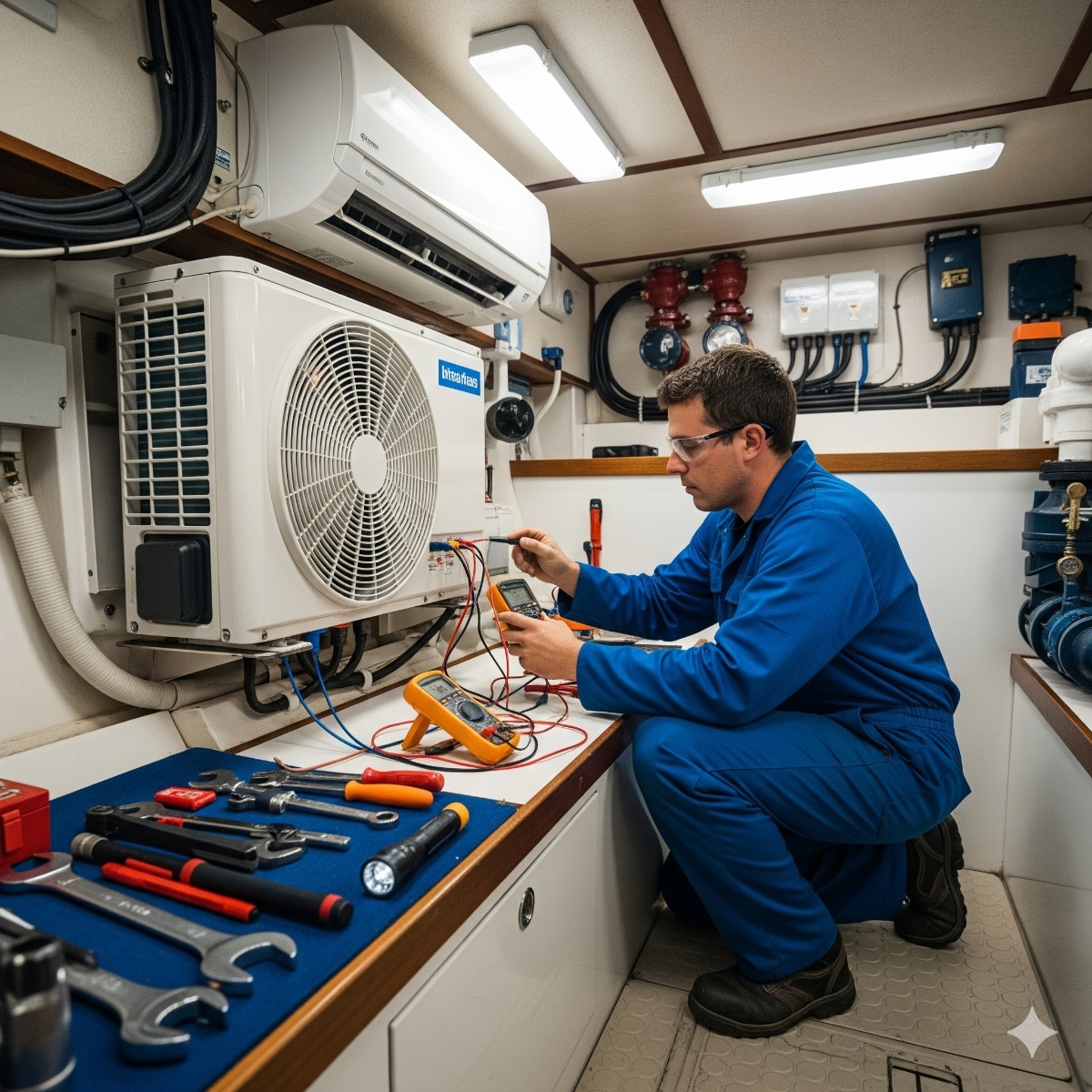
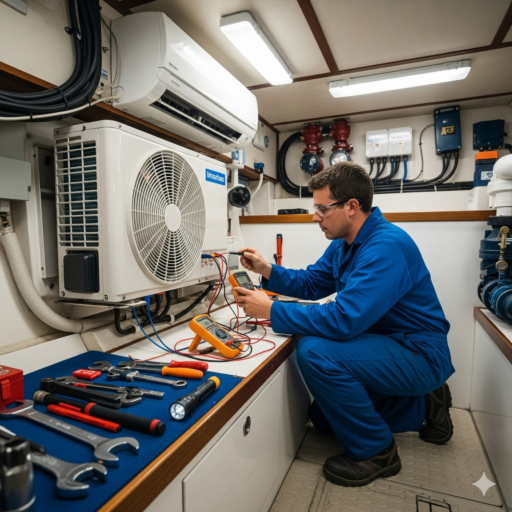
A quick owner check: feel whether the condenser area gets warm when the compressor runs, measure voltage at the fridge terminals with the compressor on, and inspect the gasket with a flashlight. If all three look fine, the fault is usually inside the sealed system or the control board, and that is where marine refrigerator repair belongs in the hands of a technician.
Freshwater systems: pump, accumulator and boat taps
The freshwater system on most boats is simple: tanks, a strainer, a 12V pressure pump, sometimes an accumulator tank, a water heater, and the lines to boat taps and showers. Problems usually show up as noise or cycling.
Pump cycles when no tap is open
This almost always means a leak somewhere on the pressurized side: a dripping tap, a weeping fitting under a sink, or a failing check valve inside the pump. Close every tap and trace the lines with a dry paper towel.
Pump runs but little water comes out
Check the inlet strainer first, because it collects sediment and tank debris. An air leak on the suction side, often a loose hose clamp, lets the pump draw air instead of water.
Rapid on-off cycling at the tap
An accumulator smooths out pressure so the pump does not pulse. If it has lost its air charge, the pump chatters every time you open a tap. Recharging it usually fixes that.
Faucets wear out too: cartridges scale up and cheap chrome-plated fittings corrode in salt air, so marine-grade replacements are the long-term fix.
Showers for boats and the sump problem
Showers for boats rarely drain by gravity. Water collects in a shower sump box and a small pump pushes it overboard. That sump is one of the dirtiest places on a boat: hair, soap scum and lint build up around the float switch until it sticks. The result is either a pump that never shuts off or a shower pan that overflows into the bilge. Clean the sump filter regularly, test the float by hand, and check that the discharge through-hull is not blocked.
Water tanks for boats: materials, sanitizing and leaks
Water tanks for boats are usually polyethylene, stainless steel or aluminum, with some older boats using fiberglass. Polyethylene does not corrode but can flex and crack at the fittings. Stainless is strong but can pit where welds meet chlorides.
Sanitize the system at least once a season, and always after the boat has sat with water in the tank. The usual approach is a diluted chlorine solution run through every tap, left to stand, then flushed out thoroughly with fresh water; follow the tank and water heater manufacturers' guidance. Also check the fill and vent: a leaking deck fill lets rain or seawater in, and a blocked vent makes the tank fill slowly.
When to call a marine technician
Many problems with boat appliances and freshwater gear are owner-level work: strainers, hose clamps, accumulators and sump cleaning. Refrigeration, water heaters with AC elements, and anything involving 120V wiring or refrigerant are better left to a technician. Breeze Marine Boat Service LLC is a licensed and insured mobile boat repair company based in San Pedro, working on boats in Long Beach, San Pedro and across LA County. We come to the slip, diagnose the fault and repair it or install equipment you supply; note that we no longer sell parts. For cooling problems specifically, see our marine refrigeration and air conditioning service.
Galley and Freshwater FAQ
Can I use a household fridge on my boat?
Sometimes, on larger boats with reliable shore power or a properly sized inverter. Marine-rated units are still the safer choice for boats that travel, anchor out or run mainly on batteries.
Why does my freshwater pump turn on by itself?
Usually a small leak on the pressure side or a worn check valve in the pump. Close all taps and trace the lines before replacing anything.
How often should I sanitize the water tank?
At least once a season and after any long lay-up with water left in the system.