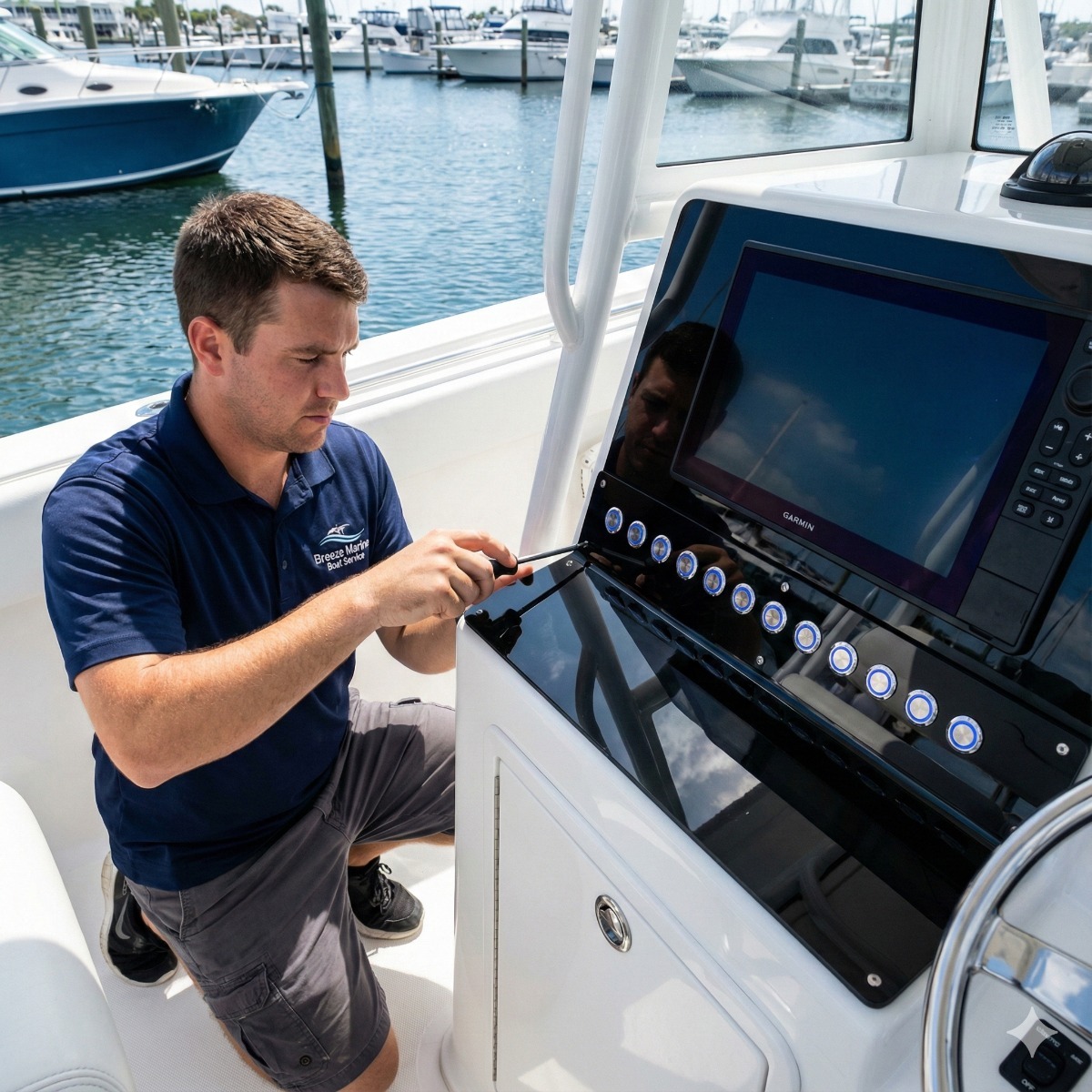

Few upgrades change the feel of an older boat as much as a refreshed helm. Over the years dashes collect abandoned holes from old electronics, cracked gauge bezels, faded plastic and a mix of switches from different eras. Replacing all of that with a clean panel sized for today's electronics makes the boat easier to run and more pleasant to look at. A good result depends on planning, though, and the wiring behind the panel matters as much as what you see in front of it.
Start With How You Use the Helm
Before choosing materials, think about what you actually do at the wheel. Which controls do you use while underway, and which only at the dock? Where do your eyes go when docking? Which displays need to be readable in direct sun? Answering these questions leads to a layout that puts the most-used items closest to hand and in the natural line of sight.
Layout checklist
- Measure the usable area, including curvature and any angle of the console face.
- Decide which displays you will fit now and which you may add later, and leave space accordingly.
- Place engine displays or gauges where they can be seen without looking away from the water for long.
- Group switches logically: navigation lights together, pumps together, accessories together.
- Check what lies behind the panel, including steering helm, control boxes and structure, before committing to cutouts.
Planning Around Electronics
Most refits now center on a single large multifunction display, often a touchscreen chartplotter that combines charts, sonar, radar and engine data. Flush-mounting it looks clean but requires the right depth behind the panel and good ventilation, since displays generate heat. Consider glare and viewing angle: a screen that is perfect standing may be hard to read seated. Leave access for cables and a way to service the unit without dismantling the whole dash.
Choosing Panel Materials
Custom boat dash panels are commonly made from a few materials, each with trade-offs:
- Acrylic. High-gloss finishes give a modern glass-helm look. A black acrylic boat dash hides seams around flush-mounted displays well. Acrylic scratches more easily than some alternatives and needs proper edge finishing and support.
- Marine polymer sheet. Very durable and UV stable, easy to machine, with a matte finish that reduces glare.
- Aluminum. Rigid and thin, but must be protected from corrosion and can get hot in the sun.
- Carbon or composite overlays. Striking appearance for performance boats.
Owners who search for a boat acrylic dash panel usually want that seamless look. The right thickness and backing are important so the panel does not flex when switches are pressed.
Switch Choices
Traditional toggle and rocker switches work, but many refits now use stainless steel push-buttons with illuminated rings. Look for sealed switches rated for wet environments, clear labeling that stays legible, and backlighting that can be dimmed for night running. Digital switching systems that control circuits through a display are another option on larger refits, although they add complexity.
The Wiring Behind the Panel
Removing an old dash usually reveals a tangle of wires added over years. A panel refit is the ideal time to fix that. A proper switch panel installation involves:
- Tracing and labeling every circuit.
- Sizing wire correctly for the load and run length.
- Protecting every circuit with an appropriate fuse or breaker.
- Using tinned marine wire, sealed heat-shrink connectors and proper bus bars.
- Supporting harnesses so they cannot chafe or strain terminals.
Pre-building the harness on a bench and then installing it produces a far neater and more reliable result than wiring switch by switch in a cramped console.
How Fabrication Works
Professional boat dash panel fabrication usually begins with removing the old panel and making an accurate template of the opening. The design is drawn with exact cutouts for each display and switch, then the panel is cut on CNC or laser equipment for precise edges. After a test fit, the switches and harness are installed, the panel is mounted and every circuit is tested.
What Owners Can Do First
- Photograph the existing dash and wiring before anything is removed.
- List every switch and what it controls, noting any that are unused.
- Collect the installation dimensions for any new displays.
When to Call a Technician
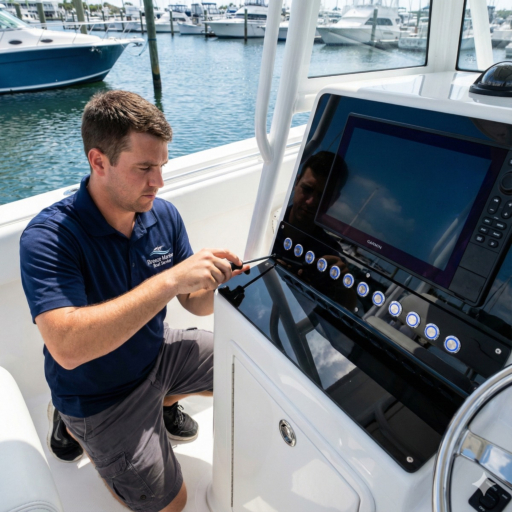
Consider professional help if the wiring behind the dash is undocumented, if you see melted insulation or corrosion, or if you want flush-mounted displays and precise cutouts. Our dash panel redesign and switch upgrade service covers design, fabrication and rewiring of marine dash panels. A new boat dash panel is also a chance to make the electrical system safer.
Dash Refit FAQ
Can a new panel cover old holes?
Yes. An overlay panel is usually sized to cover the old cutouts completely while providing fresh openings for new equipment.
Are push-button switches reliable on boats?
Quality sealed switches rated for marine use are reliable when wired correctly and protected by proper fusing.
Should I rewire while replacing the panel?
It is the best opportunity, because the wiring is exposed and access is easier than it will be later.