

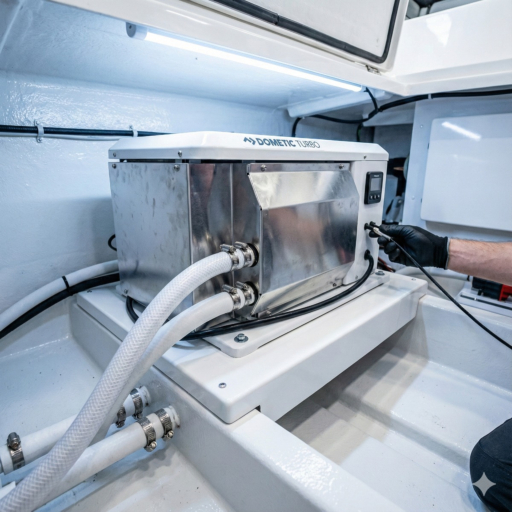
Summer afternoons in a closed cabin at Long Beach or Newport Beach can turn a pleasant boat into an oven. Whether your boat has never had cooling or still runs a tired unit from decades ago, a well-planned boat air conditioning installation comes down to four things: the right capacity, a reliable seawater loop, sensible ducting and clean power.
Why Old Boat AC Units Struggle
Most marine air conditioners are water-cooled. Seawater is pumped through a condenser coil, picks up the heat removed from the cabin and goes back overboard. Over time that loop collects growth and scale, and the compressor loses efficiency. Older units also tend to run on R-22 refrigerant, which has not been produced or imported in the US since 2020, so recharging one relies on dwindling reclaimed stock.
Typical symptoms that point toward a marine AC replacement rather than another repair include:
- Cool-feeling air that never brings the cabin temperature down on a hot day
- Repeated high-pressure shutdowns even after the strainer and seawater line have been cleaned
- Rust flaking from a steel base pan, or water stains under the unit
- Loud rattles, a compressor that struggles to start, or breakers that trip at start-up
Choosing the Right Type of System
For most boats up to roughly 50 feet, a self-contained marine air conditioner is the usual choice: compressor, evaporator, condenser and blower share one compact chassis, often under a berth or settee, with a duct feeding one or more grilles. Larger yachts often use split or chilled-water systems, which spread the equipment around the boat.
A boat air conditioner retrofit usually keeps the same type of system and location, but modern units are rarely an exact physical match, so expect some shelf modification, new vibration mounts and ducting adapters.
Marine AC Sizing: Getting the BTUs Right
Capacity is measured in BTUs per hour, and marine AC sizing starts with the volume of each cabin in cubic feet. Rules of thumb vary by manufacturer, but around 14 BTU per cubic foot is common for spaces below the waterline, rising toward 16 to 18 for a salon with large windows and direct sun. Dark hulls, big windshields and a warm climate all push the number up.
Too small a unit runs constantly and never catches up. Too large a unit cools so quickly that it shuts off before removing moisture, leaving the cabin cold and clammy. That is why a proper marine AC installation begins with measurements rather than simply copying the label on the old unit.
The Seawater Loop and the Marine AC Pump
Most cooling complaints on boats trace back to water flow. A typical loop runs from a dedicated through-hull and seacock, through a raw water strainer, into the pump, up to the condenser and out through an overboard discharge fitting above the waterline. A few details decide whether the system runs all summer or trips every afternoon:
- The marine AC pump is usually a centrifugal, magnetic-drive design that is not self-priming, so it must be mounted below the waterline where it stays flooded.
- Hoses should rise steadily from the pump to the unit, without high loops that trap air.
- The raw water strainer should be easy to reach, since it is the first thing to check when cooling fades.
- The overboard discharge should be visible, so a quick glance confirms water is flowing.
Ducting, Grilles and the Condensate Drain
Air delivery matters as much as capacity. Supply ducting should be insulated so it does not sweat inside lockers, kept short and straight, and sized to the blower outlet. The return air grille must be large enough and unobstructed; a return hidden behind cushions starves the evaporator and can ice the coil.
The condensate drain should run downhill to a shower sump or dedicated sump rather than into the bilge, where standing water breeds odors and mold.
Power: Shore, Generator or Batteries
Marine air conditioners run on 115 or 230 volt AC and draw significant current, especially at compressor start-up. At the dock that means shore power; away from it you need a generator or a large lithium bank with a suitably sized inverter. A new unit needs its own correctly rated breaker, and your shore power cord and inlet must handle the added load.
What an Owner Can Check
- Clean the raw water strainer and confirm steady flow at the overboard discharge.
- Wash or replace the return air filter every few weeks during the cooling season.
- Note any fault code on the thermostat display.
- Feel a supply grille: after a few minutes it should blow clearly colder air than the return takes in.
When to Call a Technician
If flow is good, filters are clean and the unit still trips, short-cycles or blows lukewarm air, the problem usually lies in the sealed refrigerant circuit, the compressor or the electrical controls. Those are not owner jobs, and neither is cutting new through-hulls. If you are weighing a new system for an older boat, our marine AC installation and retrofit service covers sizing, removal of the old unit, plumbing, ducting and commissioning.
Boat AC Installation FAQ
Can I replace my old unit with a smaller modern one?
Sometimes. Modern units are often more compact, but capacity should follow the cabin's volume and sun exposure, not the space the old unit leaves behind.
Why does my new AC leave the cabin cold but clammy?
That is the classic sign of an oversized unit, which reaches the set temperature before running long enough to dry the air. A blocked condensate drain can cause similar dampness.
Is a marine AC replacement worth it on an older boat?
If the existing unit uses R-22, has a corroded base pan or keeps tripping despite a clean seawater loop, replacement usually makes more sense than repeated repairs.


