A marine diesel turns a large share of its fuel into heat, and almost all of that heat leaves the engine through a small group of coolers. When those coolers foul with scale, shell and debris, the engine runs hotter, loses power and wears faster, often long before an alarm sounds. This guide explains how the coolers work, why they clog, which warning signs to watch for and what proper cleaning and testing involve.
How a Raw Water Cooling System Works
Most inboard diesels use two loops. A closed freshwater loop carries coolant through the block, while the raw water cooling system draws seawater through a strainer and a pump, pushes it through the tube bundles of the coolers and sends it overboard with the exhaust. Depending on the engine, the seawater passes through some or all of these parts:
- Heat exchanger, which cools the engine coolant.
- Aftercooler (also called a charge air cooler or intercooler), which cools the hot air coming off the turbocharger before it enters the cylinders.
- Engine oil cooler, which keeps oil temperature and viscosity in range.
- Gear or transmission cooler, which protects the gearbox oil.
Because the same seawater runs through each cooler in turn, one blockage can starve every part downstream.
Why Marine Coolers Clog and Corrode
- Scale. Heated seawater leaves mineral deposits on the inside of the tubes, and even a thin layer insulates them.
- Marine growth. When a boat sits in the slip, barnacles and mussels can settle in the intake, strainer and cooler inlets.
- Debris. Pieces of a failed impeller and flakes from eroded pencil zincs lodge at the tube ends.
- Corrosion. Electrolysis and erosion thin the tube walls until pinholes form.
- Oily film. On the air side of an aftercooler, oil mist and soot build up on the fins and cut airflow.
Warning Signs of a Clogged Heat Exchanger
A clogged heat exchanger rarely fails all at once. Watch for a temperature gauge that is normal at idle but climbs at cruise, boat engine overheating under load or in warm water, weaker water flow from the exhaust, black smoke and lost top speed when the aftercooler is fouled, coolant that disappears without an obvious leak, and milky oil or oil in the coolant, which can point to a leaking oil cooler.
Why Aftercooler Failure Is So Serious
The aftercooler sits between the turbo and the intake manifold, with seawater on one side of the core and boosted air on the other. If the core corrodes through, seawater can be drawn straight into the cylinders. The results of aftercooler failure range from rust on the valves and cylinder walls to a hydrolocked engine with a bent connecting rod. White smoke, salt crust in the intake, water at the intake drain or an engine that runs rough after sitting are reasons to stop and have it inspected.
What an Owner Can Check Between Services
- Clean the sea strainer and confirm a strong, steady stream from the exhaust.
- Inspect and replace pencil zincs on schedule, and remove the old flakes instead of letting them wash into the tubes.
- Note the coolant temperature at the same cruise rpm on every trip; a slow upward trend is an early warning.
- Check the oil dipstick and coolant for milkiness or contamination.
- Look for weeps, green crust or white salt trails around cooler end caps and hose joints.
What Professional Cooler Service Involves
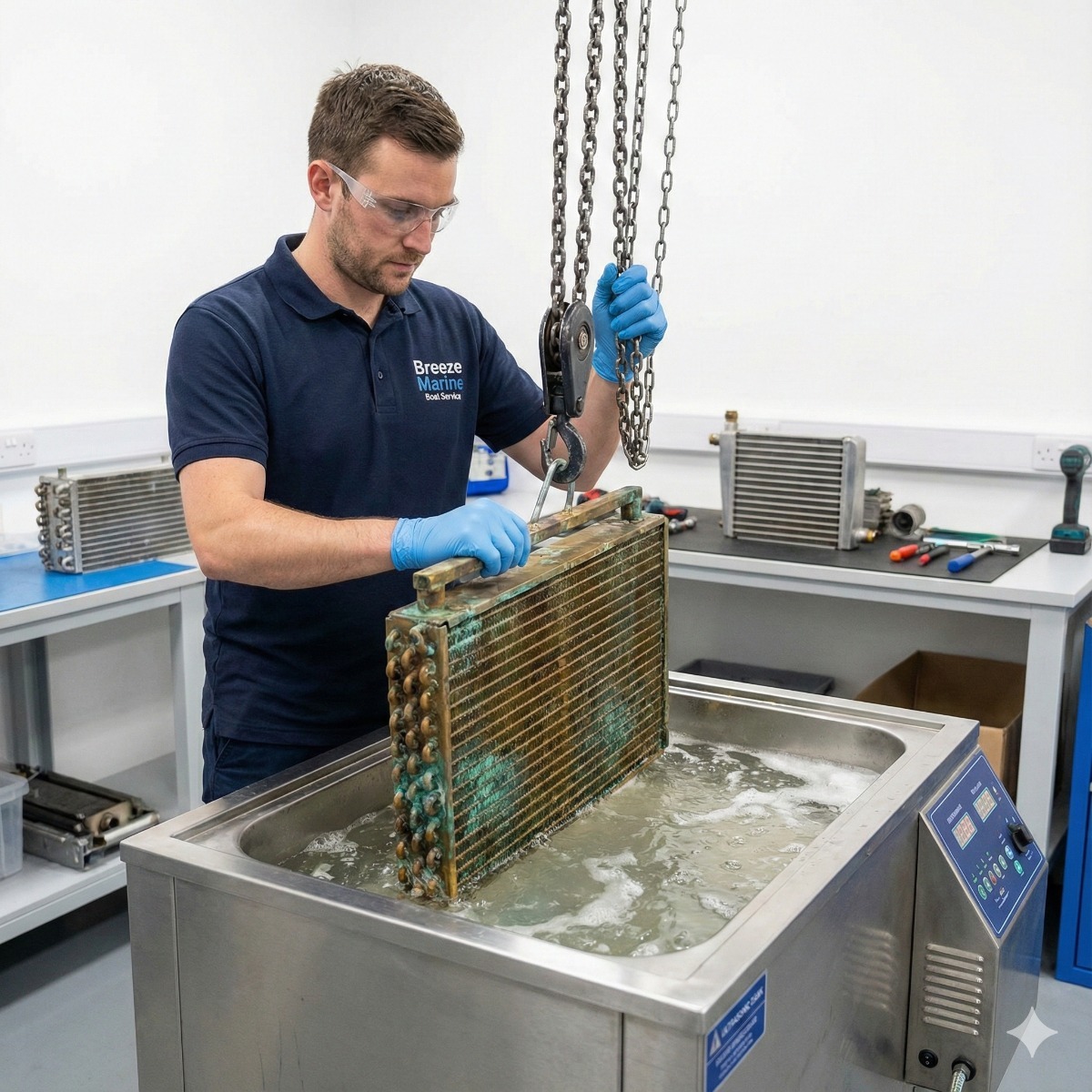
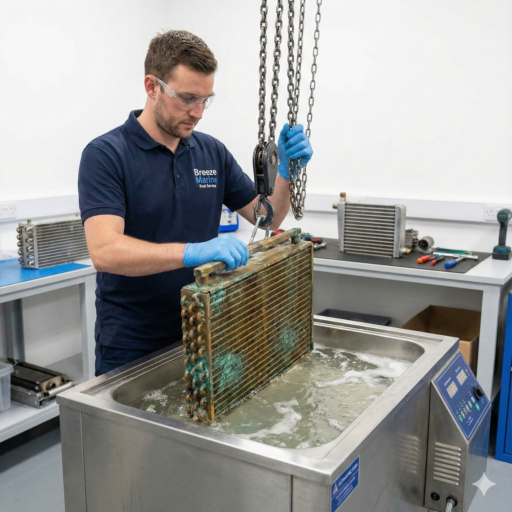
Proper marine heat exchanger cleaning starts with removing the unit, pulling the end caps and inspecting the tube bundle for erosion and pinholes. Rodding clears straight tubes but cannot reach aftercooler fins or the narrow passages that make oil cooler cleaning so awkward, which is why many shops use ultrasonic tanks and descaling solutions made for marine coolers. If you would rather hand the job over, read how our ultrasonic aftercooler cleaning and heat exchanger service works from teardown to reassembly.
A clean cooler is not automatically a sound one. Scale can hide a pinhole, so a cleaned cooler should get new seals and a hydrostatic pressure test, where the core is filled and pressurized to show whether it holds. Coolers are also worth servicing during a marine diesel engine overhaul, since much of the plumbing around them is already apart.
How Often Should the Coolers Be Serviced?
Follow the engine manufacturer's schedule first. Saltwater use, long periods sitting in the slip, warm water and high engine hours all shorten the interval, so owners who log temperatures can often spot the right moment before the alarm does.
Heat Exchanger and Aftercooler FAQ
Can I descale a heat exchanger myself?
Some owners flush coolers with descaling products made for marine use. Strong general-purpose acids can attack copper-nickel, brass, aluminum and solder joints, so rinse and neutralize thoroughly and pressure test the unit before it goes back on.
Will cleaning the coolers cure overheating?
Only if the coolers are the cause. A worn impeller, a blocked strainer or intake, a sticking thermostat or a clogged exhaust elbow produce the same symptoms, so check the whole cooling circuit.
Why pressure test a cooler that looks clean?
Because corrosion works from the inside. A core can look perfect and still leak under pressure, and on an aftercooler that leak lets seawater into the engine.