

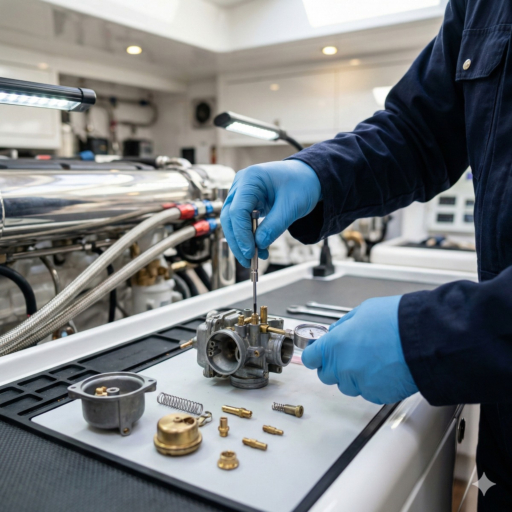
Most marine carburetors leave the factory calibrated for sea level. For a boat that spends its life in coastal harbors, that is exactly right. Tow the same boat up into the mountains, or modify the engine for more power, and the calibration no longer matches the conditions. The engine may run rich, lose power and foul plugs or, after performance changes, run dangerously lean. This guide explains how altitude and modifications affect the fuel mixture and what a proper jetting job involves.
Why Altitude Changes the Mixture
A carburetor meters fuel based on the airflow through its venturi, but it cannot sense how dense that air is. At higher elevations the air is thinner and contains less oxygen in every breath the engine takes. The carb still delivers roughly the same amount of fuel for that airflow, so the mixture becomes richer as elevation increases. A common rule of thumb is that a naturally aspirated engine loses around three percent of its power for every thousand feet of elevation, and a rich mixture makes that loss worse.
Symptoms of running rich at altitude
- Black smoke and a strong fuel smell
- Sooty, black spark plugs and misfires
- Sluggish throttle response and a boggy hole shot
- Lower wide open throttle RPM than at home
- Rough idle and increased fuel consumption
Why Performance Changes Can Cause Lean Running
The opposite problem comes from modifications. A freer-flowing exhaust, a different camshaft, a larger carburetor or a new intake can increase airflow beyond what the stock jets supply. A lean mixture under load raises combustion temperatures, which can lead to detonation, burned pistons and damaged valves. Marine engines run near full load for long periods, which makes a lean condition far more dangerous than it would be in a car.
What Marine Carburetor Jetting Involves
Marine carburetor jetting is the process of changing the carburetor's fuel metering to match the engine and the conditions. Depending on the design, that can include:
- Main jets, which control fuel flow at cruise and wide open throttle
- Metering rods on carburetors that use them, which change fuel flow with engine load and vacuum
- Power valves on some four-barrel designs, which add fuel under heavy load
- Idle and transition circuits, which affect starting, idle and the move off idle
- Accelerator pump adjustments for a crisp response when the throttle opens
Carburetor jetting for altitude usually means smaller main jets, sometimes with metering rod or power valve changes, to lean the mixture back to where it should be. Performance jetting may go the other way and add fuel.
Reading the Engine: The Plug Chop
Guesswork is not a tuning method. A plug chop is a classic test: the engine is run at steady wide open throttle on the water, then shut off immediately without idling, so the spark plugs keep a clean record of combustion at that load. The technician removes the plugs and reads the color of the insulator and the ground strap. Light tan usually indicates a healthy mixture, black and sooty means rich, and white or blistered insulators mean lean and potentially dangerous. Where possible, a wideband oxygen sensor in the exhaust gives real-time readings during a test run.
Timing and Other Checks
Carburetor re-jetting works best as part of a full tune. Ignition timing, fuel pressure, spark plug heat range and the propeller all interact with the mixture. At altitude, a lower-pitch prop may be needed to let the engine reach its recommended RPM range, since it now produces less power. Boat carburetor tuning that ignores the prop and the timing only solves part of the problem.
What Owners Can Do
- Note your wide open throttle RPM and top speed at home as a baseline.
- Record the same figures at your destination to see how far performance drops.
- Carry spare spark plugs when traveling to high-altitude lakes.
- If you move between elevations often, ask about jetting that suits the range you actually use rather than one extreme.
- Reverse the changes before running hard at sea level again.
That last point is important. A carburetor jetted lean for the mountains can be dangerously lean back at the coast.
When to Call a Technician
Jetting changes involve taking the carburetor apart, choosing parts for the specific model, and testing under load on the water. Marine performance tuning also requires knowing the safe limits for your engine, especially when it has been modified. If you are planning a trip to the mountains or have changed your engine, our marine carburetor jetting service recalibrates the fuel circuits and confirms the result with on-water testing.
Carburetor Jetting FAQ
Do I need to re-jet for a single weekend at altitude?
For a short trip at moderate elevation, many owners accept some power loss rather than change jets. For regular use at higher elevations, or if plugs are fouling, re-jetting is worthwhile.
Do fuel-injected engines need the same changes?
Most EFI systems compensate for altitude automatically using pressure sensors, so they generally do not need changes. Carbureted engines cannot compensate on their own.
Is lean or rich more dangerous?
Lean. A rich engine loses power and fouls plugs, while a lean engine under load can overheat pistons and valves.


