
When a marine engine comes apart for a rebuild, the cylinders tell much of the story. Some blocks need only a light hone and new rings. Others need to be bored oversize, and a few need a damaged cylinder repaired with a sleeve. Understanding how that decision is made helps owners read an estimate and ask the right questions before any machine work begins.
Why cylinder condition matters
Piston rings can only seal against a cylinder wall that is round, straight and properly finished. Worn cylinders become tapered, larger at the top where ring pressure and heat are highest, and out of round. Marine engines also face their own problems: rust pits from water intrusion, scoring from overheating and corrosion from sitting unused. If new rings go into a worn or damaged bore, the engine may burn oil, lose compression and blow by from the start.
How cylinders are measured
After the block is cleaned, the machinist measures each cylinder with a dial bore gauge at several depths and in two directions. The readings show:
- Taper: the difference between top and bottom diameters.
- Out-of-round: the difference between measurements taken at right angles.
- Total wear: how far the bore has grown beyond its original size.
The cylinders are also inspected for scoring, pits and cracks, and the block may be checked for deck flatness and crack indications.
When honing is enough
If taper and out-of-round are within specification and there is no deep scoring or pitting, the cylinders may only need cylinder honing. A hone is a rotating tool with abrasive stones that removes a very small amount of material and creates a cross-hatch pattern on the wall. That pattern holds oil for ring lubrication and helps new rings seat. Diamond honing uses diamond abrasives that cut consistently and produce an accurate, controlled finish, especially on harder cylinder materials.
When the block needs boring
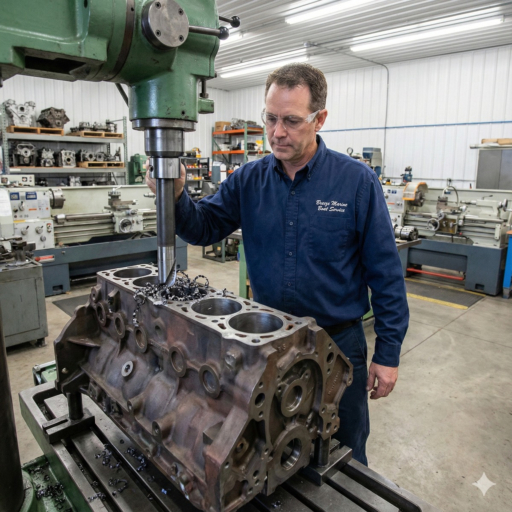
Engine block boring is required when wear, scoring or pits are deeper than a hone can remove. A boring bar cuts each cylinder to a larger, perfectly round and straight size, leaving a small amount of material for final honing. The engine then needs oversized pistons and matching rings. Common oversizes are 0.020, 0.030 or 0.040 inch, depending on the engine and available parts.
The final hone is matched to the actual pistons being installed. Each piston is measured, and the cylinder is honed to achieve the correct piston-to-wall clearance specified by the manufacturer. Too tight, and the piston can scuff or seize when hot; too loose, and the piston rocks, making noise and wearing rings quickly. That is why many machinists want the exact pistons in hand before finishing.
Torque plate honing
When cylinder heads are bolted down, the clamping force slightly distorts the cylinder bores. Torque plate honing simulates that stress by bolting a thick plate to the deck and torquing it to specification during honing. The cylinders are finished in the shape they will have in the running engine, which improves ring seal. It is especially useful on high-performance and diesel engines, and on blocks known to distort under head bolt load.
When a cylinder needs sleeving
If one cylinder is damaged beyond the largest available oversize, cracked, or deeply pitted by corrosion, cylinder sleeving can save the block. The damaged cylinder is bored oversize, and a new sleeve is pressed in and then machined to the standard or matching size. This is often more economical than replacing a block, especially on older or hard-to-find marine engines.
What owners can check before teardown
- A compression or leak-down test shows which cylinders are leaking and whether rings or valves are the likely cause.
- Blue smoke, high oil consumption and heavy crankcase blow-by suggest ring and cylinder wear.
- Oil analysis showing rising iron and chromium can indicate cylinder and ring wear.
- A history of overheating or water intrusion raises the likelihood of scoring or pitting.
These findings help a shop estimate a marine engine rebuild more accurately before the engine is opened.
Getting a quote for machine work
When requesting a quote, share the engine make and model, whether it is gas or diesel, what was found at teardown and whether you plan to supply pistons and rings. Owners searching for a marine machine shop Long Beach boaters can use should look at our engine block boring and honing service for the details of the process.
Boring and honing FAQ
Can I just hone and reuse the old pistons?
Sometimes, if the pistons and cylinders are within specification. Excessive clearance or damaged pistons require replacement.
How much can a cylinder be bored?
It depends on engine design and available oversized pistons. Beyond the maximum, sleeving or a new block is needed.
Does boring weaken the block?
Within the manufacturer's oversize limits, no. Going beyond them can leave cylinder walls too thin, especially in marine engines exposed to heat and corrosion.


