
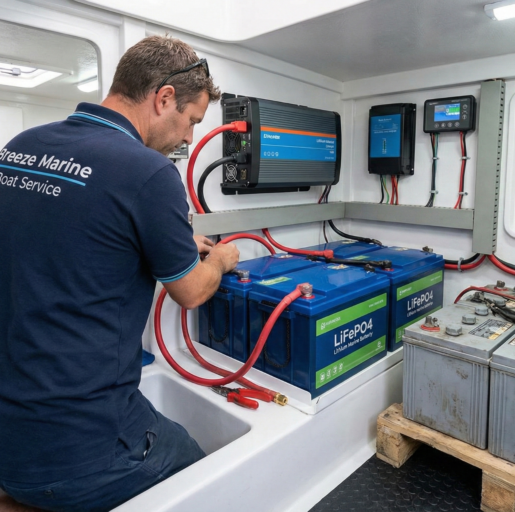
Most boats leave the factory with flooded or AGM house batteries, which is fine for starting the engine and running a few lights. Add a fridge, electronics that stay on all day, a windlass and an inverter, and the old bank struggles by the second night at anchor. An AGM to lithium conversion is one of the most talked-about electrical upgrades on the docks, and one of the most misunderstood. This guide explains what changes, what the job involves and what you can check first.
Why owners move from lead-acid to lithium
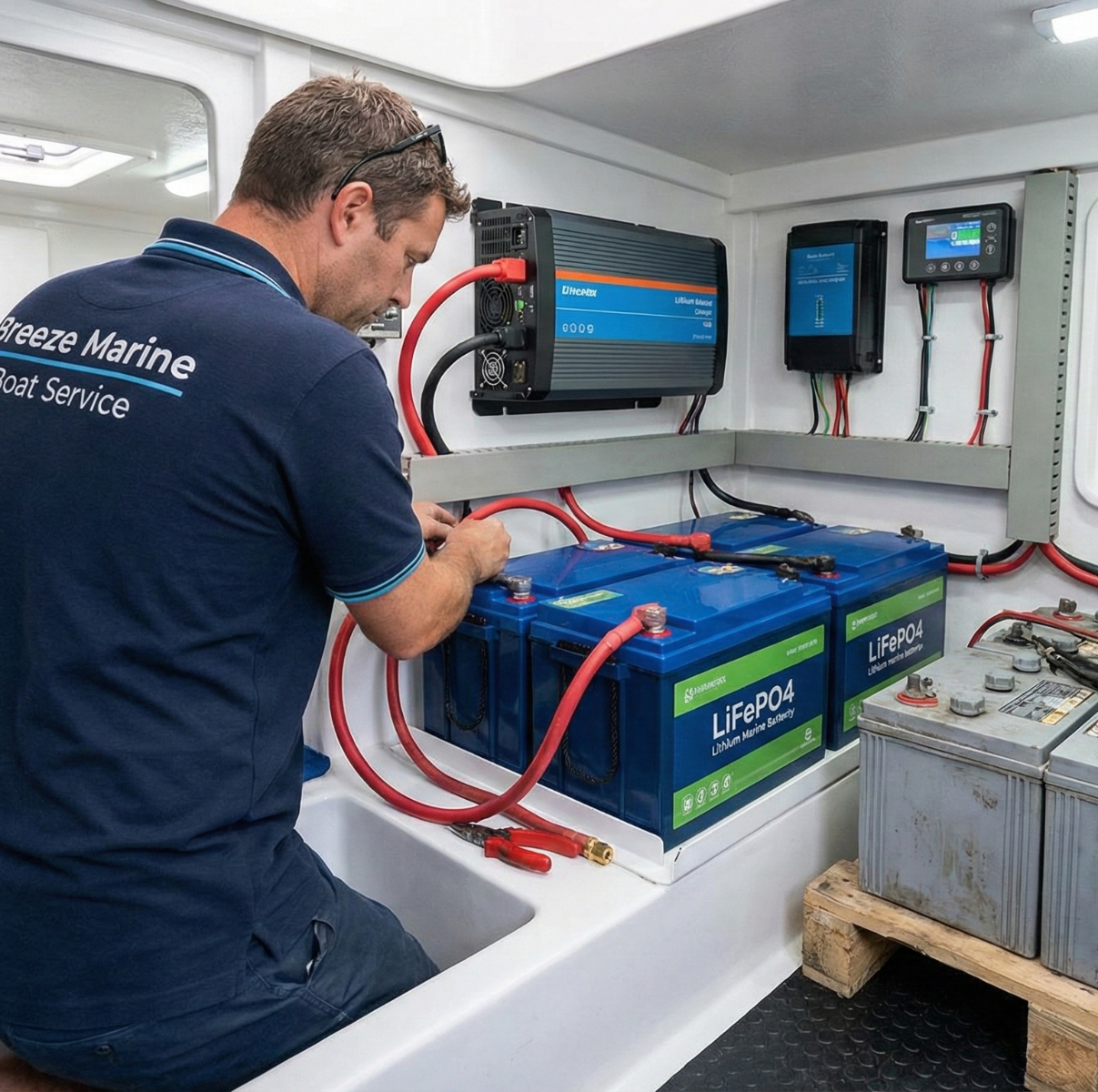
A LiFePO4 boat battery (lithium iron phosphate) behaves very differently from lead-acid:
- Usable capacity. Lead-acid and AGM batteries last longest when they are not regularly drawn much below half their rated capacity, while LiFePO4 cells are commonly used to 80 percent depth of discharge or more.
- Charge acceptance. Lithium takes a high charging current almost until it is full, so engine, generator and solar hours go further.
- Flat voltage and low weight. Voltage stays steady through most of the discharge, and the bank weighs a fraction of the lead-acid bank it replaces.
The trade-off is that lithium cells need tighter control of charging voltage, current and temperature, which is where most of the work lies.
Signs your house battery bank is holding you back
- The fridge and anchor light drag the bank down before morning.
- Electronics reset when the windlass, thruster or inverter runs.
- You run the generator or engine for hours just to recharge.
- Batteries need replacing every few seasons.
Corroded terminals, undersized cables or a tired charger cause the same complaints, and an ordinary boat battery replacement with fresh AGMs may be all an occasional day boater needs. A conversion makes most sense when you spend nights aboard or run significant loads away from shore power.
What a marine lithium battery conversion involves
A proper marine lithium battery conversion treats the whole DC system, not just the battery box.
Sizing from your amp-hour load
List every DC load, its current draw and how many hours it runs on a typical day. The daily total, plus a margin for days without charging, sets the size of the bank. Because lithium can be used more deeply, the new bank is often smaller in rated amp-hours than the AGM bank it replaces while delivering more usable energy.
Protecting the alternator
A lithium bank will pull as much current as the alternator can make, for as long as it is charging. A standard alternator with an internal regulator was built to top up lead-acid batteries and can overheat under that sustained load. The usual answers are a DC-to-DC charger, which limits the current taken from the engine circuit, or an external regulator that watches alternator temperature. Many boats also keep a separate AGM start battery so the engine can always be started.
Fusing, cabling and the battery management system
Every lithium battery relies on a battery management system (BMS) that disconnects the cells if voltage, current or temperature go out of range. A sudden disconnect while the alternator is charging can send a voltage spike through the boat, another reason the charging side must be designed for lithium. Lithium banks can also deliver very high short-circuit current, so a Class-T fuse close to the battery and properly sized cables are standard practice.
Charging profiles and monitoring
Shore chargers, inverter/chargers and solar controllers each need a LiFePO4 charging profile with the voltages the battery maker specifies, and equalization switched off. Because lithium voltage barely changes as the bank empties, a shunt-based battery monitor is the practical way to see state of charge.
Is a lithium battery conversion kit enough?
A lithium battery conversion kit can save time by bundling batteries, a DC-to-DC charger, fuses and busbars, but it is built for an average boat, not yours. It cannot know your daily load, your alternator output, whether your charger can be programmed for lithium, or whether the batteries can be secured where the old ones sat. Treat a kit as a parts list to check against your boat.
What you can check before you switch
- The type, age and capacity of your current house battery bank and start battery.
- Your alternator output and whether it has an internal or external regulator.
- The model of your shore charger, inverter/charger and solar controller, and whether each has a lithium or adjustable setting.
- A rough daily load list, including anything you plan to add later.
- The condition of cables and terminals and how the batteries are strapped down.
When to call a technician
A house bank conversion touches the engine charging circuit, shore and solar charging, high-current fusing and every system that depends on stable power. If your boat has more than one charging source, an inverter or electronics you cannot afford to lose, plan and program the whole system together. Our team handles lithium marine battery installation for boats in Long Beach, from the load audit to alternator protection and charger programming.
Lithium Conversion FAQ
Can I mix lithium and AGM batteries on the same boat?
Not in the same bank, because they charge at different voltages. An AGM start battery alongside a separate lithium house battery bank, each charged correctly, is a common arrangement.
Do lithium batteries mind a hot engine room?
Heat shortens the life of any battery, and the BMS stops charging if the cells get too hot or too cold. Mount the bank in the coolest dry space available, away from exhaust heat.
Will my existing charger work with lithium?
Some chargers have a lithium setting or accept custom voltages; older units with fixed lead-acid profiles often do not. If yours cannot match the battery maker's specifications, plan to replace it as part of the AGM to lithium conversion.