Most boat owners only need a trailer a few times: a haul-out for bottom work, a move to a new marina, or delivering a boat to its buyer. That is when a boat trailer rental starts to look sensible, because owning a trailer you use twice a year means storing and maintaining it the rest of the time. But a poorly fitting or neglected trailer can damage the boat and put you at risk on the freeway. This guide walks through what to match, what to inspect, and when another route makes more sense.
Start With the Numbers: Weight and Length
Before you call anyone about a boat trailer for rent, write down three figures: the boat's dry weight, its length overall and its beam. Then add what the boat actually carries on the road: fuel (gasoline weighs a little over six pounds per gallon), batteries, the engine or outboard if it is not included in the dry weight, anchors, water and gear. The loaded weight is often well above the brochure figure.
The trailer's rated capacity should comfortably exceed that loaded weight, not merely match it. Check the capacity plate on the tongue or frame and compare it to the axle and tire ratings, because a trailer is only as strong as its weakest rated component. Length matters too: the transom should be supported by the bunks or rollers rather than overhanging them, and the bow eye must line up with the winch post.
Bunks or Rollers: Matching the Support to Your Hull
When you compare boat trailers for rent, look closely at how each one supports the hull. Bunk trailers use carpeted boards that spread the load along the strongest parts of the bottom. Roller trailers make launching and retrieving easier at shallow ramps but concentrate the load on many small contact points.
- Deep-V hulls need bunks or rollers set to the deadrise so the keel carries weight without the sides being pinched.
- Flat or modified-V hulls want wider bunk spacing to avoid point loads that can stress the bottom.
- Pontoon boats need dedicated bunks that cradle the tubes, not a V-hull trailer.
Ask whether the bunks can be adjusted and plan time to do it before loading. A trailer set up for a different boat is the most common reason a rental leaves marks, stress cracks or a distorted hull bottom.
Sailboats: Keel, Stands and Mast Support
Trailering a sailboat is its own category. Fin and full keels carry most of the boat's weight, so the trailer needs a keel trough or keel pad that takes that load, with adjustable hull pads that only steady the boat rather than lift it. A powerboat trailer is not a substitute. For a sailboat trailer for rent, confirm:
- The keel pad length and width suit your keel, and the boat sits level fore and aft.
- Hull pads can be adjusted and locked, with pins or bolts that will not back out.
- There is a mast support, usually a crutch at the bow and a support at the stern, so the lowered mast rides secured instead of resting on stanchions or the pulpit.
Hitch, Brakes and the Tow Vehicle
Whoever supplies the trailer, you are responsible for the tow vehicle. Confirm its towing and tongue weight ratings, then match the ball size to the coupler. A 2-inch ball in a 2-5/16-inch coupler can look connected and pop off on the first bump.
Check the brakes carefully whenever you rent a boat trailer. Many boat trailers use surge brakes, which need a working actuator, fluid in the master cylinder and a lockout or reverse solenoid for backing up. Electric-over-hydraulic systems need a matching controller in the tow vehicle. In salt water, look for rusted drums or rotors, seized calipers and weeping lines.
Lights, Tires and Tie-Downs
The trailer lights are the component most likely to fail on a rental, because they are dunked at the ramp again and again. Before leaving the lot, connect the plug and walk around with a helper: running lights, brake lights, both turn signals and the license plate light. Check the tires for sidewall cracking, even tread and the pressure shown on the sidewall, and ask to see the spare.
For tie-downs, you want a winch strap or cable in good condition, a safety chain to the bow eye and transom straps at the stern. Safety chains between trailer and tow vehicle should be crossed under the tongue and hooked so they cannot bounce loose.
A Quick Walk-Around Before You Accept It
If you simply search "rent boat trailer" and take the first one available, you may inherit someone else's neglect. Spend ten minutes on this list:
- Rock each wheel for play and spin it to listen for grinding from the bearings.
- Look for cracked welds, rust-through on the frame and bent crossmembers.
- Check that the coupler latch, jack and winch all work smoothly.
- Stop after the first few miles to recheck straps, the coupler and hub temperature.
When Renting Is Not the Best Answer
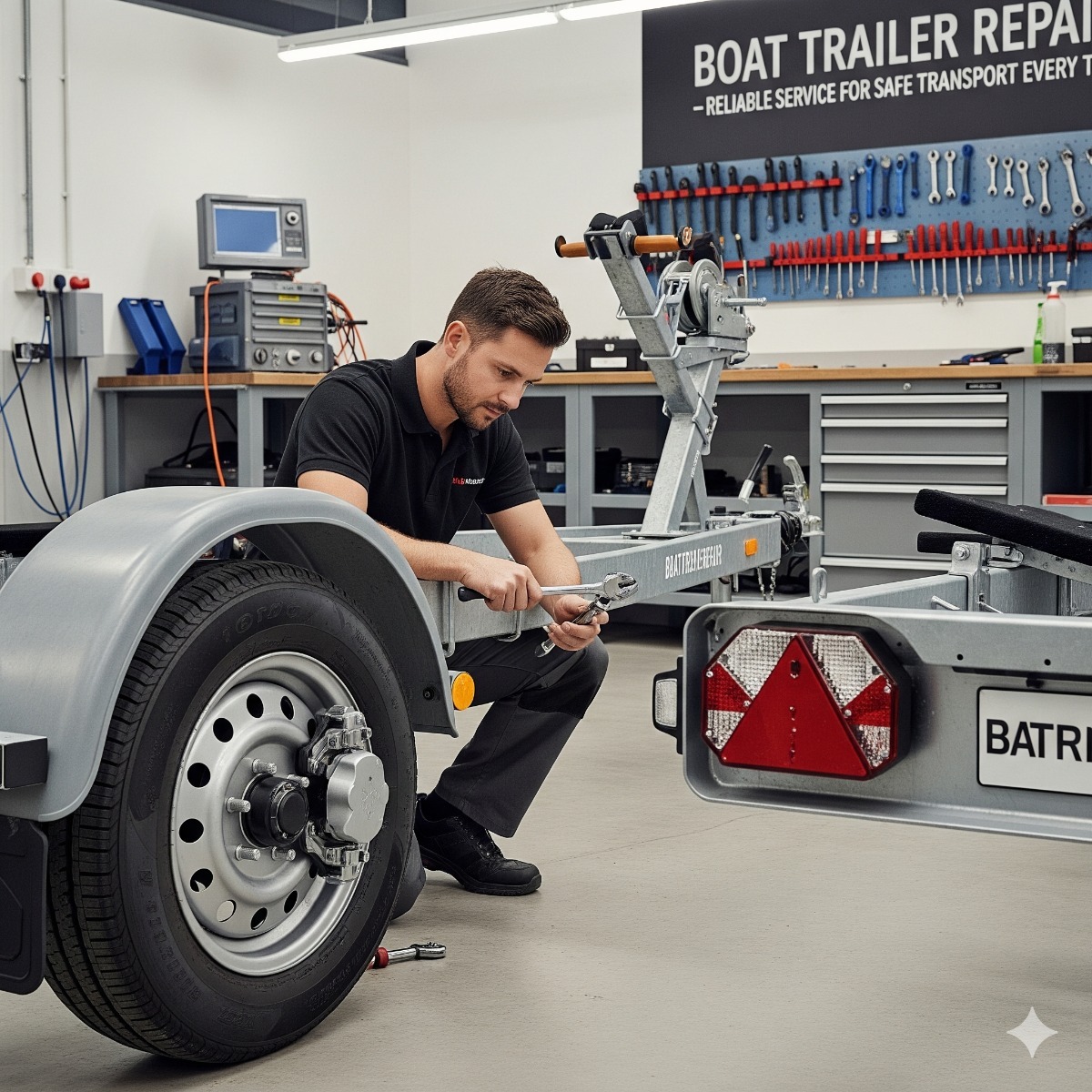
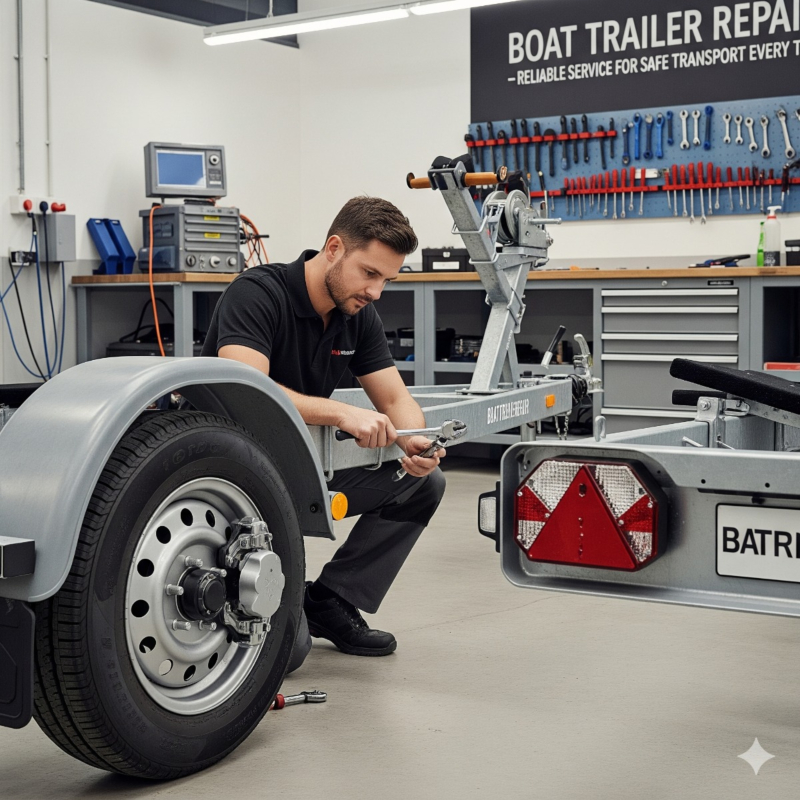
We do not rent trailers. What we often see instead is an owner with a trailer already sitting in a side yard, with seized bearings, dead lights and rotten bunks, who is about to book a boat trailer rental because they assume their own is beyond saving. Frequently it is a smaller job than it looks: bearings, a new lighting harness and fresh bunk carpet can make your own trailer road-ready again. If you are around Long Beach or San Pedro, our boat trailer repair service covers bearings, brakes, lights and bunks so the trailer you own is ready when you need it.
Trailer Rental FAQ
Can I tow my sailboat on a powerboat trailer?
Generally no. Powerboat bunks are shaped for a planing hull and do not carry the weight of a keel. The boat would rest on its hull sides, which can crack laminate and leave the boat unstable. Use a trailer with a proper keel pad and adjustable hull supports.
What should I bring when picking up a rented trailer?
Bring the boat's weight and dimensions, the correct hitch ball, a tire gauge, spare ratchet straps and a helper to check the lights.
How do I know if my own trailer is worth fixing?
If the frame and axle are sound, most other parts, including bearings, brakes, lights, bunks and the winch, are routine replacements. A frame with serious rust-through or a bent axle is a different conversation.