When something goes wrong on a boat, the first instinct is to call someone and describe it as best you can. The trouble is that a vague description such as "it runs rough" or "there is a noise" can mean a dozen different things. A few minutes of organized notes before you call can shorten diagnosis, avoid a second visit and help the technician bring the right parts the first time.
Why good notes matter
A technician arriving at your slip starts with only what you tell them and what they can reproduce. Many faults are intermittent: an alarm that only sounds after an hour, a vibration at one RPM range, a battery that goes flat over a week. If the fault does not appear during the visit, your notes become the main evidence. Whether you use a local boat repair service or a larger yard, the owner's observations are part of the diagnosis.
What to write down
The symptom itself
Describe exactly what happens. Does the engine stall, lose power, refuse to crank or crank without starting? Is a warning light on, and which one? Is there a smell of fuel, exhaust or hot electrical insulation? Precise words save time.
The conditions
- Engine temperature, RPM and boat speed when the problem appears.
- Whether it happens cold, after warm-up or only after a long run.
- Sea state and load: heavy passengers, towing, rough water.
- Whether it started suddenly or developed over several trips.
Recent history
Write down any work done in the last season: fuel added from a new source, a service, a new battery, electronics installed, a hard grounding or a trailer trip. Problems often start right after a change.
Photos and video
A short video of a noise, a gauge reading or smoke at the exhaust is often more useful than a paragraph of description. Photograph leaks where they drip and warning messages on the display.
What a boat condition assessment covers
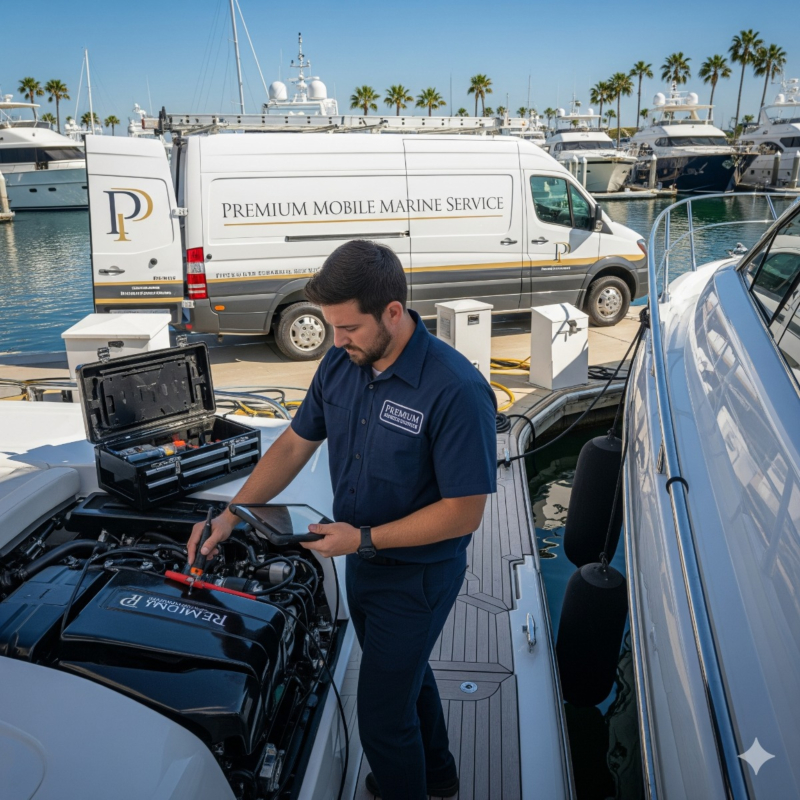
For anything beyond a single obvious fault, a technician will usually begin with a boat condition assessment. That typically includes a look at the engine and drive, fluids, belts and hoses, the fuel and cooling systems, battery and charging health, bilge and pumps, steering and controls, and the visible hull and running gear. On modern engines, engine diagnostics with a scan tool read stored fault codes and live sensor data.
The result should be a clear list: what needs immediate attention for safety, what should be planned soon and what can wait. That list is useful even if you only fix one item now, because it gives you a roadmap for the season.
Everyday boat repairs and what they usually involve
Most everyday boat repairs fall into a handful of categories:
- Starting and charging: batteries, cables, starters, alternators and switches.
- Fuel: filters, water in fuel, pumps, injectors and carburetors.
- Cooling: impellers, strainers, thermostats and heat exchangers.
- Controls: sticky throttle and shift cables, steering stiffness.
- Hull and deck: gelcoat chips, stress cracks, fittings and minor hull repairs.
Boat engine repair beyond that list, such as low compression or internal noise, needs more testing before any decision. Compression and leak-down tests tell you whether the engine is worth repairing or whether a rebuild or repower should be considered.
Quick checks you can do yourself
- Check battery voltage with a meter and look for loose or corroded terminals.
- Confirm fuel level, open the fuel valve and check the water separator bowl.
- Look at the sea strainer and confirm water is coming from the tell-tale or exhaust.
- Check that the kill switch lanyard is in place and the drive is in neutral.
- Look in the bilge for water, oil or fuel and note the color.
Stop there if anything involves fuel leaks, smoke or rising bilge water. Those are safety issues, not DIY projects.
Choosing who to call
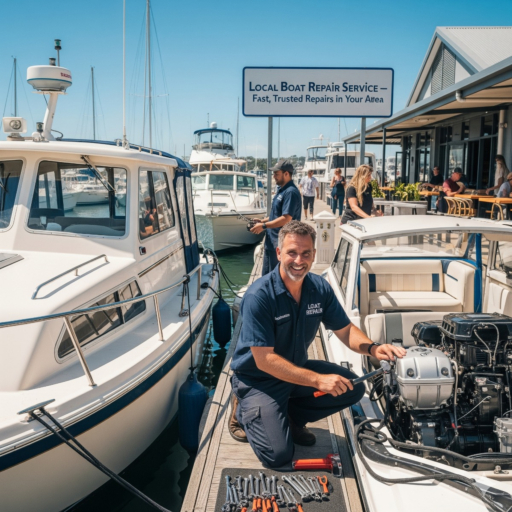
When you search boat repair near me or boat repairs near me, you will see yards, dealers and mobile technicians. A mobile team avoids a haul-out for many jobs, which is convenient when the boat lives in a slip. If you are looking for boat service and repair near me in the San Pedro and Long Beach area, you can describe your problem through the local boat repair service page and include the notes above. A clear description helps any boat repair service plan the visit properly.
Boat repair preparation FAQ
Should I try to fix it myself first?
Simple checks like battery connections, fuel valves and strainers are reasonable. Avoid opening fuel lines, electrical panels or cooling systems if you are unsure, since that can create new problems or safety risks.
What if the problem does not happen when the technician is there?
That is common with intermittent faults. Your notes, videos and any stored fault codes help narrow it down, and a sea trial under the same conditions often reproduces it.
Is a condition assessment worth it for a small boat?
Yes, especially for a newly purchased boat or one that has sat unused. It identifies safety issues early and helps you plan maintenance rather than react to breakdowns.