
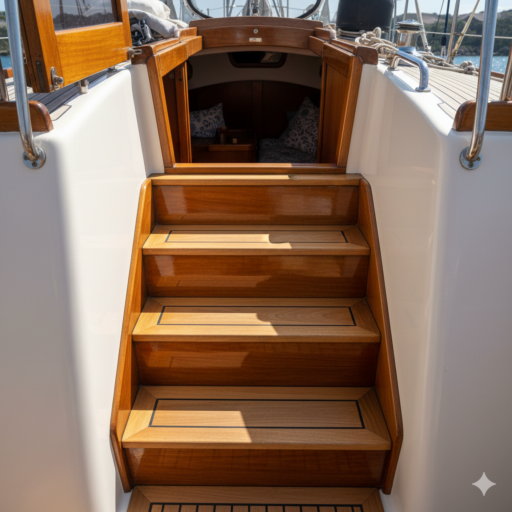
The companionway is the busiest spot on most boats. Everyone passes through it, usually carrying something, often while the boat is moving, and frequently with wet feet. Yet on many production boats the companionway stairs are little more than a steep ladder with narrow, varnished treads. This guide explains why companionway steps become a hazard, what a proper rebuild involves and what you can inspect yourself before deciding on a fix.
Why Companionway Steps Become Unsafe
Most problems develop slowly, which is why owners get used to them. The usual culprits are:
- Slick finishes. Gloss varnish looks beautiful but offers almost no grip once it is wet with spray, rain or a spilled drink.
- Thin or worn treads. Treads cut from thin stock flex underfoot, and years of traffic round off the front edges where your heel lands.
- Loose fasteners. Constant motion works screws loose; water then gets into the holes and softens the wood around them.
- Awkward geometry. A steep angle, uneven step heights or treads too shallow for a whole foot force people to climb down backwards.
Warning signs include creaks, a tread that rocks or flexes, dark staining around fastener plugs, cracked finish at the joints and guests who hesitate at the top step.
Rise and Run on a Boat
On land, stairs follow building codes. Boat stairs have to fit a space that is already fixed, so the designer must balance the rise and run within the room available. The rise is the height of each step; the run is how deep each tread is from front to back. A steep ladder saves floor space in the salon but makes every trip below a climb. Where there is room, lengthening the run and lowering the angle turns a ladder into something much closer to real stairs, which is easier on knees and far safer in a seaway.
Consistency matters as much as the angle. If one step is noticeably taller than the others, feet will catch on it. A good design divides the total height into equal steps and gives each tread enough depth for most of the foot.
The Sailboat Companionway Challenge
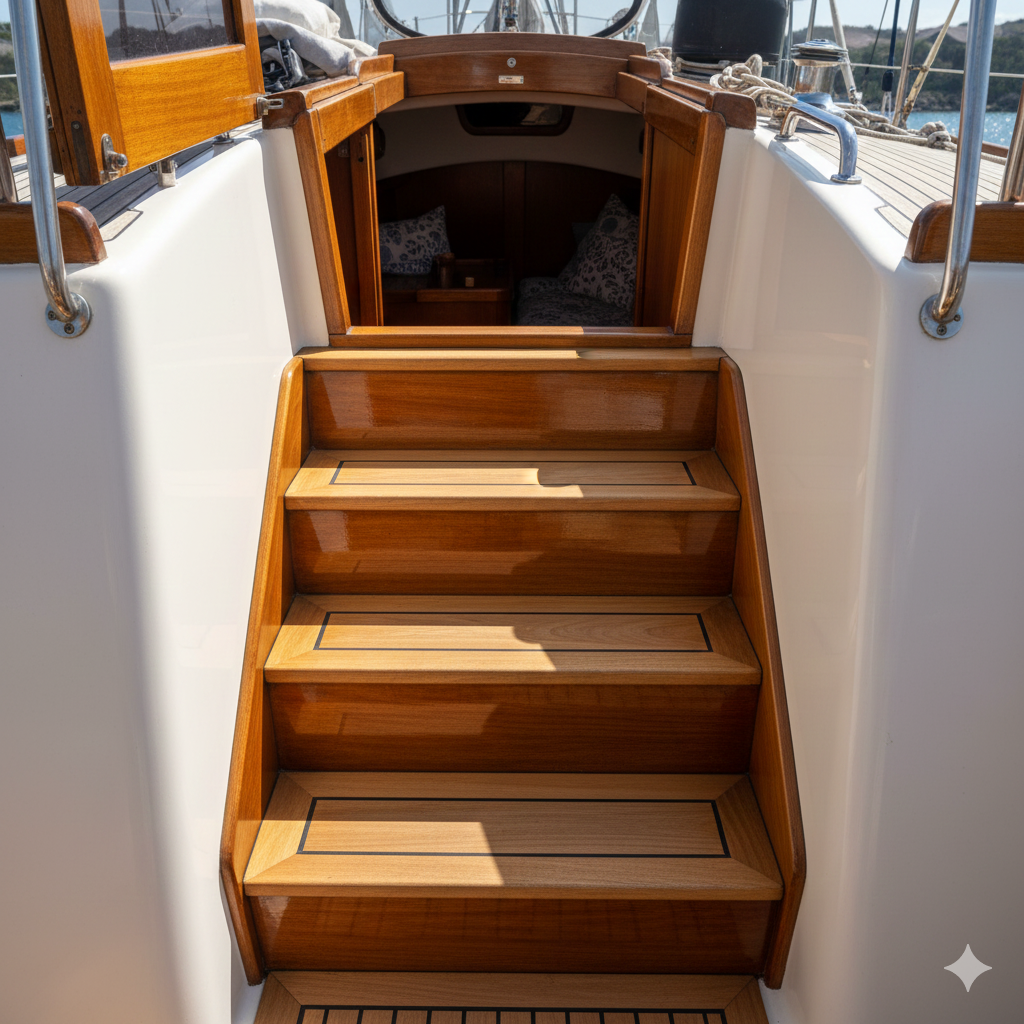
A sailboat companionway is usually the steepest entry on any boat, because the drop from the cockpit to the cabin sole is high and floor space below is tight. On many sailboats the ladder also doubles as the engine access cover, so it has to lift off or hinge out of the way. Any new design needs to keep that access easy, with fittings that hold the stairs firmly while under way but release quickly when you need to check the engine. Solid handholds on both sides matter just as much as the treads.
What a Companionway Ladder Replacement Involves
Boat interiors are rarely square, so a companionway ladder replacement starts with templates of the actual opening rather than measurements from a drawing. From there the work typically moves through these stages:
- Material choice. Teak is naturally oily, stable and forgiving if the finish wears; mahogany is lighter and takes varnish beautifully but needs its coating kept intact.
- Tread thickness and joinery. Thicker stock resists flex, and well-fitted joints between treads and stringers keep the stairs quiet for years.
- Edge shaping. Rounded front edges are kinder to shins and bare feet.
- Finishing. Gloss where hands and eyes land, grip where feet land.
- Bedding and fastening. The stairs must be fastened securely and sealed so water cannot track into the cabin sole.
Choosing Non-Skid Treads
Non-skid treads work best when the grip is built into the wood rather than stuck on afterwards. Common approaches include routed grooves across the tread, strips of grit set into shallow channels and textured finishes on the stepping surface. Adhesive tape is quick to apply, but it tends to lift at the edges and trap dirt. Whatever method you choose, test it with wet bare feet and with deck shoes, since both are common on board.
Teak Stairs vs. Painted Steps
Teak stairs remain the classic choice for good reason: the wood looks right oiled, varnished or left natural, and it holds fasteners well. On a motor yacht, well-finished yacht stairs are also one of the first things guests notice, so matching the grain and finish of the surrounding joinery pays off. On a hard-working fishing boat, simple painted steps with an aggressive non-skid surface may be the more practical answer.
What You Can Check Yourself
- Stand on each tread and shift your weight; any movement or creaking points to loose fasteners or failing joints.
- Look for dark stains or soft wood around fastener plugs, a sign that water is getting in.
- Test the grip with a wet hand and a wet shoe sole.
- Make sure the ladder sits firmly in its fittings and cannot lift out unexpectedly.
- Check that there is a solid handhold within reach at the top and bottom.
Small fixes such as tightening fasteners or refreshing the finish are reasonable owner jobs. If the treads are soft, split or chronically loose, or if the geometry itself is the problem, a rebuild is the better answer. When you are ready to replace a ladder or tired steps, our custom companionway stairs and treads service starts with a precise template of your opening.
Companionway Stairs FAQ
Can a steep ladder be turned into proper boat stairs?
Often, if there is floor space at the bottom to lengthen the run. Even when there is not, deeper treads and a better handhold can make the climb noticeably easier.
How often should varnished treads be refinished?
It depends on traffic and sun exposure. Refinish when the coating turns cloudy, cracks or wears through at the front edge, before bare wood starts absorbing water.
Do built-in grip grooves spoil the look of teak?
Not when they are planned from the start. Routed grooves and inlaid grit strips can be laid out to follow the grain, so the steps still read as fine joinery rather than a safety add-on.