
Sound on a boat behaves very differently from sound in a car or living room. There are no walls on an open deck to reflect bass, wind carries the high frequencies away, and engine and water noise compete with the music at cruising speed. On top of that, everything aboard lives with salt, UV and moisture. A stereo that sounds great and lasts for years starts with planning, not with picking the loudest speakers in the catalog.
Start with how you use the boat
Before choosing any hardware, think about where people actually sit and listen. Most boats have three natural zones: the helm and cockpit, the bow or swim platform, and the cabin. A wake boat that tows riders needs sound projected well behind the transom; a cruiser used for sunset dinners needs clear, moderate sound in the cockpit and a quiet cabin. Knowing your zones determines how many speakers, how much amplifier power and what kind of controls you need.
- Helm and cockpit: the main listening area, usually served by the head unit's primary outputs.
- Bow or swim deck: often wants independent volume so guests can turn it up without deafening the helm.
- Cabin: lower volume, sometimes a separate source for night use.
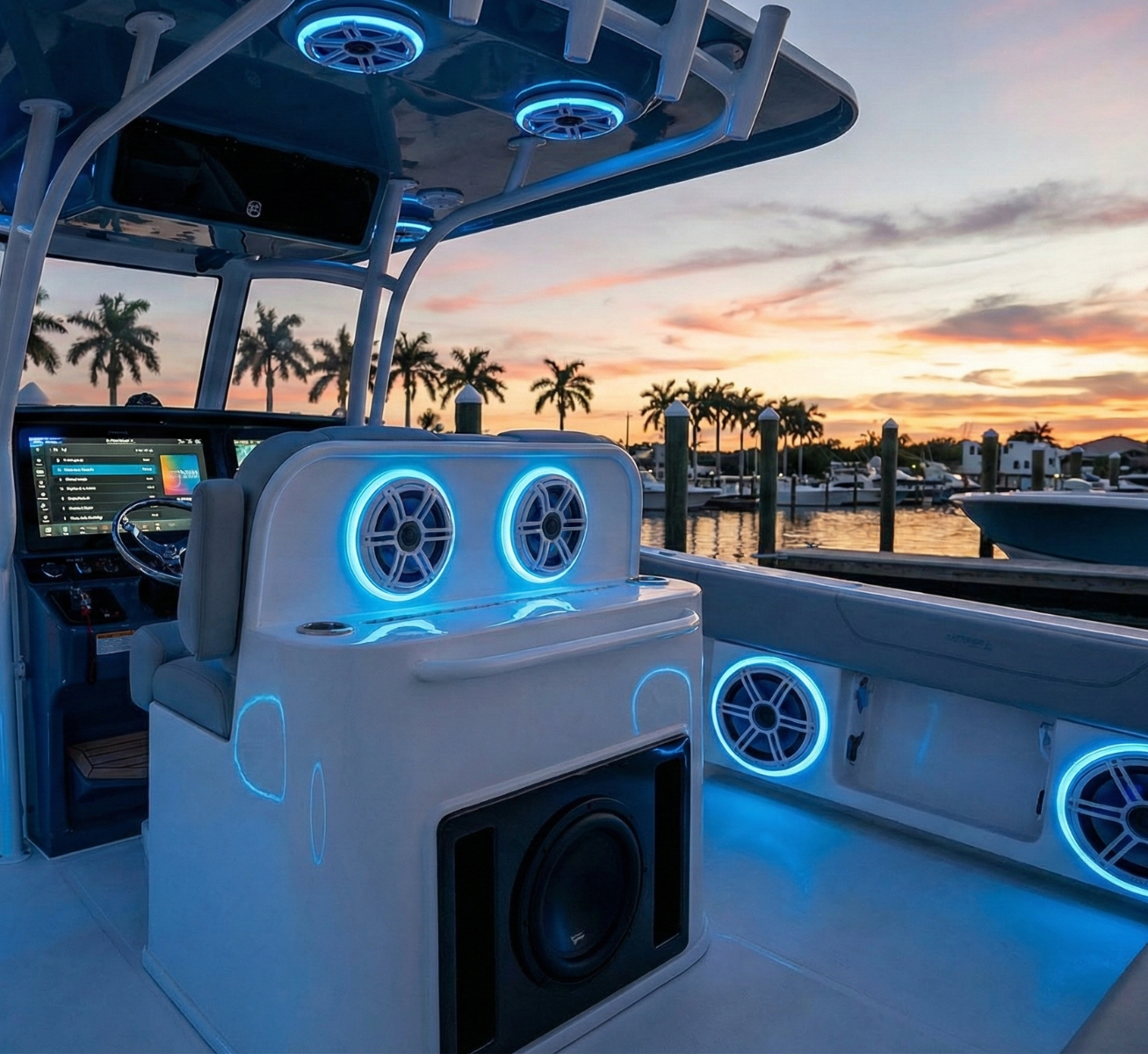
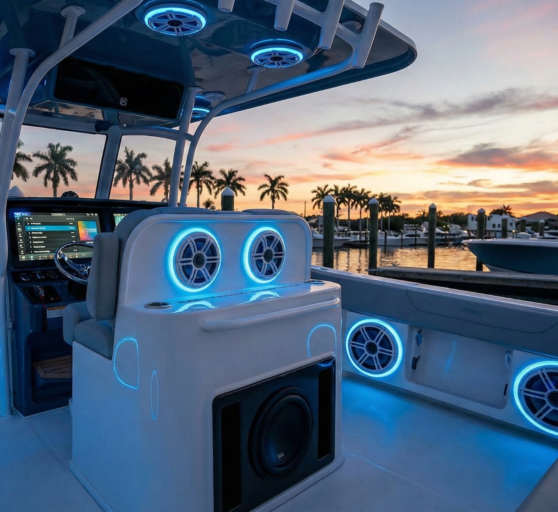
- Tower or wake speakers: projection over long distances, which demands serious amplifier power.
Choosing the source unit
A dedicated marine stereo head unit is sealed against moisture, has a UV-resistant face and usually supports multiple zones, Bluetooth streaming and wired remotes. Many modern chartplotters can also control compatible audio systems, which saves dash space. If you plan to keep an existing unit, check how many zones and preamp outputs it offers, because that determines whether you can add amplifiers and subwoofers later without replacing it.
Power: amplifiers and batteries
Marine amplifiers are where real volume and clarity at speed come from. A head unit's built-in amplifier is fine for a pair of cockpit speakers at moderate volume, but tower speakers and subwoofers need dedicated amplification. Class D amplifiers are the usual choice aboard because they are efficient and run cooler, which matters in tight, poorly ventilated compartments.
More amplifier power means more current. A large system can draw 30 amps or more at high volume, so the batteries and charging system must be considered. Many owners add a dedicated audio battery with a battery isolator or combiner, so a long afternoon of music at anchor never leaves the engine unable to start. Fusing each power run close to the battery is not optional; it protects the wiring from fire if a cable chafes through.
Speakers and placement
Marine speakers use polypropylene or treated cones, rubber surrounds and corrosion-resistant hardware so they survive spray and sun. Placement matters as much as brand. Speakers should be aimed toward the listening area, mounted where they will not be kicked or stepped on, and installed in enclosures or panels that are sealed from the hull cavity so bass does not disappear into the bilge. A boat speaker replacement is also a good moment to check cutouts for rot or cracking and to reseal the mounting flanges against water intrusion.
Wiring that survives salt air
Most failures in boat audio installation come from wiring, not components. Bare copper wire corrodes from the inside out, turning green and increasing resistance until a speaker goes quiet or an amplifier cuts out. Tinned copper marine-grade wiring, adhesive-lined heat-shrink connectors, proper strain relief and secured cable runs away from bilge water and moving parts keep the system reliable. Clean routing also makes future troubleshooting far easier.
Tuning the system
Once everything is installed, DSP tuning is what makes the system sound balanced rather than simply loud. A digital signal processor lets the installer set crossovers, adjust equalization for each zone, time-align speakers at different distances and set gain properly so amplifiers do not clip. A well-tuned system at 70 percent volume often sounds clearer than an untuned one at full blast, with less risk of blown speakers.
What owners can check before a consultation
- Take photos of the dash, existing speakers, and any spaces where a subwoofer or amplifier might fit.
- Note your battery setup and whether you have a separate house battery.
- Decide on the sources you use: phone streaming, satellite radio or onboard media.
- List any lighting you want synced with the audio.
If you are searching for boat stereo installation near me, those photos and notes let an installer suggest a layout before any work begins. You can see how we plan and tune systems on our marine audio and boat stereo installation page. A thoughtful boat stereo installation or full marine audio installation should leave the wiring as tidy as the finished dash.
Boat stereo FAQ
Can I use car audio equipment on a boat?
It is not recommended. Car components are not sealed against moisture or rated for UV and salt exposure, so they tend to corrode and fail within a season or two.
Will a bigger system drain my batteries?
It can at anchor. A dedicated audio battery with an isolator or combiner protects the starting battery.
Do I need a subwoofer on an open boat?
Not always, but open decks lose bass quickly, so a compact marine subwoofer often makes music sound fuller at moderate volume.