
Most owners never think about the rubber valves hidden inside their exhaust system until an engine fills with water. On stern drive boats, exhaust flappers and shutters act as one-way valves that let exhaust gases out but stop seawater from rushing back in. They are inexpensive parts, yet when they fail the consequences can include a bent connecting rod or a ruined engine. This guide explains how they work, how they fail and what inspection involves.
Why Stern Drives Need Them
On stern drive boats, exhaust typically exits through the drive or through the transom, close to the waterline. When the boat is running, pressure keeps water out. But when you chop the throttle, back down hard, or a following sea catches the stern, a surge of water can push back into the exhaust. This is called water reversion. Without working valves, that water can travel up through the Y-pipe and exhaust elbows and into open exhaust valves, and from there into the cylinders.
What Hydrolock Means
Water does not compress. If a cylinder contains enough water when the piston rises, the engine stops abruptly, which is called hydrolock. Best case, it will not crank until the water is removed. Worst case, a connecting rod bends or breaks. Smaller amounts of water cause rust inside cylinders, milky oil and gradual damage that may not show up for weeks.
Types of Valves
- Flappers: rubber valves fitted in the exhaust pipes or Y-pipe outlets, common on many stern drives; MerCruiser exhaust flappers are a familiar example
- Exhaust shutters: valves mounted deeper in the exhaust path, often in the transom assembly or exhaust bellows
- Bellows-mounted flappers: on some systems the flapper sits within the exhaust bellows between the transom and the drive
How They Fail
Rubber exhaust valves live in a hot, wet environment. An engine that has overheated, even briefly, can harden, crack or melt them. Age alone makes them stiff. Common failures include:
- Cracked or torn flaps that no longer seal
- Flappers that have come loose and fallen down into the Y-pipe
- Melted rubber from an overheating event, sometimes blocking exhaust flow
- Corroded mounting points and loose fasteners
A missing flapper has not simply disappeared. It is usually lodged lower in the exhaust, where it can restrict flow and raise back pressure.
Warning Signs
- Milky or rising oil level, a sign of water in the crankcase
- Rough running or misfire on one cylinder after a hard stop or reversing
- Rust on spark plugs or water on plug tips
- Louder or raspier exhaust note than usual
- Any past overheating event, even if the engine seemed fine afterward
What Inspection and Replacement Involve
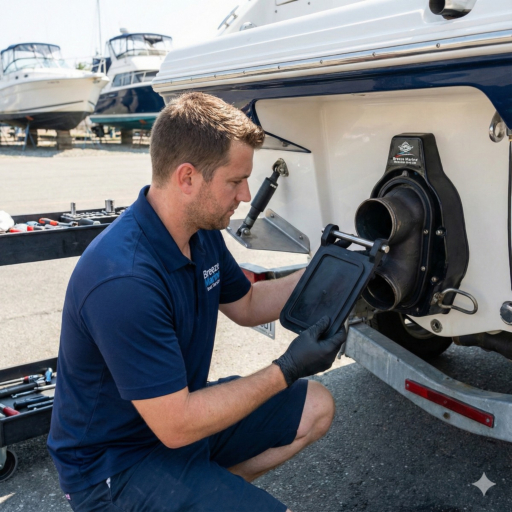
A shutter inspection depends on the engine and drive. On some setups, the technician can reach the flappers by removing the exhaust elbows or risers and looking down into the Y-pipe. On others, the drive must be removed to reach the shutters and bellows. During exhaust flapper replacement, old rubber pieces are retrieved, mounting holes and fasteners checked, and new valves installed with correct orientation. This is also a good time to inspect risers, gaskets and elbows for internal corrosion and to check the bellows for cracks.
If the Y-pipe itself is corroded or damaged, exhaust y-pipe repair or replacement may be needed so the new flappers have a sound surface to seal against.
How to Reduce the Risk
- Avoid chopping the throttle to idle in a following sea; ease off gradually
- Back down gently, especially with the transom low in the water
- Treat any overheat as a reason to inspect the exhaust valves
- Check oil level and color regularly for any sign of water
- Include exhaust valves in your periodic maintenance inspection
When to Call a Technician
If you see milky oil or water on plugs, do not keep cranking the engine. Water in the cylinders needs to be removed properly and the oil changed promptly to limit internal rust. Book an inspection after any overheat, when the boat is new to you, or if nobody can tell you when the boat exhaust flappers were last checked. Our exhaust flapper and shutter service for stern drives covers San Pedro, Long Beach and Los Angeles County.
Exhaust Flapper FAQ
How often should exhaust flappers be replaced?
There is no single interval. Inspect them periodically and after any overheating, and replace them when they are hard, cracked or deformed.
Can I tell if a flapper is missing without taking things apart?
Not reliably. Symptoms such as water in the oil suggest a problem, but a visual inspection is the only way to confirm.
Can water get in even with good flappers?
Yes, from other causes such as a failed riser gasket or cracked manifold. Flappers are one layer of protection, not the only one.


