
Most owners only worry when the temperature gauge climbs. Yet the small valve that decides how warm your engine runs, the thermostat, can fail in two directions. A valve that sticks closed pushes the engine toward marine engine overheating, while one that sticks open leaves it running too cool, wasting fuel and building up carbon and moisture. This guide explains how a marine thermostat works, which symptoms point to it, what you can check at the dock and when the job belongs with a technician.
What the Thermostat Does on a Boat Engine
The thermostat sits in the thermostat housing, usually at the front or top of the engine, and keeps water inside the block until the engine reaches operating temperature. A wax pellet expands as it warms and opens the valve, sending hot water toward the exhaust manifolds or heat exchanger and letting cooler water in behind it. On a raw-water-cooled engine it meters seawater directly; on a closed-cooled engine it controls antifreeze that is then cooled by seawater in the heat exchanger.
Many raw-water-cooled engines use a lower-rated thermostat, often around 140 to 145 degrees F, because seawater drops salt and scale faster when it runs hot. Closed-cooled engines typically run warmer, around 160 degrees F. Confirm the correct rating in your engine manual, since the wrong part can mimic a failed one.
Stuck Closed: The Overheating Side
When the valve cannot open fully, hot water stays trapped in the block. Typical signs of a stuck thermostat on the closed side include:
- The gauge climbs steadily after warm-up and keeps rising under load.
- The overheat alarm sounds even though the raw water pump and impeller were recently serviced.
- Water flow at the exhaust looks normal, yet the engine still heats up.
- The housing is much hotter than the hose leaving it.
On saltwater boats the usual culprit is corrosion: salt crystals and scale build up around the valve edge and spring until it can no longer move freely. Rubber from a broken impeller can also wedge the valve partly shut.
Stuck Open: The Engine Running Cold
An open valve is easy to miss because nothing alarms. The gauge sits low even after a long run, and you may notice a rough idle, poor fuel economy, sooty exhaust or milky residue under the oil cap. Over a season, an engine running cold wears faster because the oil never gets hot enough to drive off moisture.
Thermostat or Impeller? Reading the Pattern
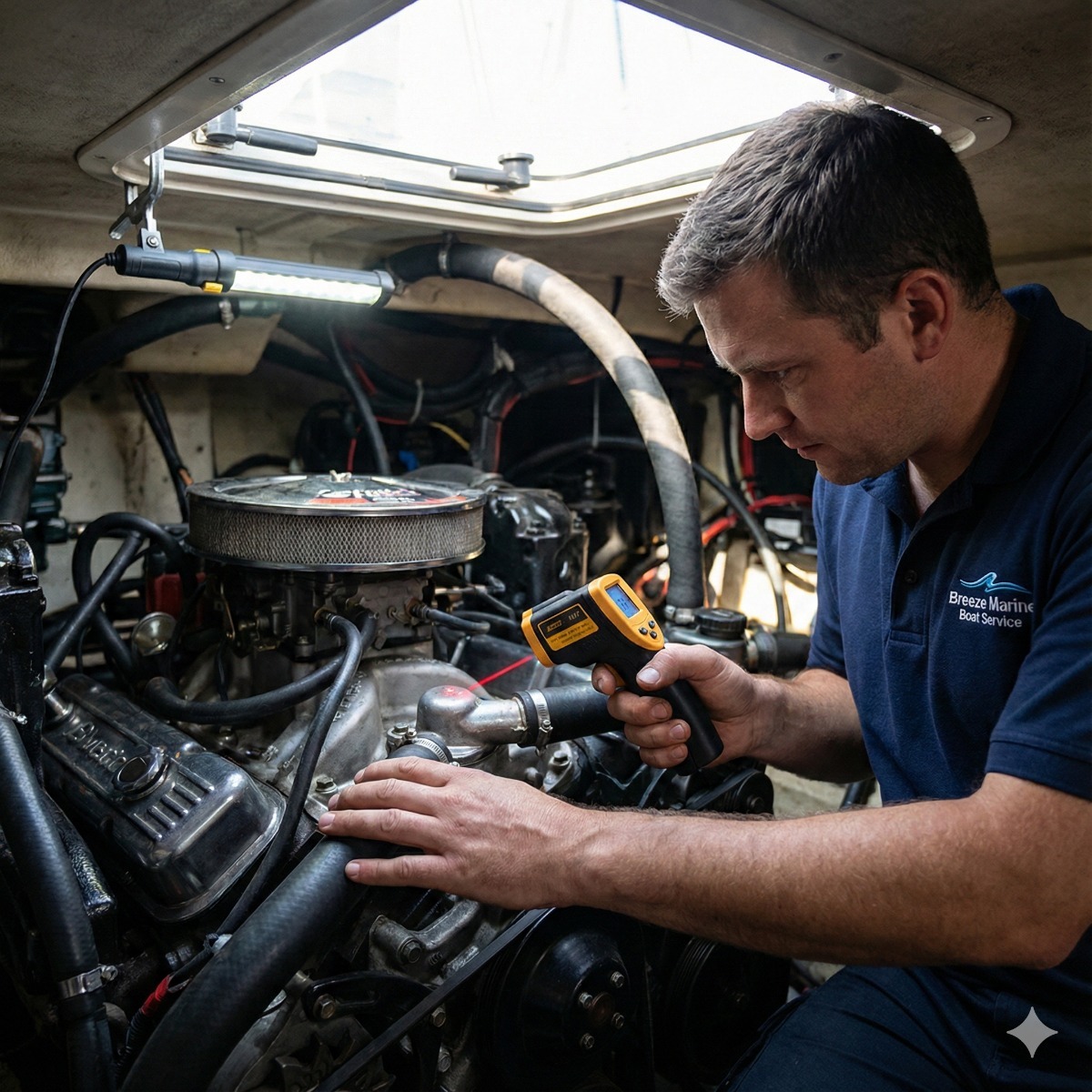
Not every hot gauge is a thermostat problem. Boat overheating at idle that improves at cruising speed usually points to a weak impeller or worn pump, because the pump cannot move enough water at low RPM. A valve that is not opening tends to cause heat at every speed, often worse under load. A faulty temperature sender can mimic both, so compare the gauge with an infrared thermometer reading before buying parts.
What an Owner Can Check
- Water flow: with the engine running, confirm a steady stream at the exhaust outlet or telltale.
- Intake and strainer: clear weed, shells or plastic before blaming the thermostat.
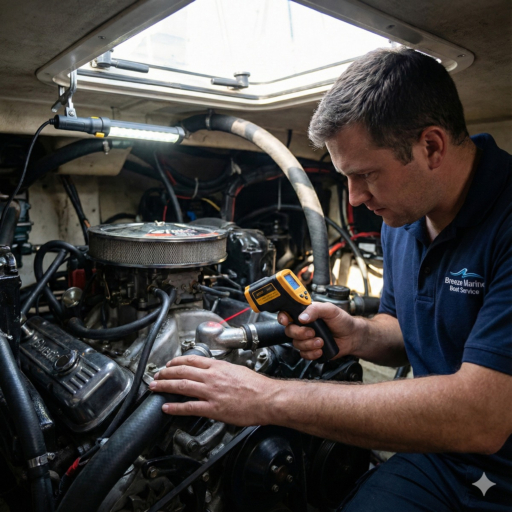
- Temperature spread: after warm-up, use an infrared thermometer on the thermostat housing, the outlet hose and the manifolds. A cool outlet hose on a hot engine suggests a valve that is not opening.
- Coolant level: on closed-cooled engines, check the reservoir only when cold. Never open a hot pressure cap.
What Thermostat Testing Involves
Proper thermostat testing takes the part off the engine. The cover comes off, the bore is inspected for corrosion and the thermostat goes into a heated water bath with a thermometer to see when it starts to open and when it is fully open. A unit that opens late, opens only partway or fails to close as the water cools should be replaced, and the mating surfaces are cleaned and fitted with fresh gaskets, since a reused gasket is a common source of seawater leaks.
Marine thermostat replacement is a modest job on most engines, but it rarely makes sense on its own. The same visit is the right time to look at the impeller, belts, hoses and coolant age. If you would rather have the whole loop checked at once, a marine cooling system service covering the impeller and thermostat looks at the pump, the thermostat and the water flow together.
How Often to Service the Thermostat
A common guideline for recreational boats is to renew the thermostat about every three years or 300 hours, sooner on engines that work hard in warm salt water. On closed-cooled engines, pair it with a coolant flush, since old antifreeze loses its corrosion inhibitors and lets scale form inside the block.
When to Call a Technician
Call for help if the gauge keeps rising and you cannot find a blocked strainer or weak flow, if the engine runs cool all season, or if the cover bolts are seized with corrosion. Older aluminum housings can crack or strip threads when forced. Repeated heat also stresses head gaskets, exhaust hoses and risers, so early diagnosis costs far less than the damage it prevents.
Thermostat FAQ
Can I run my boat without a thermostat?
It is not a good idea. The engine runs cold, and on some designs water takes the bypass instead of the block, creating hot spots. Removing it to cure overheating hides the real cause.
How do I tell a stuck thermostat from a worn impeller?
Watch when the heat appears. Heat mostly at idle points toward the impeller; heat at every speed and under load points toward a valve that is not opening.
Does salt water shorten thermostat life?
Yes. Salt and scale collect on the valve and spring, especially on raw-water-cooled engines, so boats kept in salt water should expect to renew the thermostat more often.