If your engine fires straight up on a warm afternoon but grinds and coughs every morning, the choke is a prime suspect. The same goes for an engine that starts fine but blows smoke and loads up once warm. Carbureted boat engines still power a huge number of inboards, sterndrives and older outboards, and the choke is one of the simplest parts of the fuel system. Because it is simple, it is also easy to overlook, and a few minutes of inspection can save a lot of cranking.
What the Choke Does
A cold engine needs a richer mixture to start because fuel does not vaporize well on cold metal. The choke is a valve at the top of the carburetor that partially closes the air intake when cold, increasing the proportion of fuel. As the engine warms, the choke opens gradually until it is fully open at operating temperature. At the same time, a fast-idle cam holds the throttle slightly open so the cold engine idles faster and does not stall.
Types of Choke Systems
Most marine engines use an automatic choke of one of two types:
- Electric choke. A bimetal spring in a housing is warmed by an electric heating element powered when the ignition is on. As it heats, the spring relaxes and lets the choke open.
- Thermal choke. The spring is warmed by engine heat, either directly from the manifold or through a heat tube.
Some older engines and many small outboards use a manual choke or an enrichment circuit instead. The principles are the same even if the hardware differs.
Symptoms of Choke Problems
Choke stuck open or opening too early
- Engine is hard to start when cold and may need repeated attempts.
- Stalls shortly after starting or when shifting into gear before warming up.
- Stumbles on acceleration while cold.
Choke stuck closed or opening too slowly
- Engine starts but runs rough and rich as it warms.
- Blowing black smoke, strong fuel smell and fouled spark plugs.
- Poor fuel economy and high idle that does not settle.
Why Chokes Misbehave on Boats
The marine environment is hard on small linkages. Salt air corrodes the pivots and shafts so the valve binds. Old varnish and carbon build up around the choke shaft. Electric elements burn out or lose their power feed through corroded connectors. Springs weaken with age and heat, and adjustment can drift if the housing was loosened during other work.
What Owners Can Check
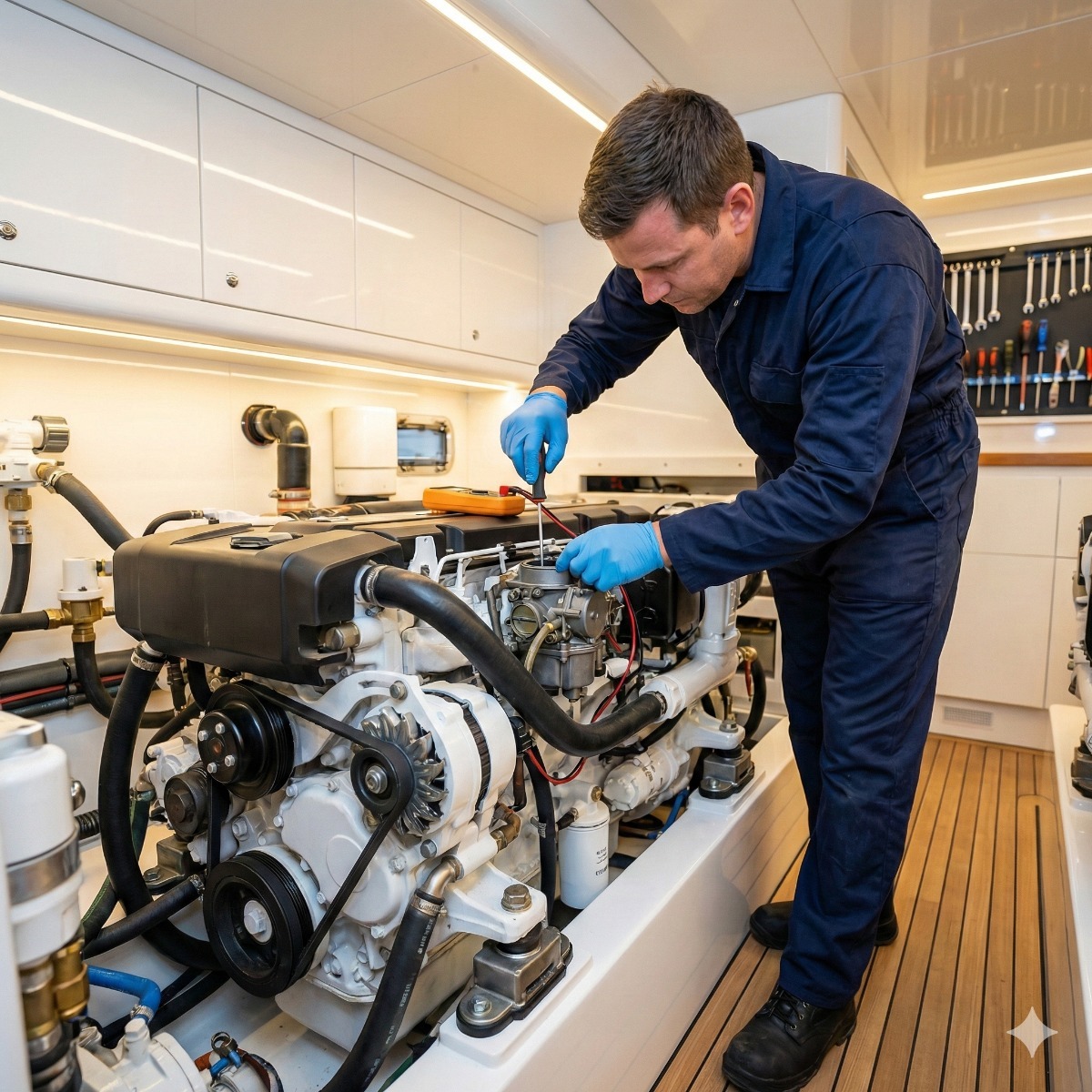
With the engine cold and off, remove the flame arrestor and look at the valve at the top of the marine carburetor. On most automatic chokes it should be closed or nearly closed when the engine is cold. Opening the throttle once usually allows it to snap to its cold position.
- Gently move the valve by hand; it should move freely without sticking.
- Start the engine and watch: the valve should open gradually over a few minutes, not instantly and not stay shut.
- On electric chokes, check the wire and connector at the housing for corrosion or breakage.
- Look for bent or disconnected linkage rods.
Keep hands clear of the carburetor throat and never start the engine without the flame arrestor in place for more than a quick observation, as backfires can occur. On inboards, run the blower before starting.
What Choke Service Involves
A proper choke system adjustment begins with the engine completely cold. The technician checks the closing angle of the choke plate, confirms that the heating element or heat source works, and cleans and frees the shaft and linkages. The housing is set against its index marks to the specification for that carburetor, and the pull-off, which opens the choke slightly once the engine fires, is checked with gauges. The fast-idle speed is then adjusted so the engine idles at the correct elevated speed when cold and returns to normal idle as it warms. Electric choke repair may involve replacing the element or the whole thermostatic housing.
Related Causes to Rule Out
Not every cold start problem is the choke. Stale fuel, a weak accelerator pump, a leaking float needle, ignition issues and low battery voltage can all produce similar symptoms, which is why the whole picture matters.
When to Call a Technician
Book service if the choke is seized, the engine floods or smokes heavily, you smell fuel in the engine compartment, or adjustment does not solve the problem. Our choke system adjustment and repair service covers electric and thermal systems and fast-idle calibration.
Choke Problems FAQ
Can I just leave the choke wired open?
That makes cold starting harder and can cause stalling at the dock. Fixing the choke is safer and easier on the starter.
Why does my engine smoke only when warm?
A choke that stays closed too long keeps the mixture rich after warm-up. Checking its opening is a good first step.
Does a fuel-injected engine have a choke?
No. Fuel injection adjusts the mixture electronically, so cold starting problems there have different causes.