Many cruising boats heat their cabins with the same unit that cools them in summer. Reverse cycle systems are efficient and convenient, but they have one component that gets little use for much of the year and tends to protest when it is suddenly called on. If you switch to heat on a chilly evening and find the boat heater blowing cold air, the fault usually lies in a small number of places. This guide explains how the system works, what fails and what you can safely check.
How Reverse Cycle Heating Works
In cooling mode, refrigerant absorbs heat from the cabin air at the evaporator coil and rejects it into seawater at the condenser. To heat, the system reverses the refrigerant flow so the cabin coil becomes the hot side and heat is extracted from the seawater instead. Even cool seawater contains usable heat energy. The component that reverses the flow is the reversing valve, a four-way valve with an internal slide moved by refrigerant pressure and controlled by an electric solenoid coil.
Marine heat pumps have a practical limit. As seawater gets colder, less heat is available and output drops. In very cold water, typically below the mid-forties Fahrenheit, many systems struggle and may shut down on low-pressure protection. That is a limitation of the technology, not necessarily a fault.
Common Reasons for Cold Air in Heat Mode
Stuck reversing valve
After months in cooling mode or sitting unused, the internal slide can stick in one position. A stuck reversing valve leaves the unit cooling no matter what the control says. Sometimes it frees itself after the system runs; sometimes it needs specialist technique, and occasionally replacement.
Reversing valve solenoid problems
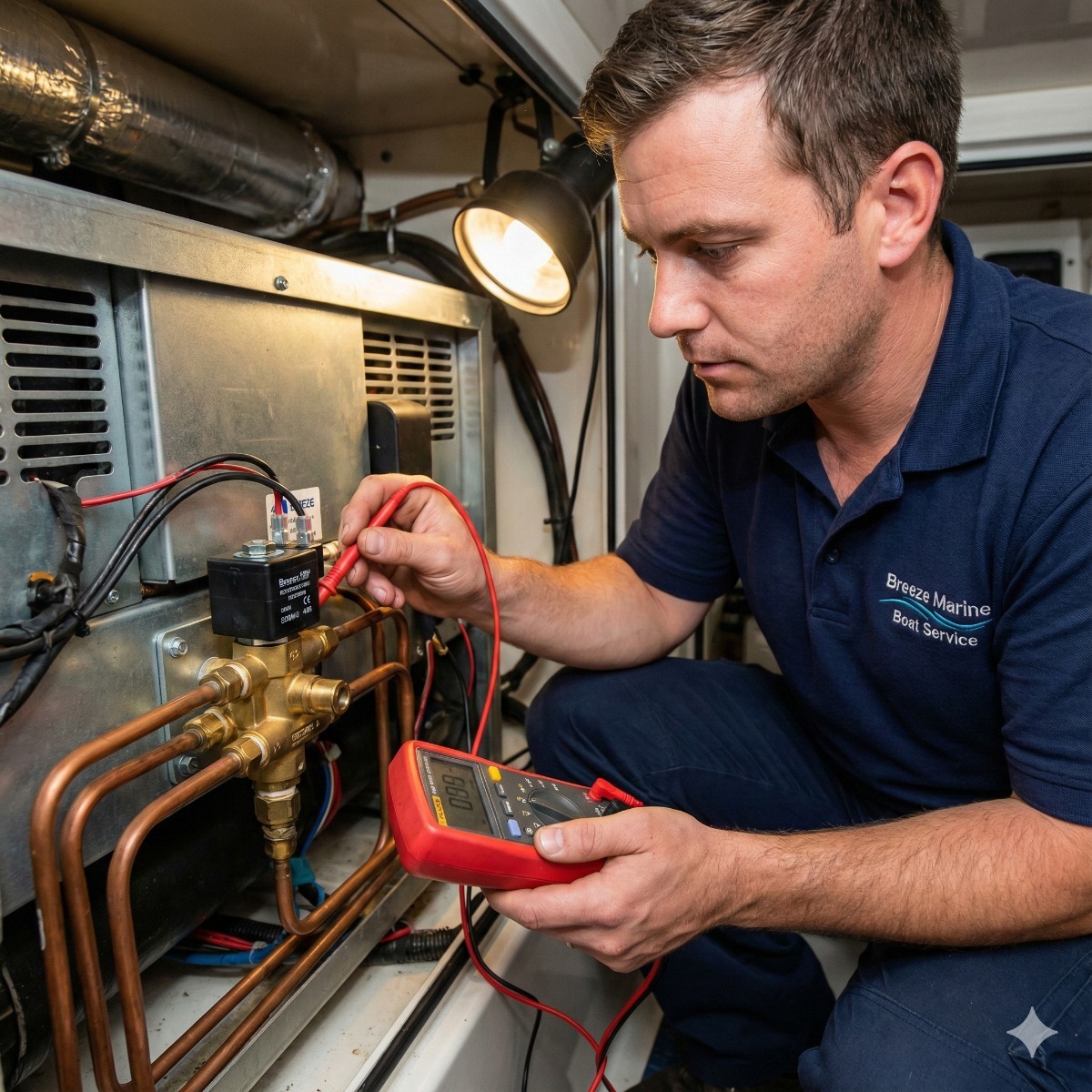
The valve only shifts when its coil is energized, on most systems in heat mode. A burnt coil, a broken wire, a corroded connector or a control that is not sending voltage all produce the same symptom. When switching to heat, you can often hear a distinct click or whoosh as the valve changes over. No sound is a useful clue.
Water flow problems
In heat mode the seawater side is where heat is collected. A clogged strainer, fouled intake, air-locked or failing pump or a scaled condenser coil reduces flow, and the unit may frost up and trip on low pressure.
Sensor and control issues
If the ambient air sensor is mounted near a cold hull side, a draft or a hatch, the control may think the cabin is warm enough and stop calling for heat. Incorrect control settings, such as a mode set to cool only, are also surprisingly common.
What Owners Can Check
- Confirm the control is set to heat or automatic, with a set point above cabin temperature.
- Check the seawater strainer and clean it. Confirm there is a steady discharge of water overboard.
- Clean or replace the return air filter; a clogged filter reduces airflow across the coil.
- Listen for the click of the valve when switching modes.
- Check the breaker for both the unit and the seawater pump.
- Note any fault codes shown on the display and look them up in the manual.
Do not open refrigerant lines or try to free a valve by striking it. Refrigerant work requires proper equipment and handling.
What a Technician Does
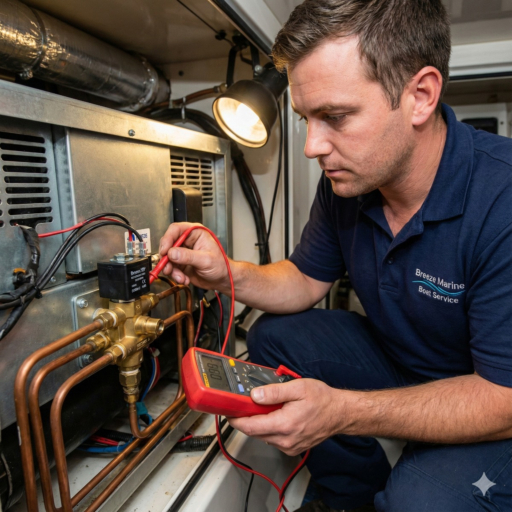
Systematic reverse cycle heating troubleshooting starts with electrical checks: verifying that the control sends voltage to the coil in heat mode and measuring coil resistance. If the coil and signal are good, the technician measures refrigerant pressures and temperatures to confirm whether the valve is shifting. A sticking valve can sometimes be freed using pressure differentials; if not, it is replaced, which requires recovering and recharging refrigerant. Water flow, pump performance and coil condition are checked at the same time, and sensor placement is corrected where needed. Thorough boat heat pump troubleshooting looks at the whole system rather than a single part.
Seasonal Habits That Help
- Run the system in heat mode briefly every few weeks during the cooling season so the valve moves.
- Keep strainers clean and have the condenser coil descaled when output drops.
- Service filters regularly for both heating and cooling performance.
When to Call a Technician
Call for help if basic checks do not restore heat, if the unit trips repeatedly, ices up or smells burnt, or if you suspect a refrigerant leak. Since the same unit provides your marine air conditioning, a proper fix protects summer comfort too. Our reverse cycle heating troubleshooting service covers marine HVAC repair from valves and coils to water flow. The same diagnostic approach applies to boat air conditioning repair.
Reverse Cycle FAQ
Why does my unit heat for a while and then blow cold?
Often low seawater flow or very cold water causes the unit to frost and trip. Check the strainer and pump first.
Is a burnt valve coil expensive to fix?
A coil is usually a simpler repair than the valve itself because it is electrical and does not require opening the refrigerant circuit.
Can I heat my boat in winter with reverse cycle?
Yes, in moderate seawater temperatures. In very cold water, output drops and a different heat source may be needed.