Few moments on the water are more stressful than an engine that dies just as you shift into gear near the dock. Without power, you lose steering and control at the worst possible time. Stalling at the dock is a common complaint on carbureted inboards and sterndrives, and it usually comes down to a few related adjustments rather than a major mechanical failure.
Why engines stall in gear
At idle in neutral, the engine only has to overcome its own internal friction. When you shift into gear, the propeller suddenly bites into the water and adds a heavy load. The engine speed drops, sometimes by 100 to 200 RPM. If the idle was already set low, or the fuel mixture is marginal, that sudden load is enough to stop it. This is why a boat dies when put in gear even though it seemed to idle normally a moment earlier.
The main causes
- Idle speed set too low: the engine has no reserve to absorb the load of the propeller.
- Lean idle mixture: not enough fuel at idle makes the engine weak and hesitant under sudden load.
- Rich idle mixture: too much fuel causes a rough idle, a raw fuel smell and fouled spark plugs.
- Incorrect ignition timing: retarded timing reduces power at low speed, making the engine more likely to stall.
- Vacuum leaks: cracked hoses or leaking intake gaskets let unmetered air into the engine, making the mixture unstable.
- Dirty idle circuits: varnish from old fuel can partially block tiny passages in the carburetor.
- Shift cable adjustment: a misadjusted cable can cause hard engagement and a sudden load spike.
What owners can check first
Before adjusting anything, rule out simple causes.
- Make sure the engine is fully warmed up; many carbureted engines idle poorly when cold.
- Confirm the choke is fully open when warm.
- Check the flame arrestor for dirt or oil that could restrict airflow.
- Look for cracked or disconnected vacuum hoses.
- Inspect the fuel filter and water separator for contamination.
- Use fresh fuel, especially after storage, since old fuel can cause a rough idle and stalling.
How professional tuning works
Proper idle speed and mixture optimization follows a sequence, because each adjustment affects the others.
Warm-up and baseline
The engine is brought to full operating temperature, and the fast-idle cam is released. Tuning a cold engine gives misleading results.
Ignition timing
Ignition timing is checked with a timing light and set to the manufacturer's specification. Carburetor adjustments are pointless if timing is wrong.
Mixture balancing
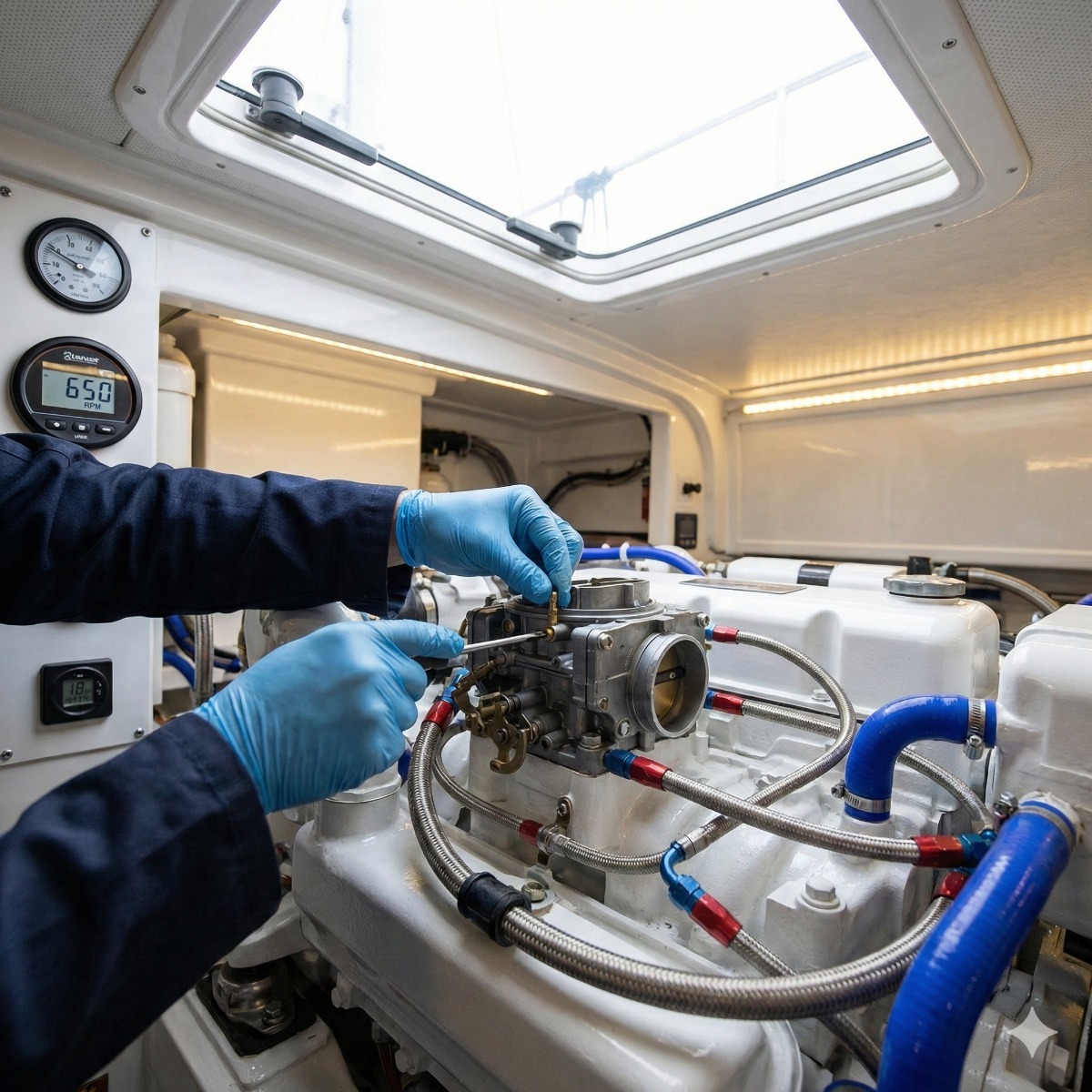
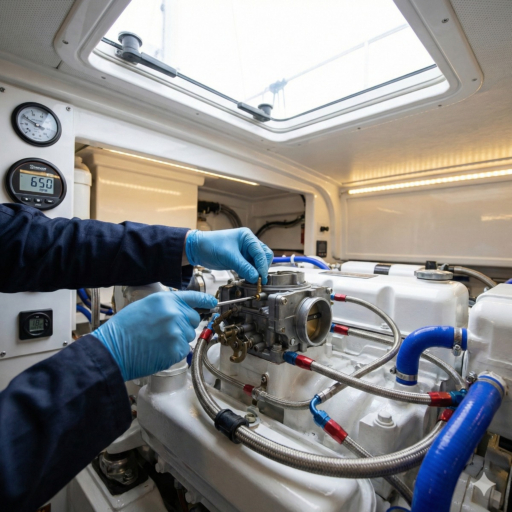
With a vacuum gauge connected to the intake manifold, the technician slowly turns the idle mixture screws to find the highest, steadiest vacuum reading. This vacuum gauge tuning is more precise than adjusting by ear. On carburetors with more than one mixture screw, each is balanced for a smooth idle.
In-gear idle setting
The final boat idle speed adjustment is made with the boat in the water and in gear, because that is when the engine carries a real load. Idle speed is set so the engine runs smoothly and does not stall or clunk when shifting. Typical in-gear idle speeds are lower than neutral idle, but the exact target depends on the engine and drive.
Why not just turn up the idle?
Raising the idle speed may stop the stalling, but it can create other problems: harsh shifting, higher wear on the shift mechanism and a boat that moves too quickly at idle in tight marinas. A correct air-fuel mixture adjustment and verified timing usually allow the engine to idle smoothly at a normal speed while still handling the load of shifting into gear.
When tuning is not enough
If the engine still stalls after correct timing and carburetor adjustments, the cause may be deeper: worn ignition components, low compression, a failing fuel pump or a carburetor that needs cleaning or rebuilding. A tune-up visit that includes these checks helps pinpoint the problem. You can read how we approach this work on our idle speed and mixture optimization service page.
Idle and stalling FAQ
Why does my engine smell of raw fuel at idle?
The idle mixture is probably too rich. Excess fuel wastes gas, fouls spark plugs and produces strong fumes.
Can I adjust the idle mixture screws myself?
Small adjustments are possible with the engine fully warm, but without a vacuum gauge and timing check it is easy to make the problem worse.
Does this apply to fuel-injected engines?
Not directly. Fuel-injected engines control idle electronically, so stalling points to sensors, idle air control or fuel pressure issues instead.