
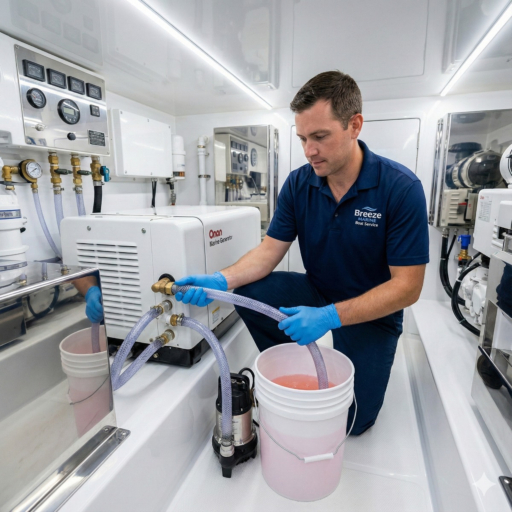
A generator that starts easily, carries the load for twenty minutes and then shuts itself down with a high temperature alarm is one of the most familiar complaints from owners who rely on air conditioning at the dock. The cause is usually on the cooling side, and in many cases it is mineral scale hiding inside the heat exchanger. This guide walks through how generator cooling works, why scale forms, what you can check yourself and what a professional descaling involves.
How the Raw Water Cooling System Works
Most marine generators use two cooling circuits. A closed freshwater circuit filled with coolant circulates through the engine block, much like a car engine. That coolant then passes through the heat exchanger, a bundle of small tubes inside a shell. On the other side of those tubes, the raw water cooling system draws seawater through a seacock and strainer, pushes it through the tubes with a rubber impeller pump and discharges it with the exhaust. The seawater carries heat away from the coolant without the two ever mixing.
Why Scale Builds Up
Seawater contains dissolved calcium and other minerals. When it is heated inside the exchanger, some of those minerals drop out of solution and bake onto the tube walls as a hard, chalky layer. Warm water temperatures, long run times at high load and seawater sitting still in hot tubes after shutdown all speed up the process. Scale is a poor conductor of heat, so even a thin coating makes a difference, and a thick one narrows the tubes until flow drops as well.
Pieces of a failed impeller, shell fragments and marine growth can also lodge at the inlet end and create a clogged heat exchanger that blocks several tubes at once.
Signs Your Generator Is Losing the Cooling Battle
- It runs cool at light load but overheats when the air conditioning or water heater kicks in.
- Temperature climbs steadily over the first 15 to 30 minutes instead of settling.
- Exhaust water flow looks weaker than it used to, or there is more steam at the outlet.
- The problem gets worse in summer, when seawater is warmer.
- A new impeller and a clean strainer did not solve it.
Any of these point toward marine generator overheating caused by poor heat transfer rather than a faulty sensor.
What an Owner Can Check First
Before assuming scale, rule out the simple causes. With the generator off and cool:
- Confirm the seacock is fully open.
- Remove and clean the raw water strainer basket.
- Inspect the impeller for missing or cracked vanes. If pieces are missing, they have probably traveled downstream toward the exchanger.
- Check the coolant level in the expansion tank only when the engine is cold. Opening a hot cooling system can cause serious burns.
If all of that checks out and the overheating continues, the heat exchanger is the next suspect.
What a Heat Exchanger Flush Involves
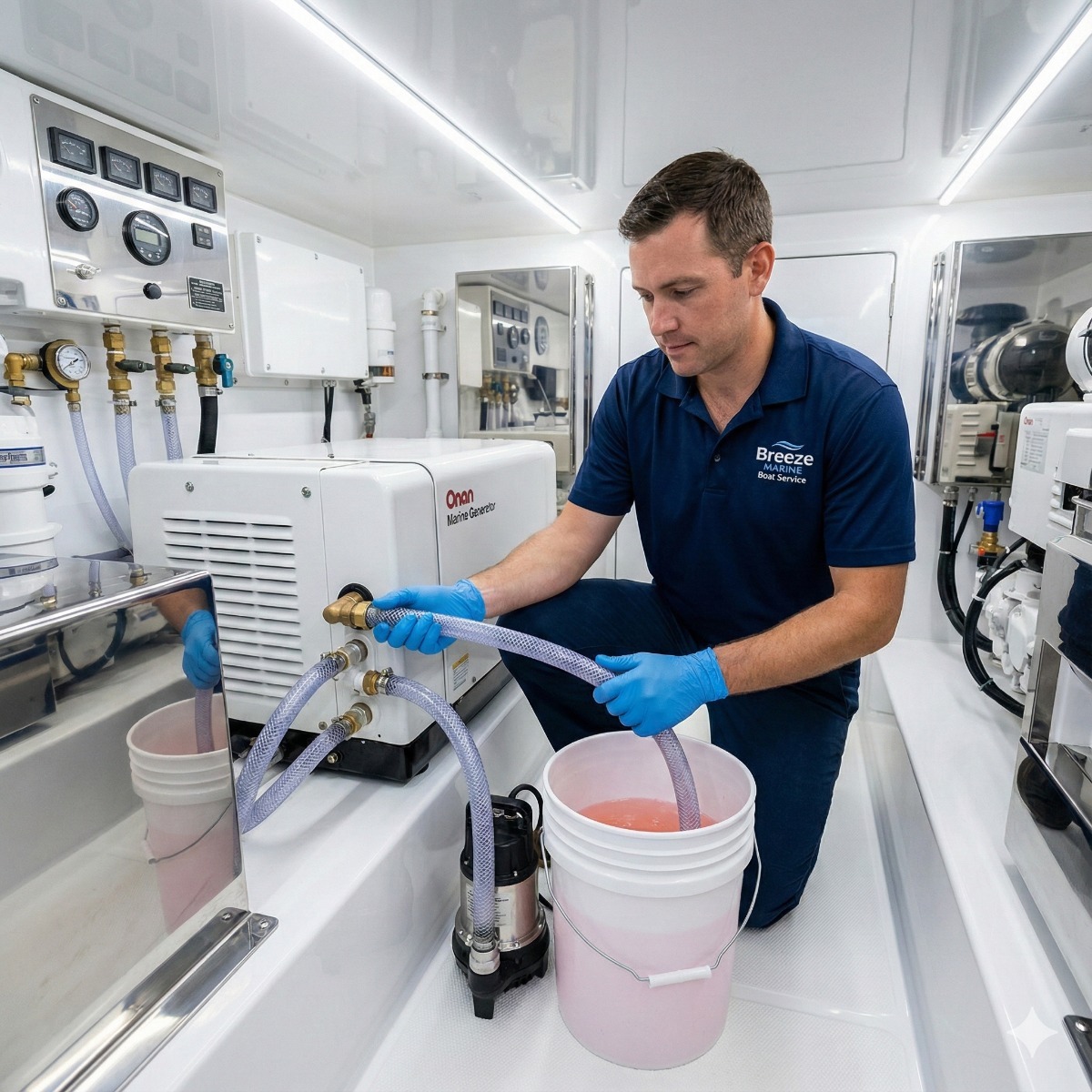
A heat exchanger flush uses a descaling solution designed to dissolve calcium deposits without attacking copper, bronze or rubber. The raw water side is isolated from the sea, the impeller is bypassed so the chemical cannot harm it, and the solution is pumped in a loop through the exchanger until the reaction slows. The system is then rinsed thoroughly with fresh water. Because the work is done in place, there is no need to pull the exchanger or open the coolant side. Many exchangers also carry a sacrificial zinc, and it makes sense to renew it while the system is apart.
Generator heat exchanger descaling is not the same as mechanical generator heat exchanger cleaning, where the end caps come off and the tubes are rodded out. Rodding clears debris and heavy blockages but can damage thin tubes, so chemical descaling is often the gentler first step. Neither method repairs a leaking or badly corroded exchanger; that calls for replacement.
Make Descaling Part of Marine Generator Maintenance
Scale returns over time, so descaling works best as part of routine marine generator maintenance rather than as an emergency fix. Noting the operating temperature under a known load gives you an early warning: if the reading creeps up season after season, the exchanger is losing efficiency. When you book marine generator service for impellers, belts or oil, mention any temperature changes so the cooling side gets attention too.
When to Call a Technician
If your generator still overheats with a fresh impeller, a clean strainer and good exhaust flow, it is time for a professional look. Descaling means isolating the raw water side, handling chemicals safely and verifying temperatures under full load afterward. Owners in Long Beach and nearby harbors can book our generator heat exchanger descaling service to restore cooling without removing the unit.
Generator Overheating FAQ
Can I descale a generator heat exchanger myself?
Owners with the right pump, fittings and descaler can, but it means isolating the raw water side, protecting the impeller and disposing of the spent solution properly. A mistake can leave chemical in the system or damage rubber parts, so many owners prefer to hand the job over.
How do I tell a clogged heat exchanger from a bad impeller?
Start with the impeller, because it is easier to inspect. If a new impeller and a clean strainer do not change the overheating pattern and exhaust water flow is still weak, the exchanger is the likely restriction.
How often should the heat exchanger be descaled?
It depends on run hours, water temperature and how the generator is used. Rather than following a fixed calendar, watch the operating temperature under load and descale when it starts to rise.