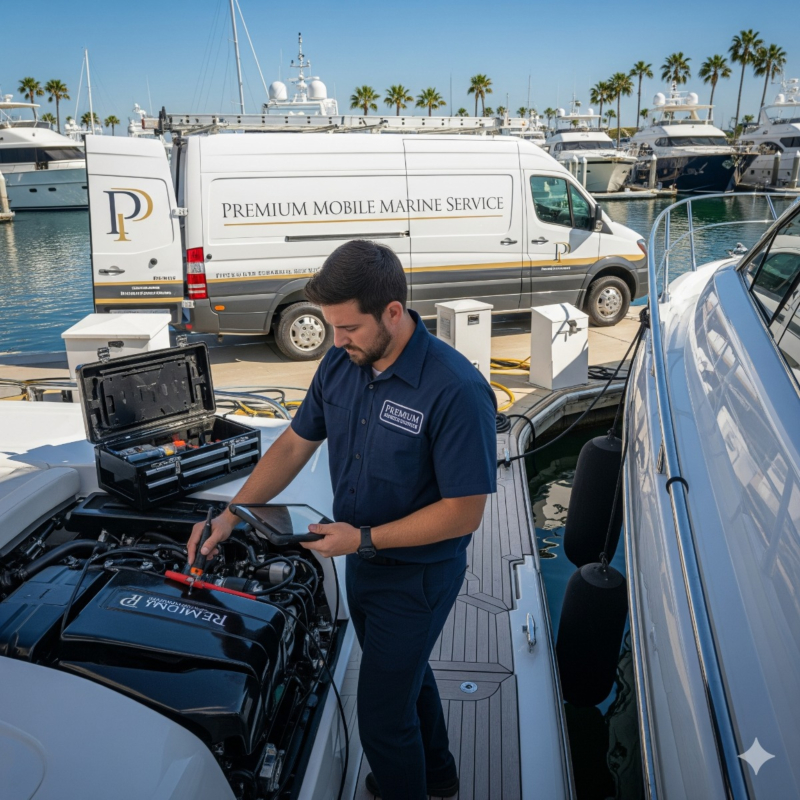

When an engine starts misbehaving, the most useful thing an owner can do is observe carefully. A technician can read fault codes and run tests, but the clues you collect on the water, such as when the problem started, under what load and what it sounded or smelled like, often shorten the diagnosis more than any tool. This guide explains what to record, what the common symptoms usually point to, and what to expect from the repair.
Write Down These Details First
Before you book any marine engine repair, make a short note with the following information. It takes five minutes and saves time at the boat.
- Engine make, model and hours: the hour meter and the model plate tell the technician which parts and procedures apply.
- When the problem appears: at start-up, at idle, at cruise, at full throttle, or only after the engine is warm.
- What changed recently: a fuel fill-up, a service, a grounding, a long lay-up or a new battery.
- Gauges and alarms: temperature, oil pressure, voltage and any warning lights or beeps, with the readings if you saw them.
- Sounds, smells and smoke: knocking, whining, a burning smell, or white, blue or black exhaust smoke.
Common Symptoms and Likely Causes
Hard starting or no start
Weak batteries, corroded connections and failing starters account for many no-start calls. If the engine cranks but will not fire, fuel delivery and ignition come next: a clogged filter, water in the fuel, a failed fuel pump or, on gasoline engines, a spark or ignition fault.
Loss of power or poor top speed
A fouled bottom or damaged propeller can mimic engine trouble, so rule those out first. On the engine itself, restricted fuel filters, dirty injectors, a sticking carburetor on older gasoline engines or a turbo problem on diesels are frequent causes.
Overheating
Most overheating traces back to the raw water side: a worn impeller, a blocked intake or strainer, a scaled heat exchanger or a failing thermostat. Continuing to run a hot engine risks warped heads and failed gaskets, so shut down and investigate.
Smoke from the exhaust
White smoke that smells sweet can mean coolant in the combustion chamber. Blue smoke indicates oil burning, often from worn rings or valve guides. Black smoke on a diesel usually means too much fuel for the air available, from a dirty air filter, an injector fault or an overloaded engine.
Knocking, vibration or new noises
Mechanical noises should never be ignored. They can come from something as simple as a loose mount or as serious as a failing bearing, and running the engine further can turn a repair into a rebuild.
Inboards, Outboards and Diesels Need Different Approaches
Inboard and outboard engines share the same basic principles but differ in access and in where problems hide. Inboard marine engines sit inside the hull, so exhaust risers, manifolds, engine mounts, shaft alignment and bilge conditions all come into play. Outboard motor repair more often involves the lower unit, water pump, trim and tilt, and fuel system components exposed to salt spray.
Larger boats and yachts frequently run diesels, and boat diesel repair focuses on clean fuel, correct air supply, injector condition, valve adjustment and cooling system health. A yacht engine service on twin diesels also includes generators and transmissions, which share the same cooling and fuel supply concerns. Owners searching for yacht engine repair should expect a technician to ask for maintenance records for all of these systems, not just the main engines.
How Diagnosis and Repair Usually Proceed
Good engine diagnostics follow a logical order: confirm the complaint, check the simple things (fuel, air, spark or compression, cooling, battery), read any stored fault codes on electronically controlled engines, and then test the suspect component rather than replacing parts on guesswork. If the problem only appears under load, a sea trial is often needed to reproduce it.
Once the cause is confirmed, the repair might be as simple as a filter and impeller or as involved as replacing a manifold, rebuilding a fuel system or opening the engine. Ask for the findings in writing and for any additional work to be quoted before it starts. For diagnosis and repair of inboards and outboards at the dock in Long Beach and San Pedro, see the professional marine engine repair service page.
When to Stop and Call for Help
Shut the engine down and get professional boat engine repair if you see an overheat alarm, a drop in oil pressure, fuel or oil in the bilge, heavy smoke, or hear a new knock. Carrying on to finish the day's trip is how a manageable fault becomes a major one.
Engine Trouble FAQ
Should I keep running an engine that is overheating?
No. Reduce throttle, shut down when it is safe and check the raw water flow and strainer. Repeated overheating can damage gaskets, heads and exhaust components.
Can I clear a warning light by restarting the engine?
Restarting may clear the light temporarily, but the fault code usually stays stored. Have it read so the underlying cause is found.
How often do marine engines need professional service?
Most manufacturers call for service every 100 hours or once a year, whichever comes first, with additional checks before and after the main season.