
A shore power cord looks like the simplest part of a boat's electrical system: one end goes into the dock, the other into the boat, and the lights come on. Yet that connection carries more current, for more hours, in a wetter and saltier place than almost anything else aboard. When it starts to fail, the first sign is usually heat. This guide explains why a hot shore power plug happens, what to look for, what you can safely check yourself, and when the job belongs to a marine electrician.
Why Shore Power Connections Overheat
Heat at a plug is resistance turning electricity into warmth instead of delivering it to your loads. On a boat, resistance builds up for a few predictable reasons:
- Corrosion on the blades. Salt air and moisture attack the plated contacts. Pitted metal touches its mate over a smaller area, so the same current is squeezed through less metal.
- Loose or worn contacts. Vibration, wakes and the weight of a cord hanging from the dock pedestal slowly loosen the connection, and the springs inside a socket lose tension over years of use.
- Partial insertion. A plug that is not fully seated and locked has only part of each blade in contact.
- Heavy continuous loads. Air conditioning, a water heater and a battery charger running together keep a connection close to its rating for hours at a time.
These causes feed each other. A little heat speeds up corrosion, corrosion adds resistance, and resistance makes more heat. That loop is why a warm plug tends to get worse rather than settle down, and why a browned or melted connector should be treated as a fire risk, not a cosmetic problem.
Warning Signs to Watch For
Most failing connections give plenty of notice if you know where to look:
- A plug body or cord end that feels warm after loads have been running for a while.
- Brown, black or melted plastic around the pins, at the boat end or at the pedestal.
- A cracked, stiff or chalky cord jacket, or tape wrapped over a damaged section.
- Lights that dim or an air conditioner that struggles when another load switches on.
- A breaker on the dock or an ELCI breaker on the boat that trips repeatedly.
- A faint burnt smell near the inlet or inside the locker behind it.
What an Owner Can Safely Check
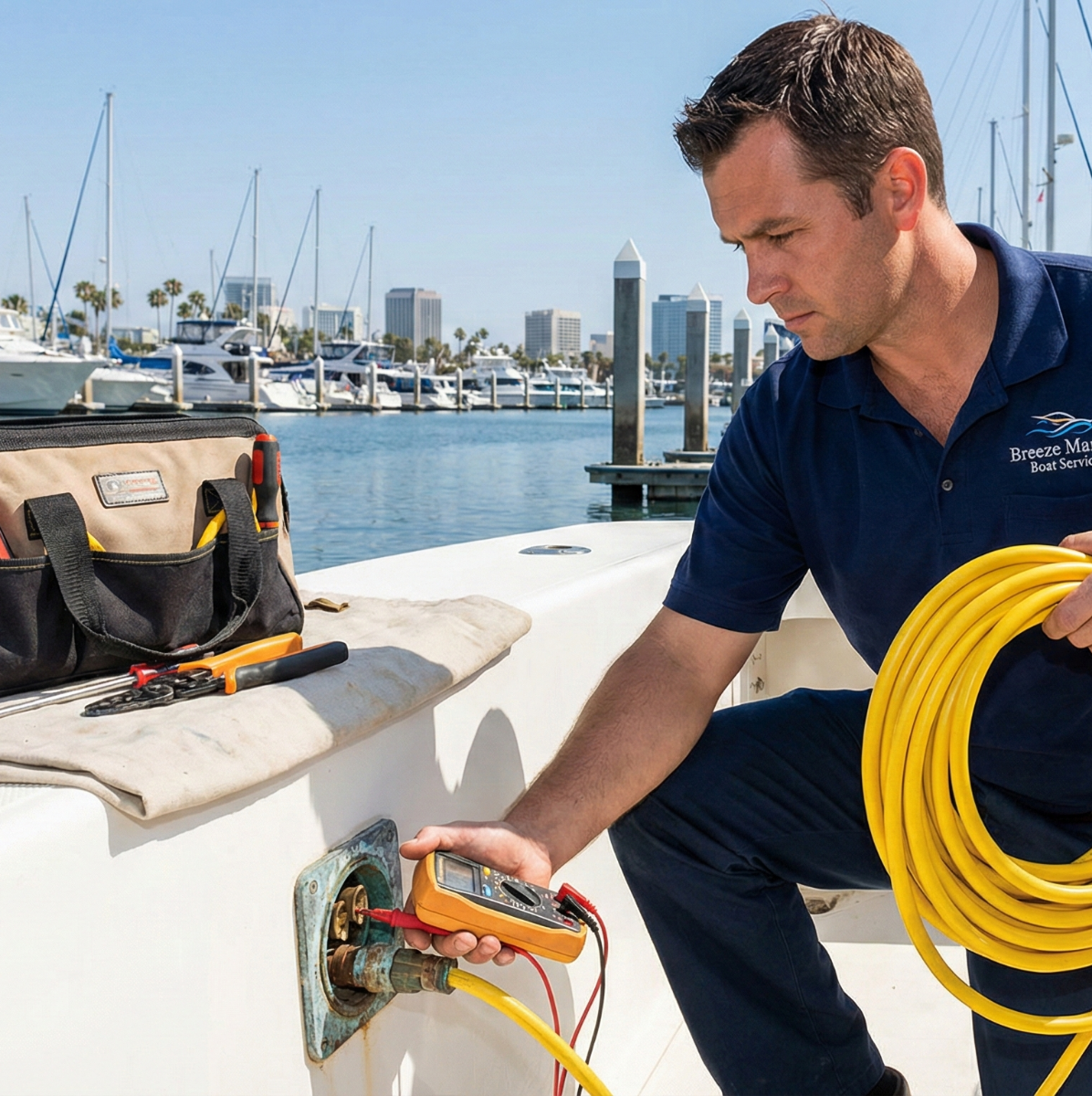
With power switched off at the pedestal and the cord unplugged at both ends, you can do a useful visual check. Look at each blade and socket for discoloration, green or white corrosion and pitting. Flex the cord along its length and look for cracks near the ends, where most of the bending happens. Make sure the locking ring or cover closes properly and that the weather boot is not split.
A few habits also reduce wear. Switch off the dock breaker before plugging in or unplugging, so the contacts do not arc under load. Support the cord so it does not hang by the plug, and avoid household adapters and extension cords. Resist the temptation to sand corroded blades: sanding strips the protective plating and leaves bare metal that corrodes faster, so a pitted or burnt connector needs replacing rather than cleaning.
What a Professional Shore Power Inspection Involves
A proper shore power inspection follows the power from the dock to the panel instead of looking at the plug alone. A technician typically:
- Checks both ends of the cord and the pedestal socket for heat damage.
- Opens the shore power inlet to look at the wiring behind it, because heat often travels back along the conductors and hardens or discolors the insulation.
- Tests the ELCI breaker or GFCI protection to confirm it trips when leakage current is present.
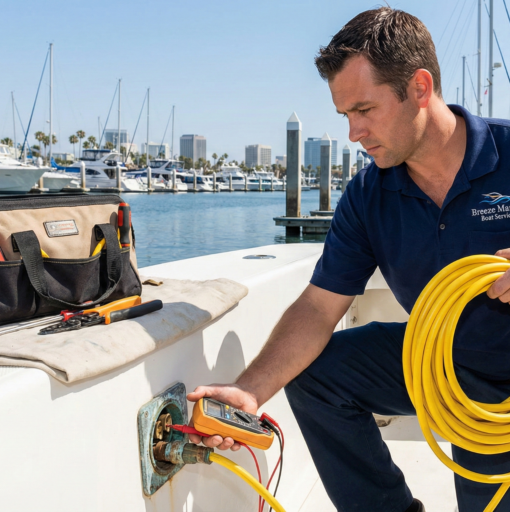
- Runs real loads and measures voltage drop between the pedestal and the panel. A large drop points to resistance somewhere in the line.
From there, the fix might be shore power cord replacement, a new inlet with the damaged wire cut back, or both. Many owners also choose a SmartPlug upgrade, which replaces the traditional twist-lock design with a pin-and-sleeve connection that locks straight in and seals against water. If you are seeing any of the warning signs above, Breeze Marine can carry out a shore power inspection and cord replacement for boats in Long Beach, San Pedro and Huntington Harbor.
When to Call a Technician Right Away
Some findings mean you should stop using the connection until it is repaired: a plug that is hot rather than slightly warm, melted or charred plastic, exposed conductors, a burning smell, or a breaker that trips as soon as power is applied. The same goes for any tingle felt when touching metal fittings aboard. These are boat electrical repair problems rather than routine maintenance, and they carry both fire and shock risk around the water.
It is also worth having the system checked when you buy a boat, after a long lay-up, or if nobody knows how old the cord and inlet are.
Shore Power FAQ
How warm is too warm for a shore power plug?
A healthy connection should feel about the same temperature as the cord around it. Noticeable warmth means resistance, so a hot shore power plug should be unplugged with the dock breaker off and inspected before it is used again.
Should I replace the cord or the inlet first?
Heat damage usually affects both sides of the connection, so they should be inspected together. Plugging a new cord into a damaged inlet can ruin the new cord quickly.
Is a SmartPlug upgrade worth it?
For boats that run heavy loads such as air conditioning on shore power, many owners find it worthwhile, because the larger contact area and straight-in locking design reduce the conditions that cause overheating. The boat inlet and the cord end are changed together as a matched pair.