
Most electrical trouble on a boat does not start with a failed component. It starts with a connection that has slowly corroded in salt air until it can no longer carry current. A navigation light that flickers when you hit a wake, a bilge pump that runs slowly, or a breaker that trips for no obvious reason are all classic signs. Understanding how boat wiring fails helps you describe the symptom accurately and decide when a problem needs professional marine electrical repair.
Why Wiring Fails in a Marine Environment
Automotive wiring is built for a dry, sealed engine bay. A boat asks far more of the same copper. Moisture, salt crystals and constant vibration attack every terminal, and the damage often hides under insulation where you cannot see it.
Black wire disease and wicking
Bare copper strands corrode into a dark or green powder. Salt water can wick several inches up inside the insulation, so a wire that looks fine at the terminal may be rotten a foot further along. This is why a proper repair cuts back to bright, clean metal rather than just crimping a new end onto a damaged conductor.
Chafe and heat
Wires that rub against a hull stringer, a hatch hinge or an engine bracket eventually wear through. Undersized wire run close to its limit gets warm, the insulation hardens and cracks, and resistance rises further.
Poor previous repairs
Household wire nuts, electrical tape and uninsulated butt connectors are common finds. They may work for a season, then fail intermittently. A good boat electrician will often spend as much time undoing earlier shortcuts as fixing the original fault.
Symptoms Worth Writing Down
A clear description saves diagnostic time. Note exactly what happens and when:
- Lights dimming when a pump, windlass or fridge compressor starts
- A breaker that trips immediately versus one that trips after running for a while
- Equipment that works at the dock but fails when the boat is pounding in a swell
- Warm or discolored terminals, melted insulation or a burning smell
- Gauges that read erratically or drop to zero and come back
A breaker that trips instantly usually points to a short. One that trips after a few minutes suggests an overload or a failing motor drawing too much current. Equipment that dims under load points toward resistance somewhere in the circuit.
How a Marine Electrician Traces the Fault
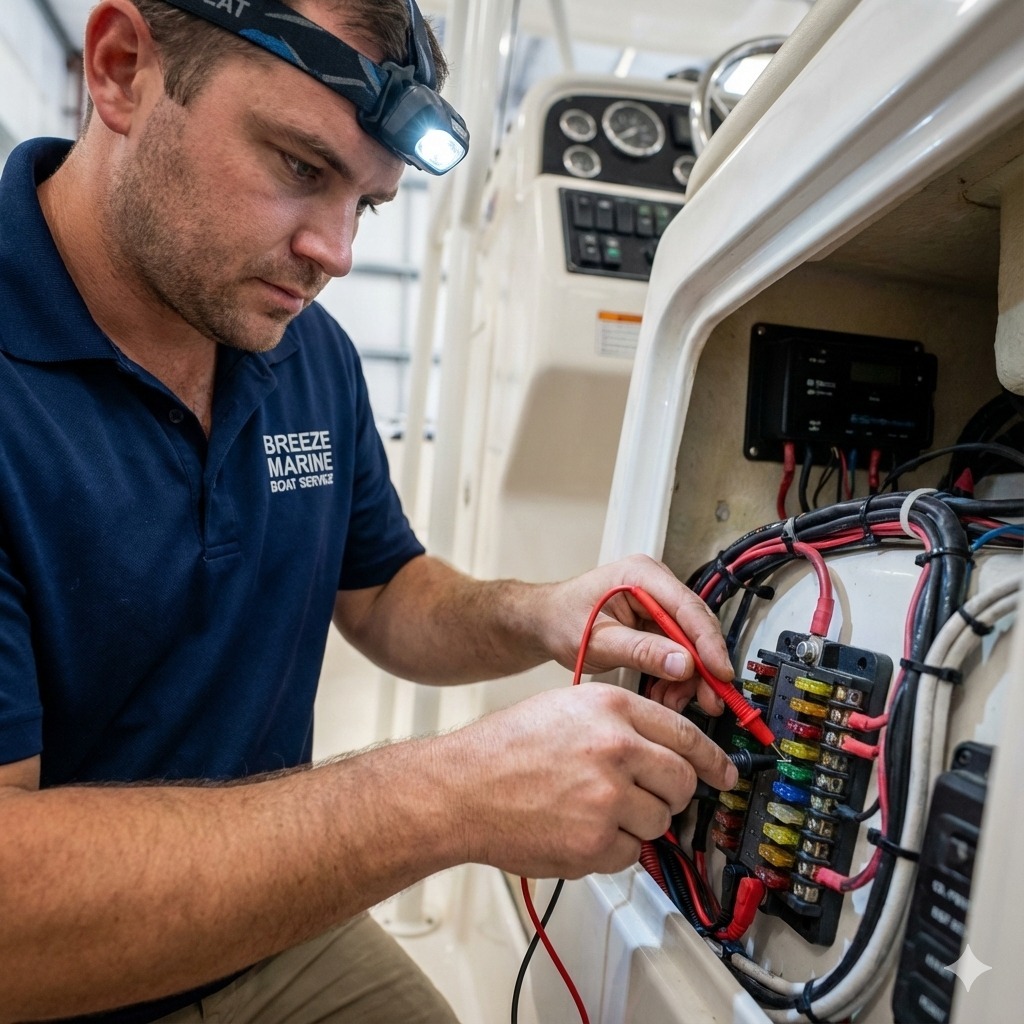
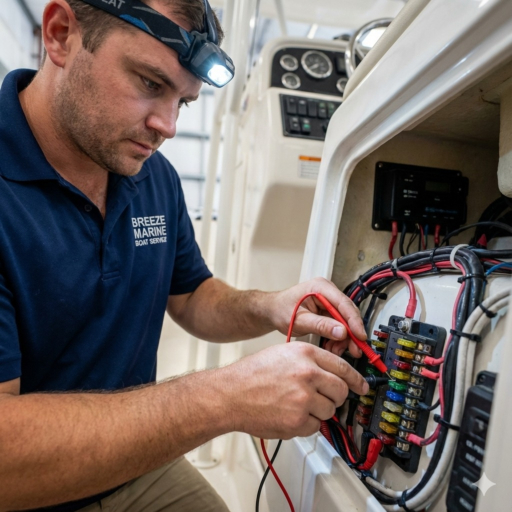
Guessing and replacing parts is expensive. A methodical marine electrician checks the circuit in sections: voltage at the source, at the switch or breaker, and at the load. That quickly shows whether the break is on the positive side or in the negative return, which is just as likely to be the culprit.
The most useful test is a voltage drop test. Instead of checking whether voltage is present with nothing running, the technician measures across a connection or cable while the circuit is working. A healthy connection shows almost no voltage drop. A corroded terminal or undersized wire shows a measurable loss, which pinpoints the exact spot where power is being wasted as heat.
What Proper Repairs Look Like
Good marine electrical services follow recommended marine practice rather than automotive habits. Expect to see:
- Tinned, multi-strand marine wire that resists corrosion and vibration
- Adhesive-lined heat shrink terminals that seal out moisture
- Correct wire gauge for the load and the length of the run
- Fuses or breakers sized to protect the wire, close to the power source
- Consistent color coding and labels so the next person can follow the circuit
Shore Power, Plugs and Sockets
AC problems deserve extra caution. Worn marine electrical sockets and cord ends are a frequent source of heat, because a loose or corroded contact creates resistance at exactly the point where the most current flows. Check your shore power cord and inlet for browned plastic, pitted pins or a plug that feels warm after use. Any of these means the marine electrical plugs and sockets should be inspected and replaced as a set, since a new cord in a damaged inlet will quickly be damaged too.
What an Owner Can Safely Check
Some basic inspection is well within reach of most owners, as long as you unplug from the dock and switch off the batteries first:
- Look at battery terminals and main cable ends for corrosion or loose nuts
- Inspect visible wiring in the bilge for chafe, sagging runs or wires sitting in water
- Check that fuse holders are tight and fuses are the correct rating
- Smell and look for heat damage around the distribution panel
Stop there if you find melted insulation, anything on the AC side, or a fault you cannot isolate. At that point boat electrical repair is a job for someone with the right meters and experience.
When to Call a Professional
Call for help when a breaker keeps tripping, when you smell burning insulation, when shore power equipment is hot, or when a fault is intermittent and you cannot pin it down. Electrical fires are a leading cause of boat losses, so these are not symptoms to live with. Our marine electrical repair and troubleshooting service covers boats in San Pedro, Long Beach and across Los Angeles County.
Boat Wiring FAQ
Can I just replace a corroded terminal?
Only if the wire behind it is clean. Strip back the insulation a little; if the strands are dark or green, corrosion has wicked up the wire and the damaged section needs to be cut out or the run replaced.
Why does my breaker trip only when underway?
Motion and vibration can make a chafed wire touch the hull or another conductor, creating a short that disappears at the dock. It usually takes tracing the circuit under load to find it.
Is electrical tape acceptable on a boat?
Not as a permanent repair. Tape lets moisture in and loosens with heat. Sealed heat shrink connections are the accepted approach.