



Most boat owners worry about batteries going flat. Fewer realize that too much charging can be just as destructive. A voltage regulator that stops controlling the alternator can push charging voltage well above safe levels, boiling batteries, damaging electronics and in severe cases creating a fire risk. The good news is that a failing regulator usually leaves clear clues, and simple checks with a multimeter can reveal them early.
What a voltage regulator does
An alternator produces more voltage as it spins faster. The regulator's job is to control the alternator's field current so the system voltage stays in a safe band regardless of engine speed or electrical load. In most boats, that band is about 13.8 to 14.4 volts while charging for lead-acid and AGM batteries, with some regulators briefly allowing slightly higher absorption voltage depending on the battery type.
Regulators come in two broad styles. Many alternators have an internal regulator built into the back of the unit. Larger or upgraded charging systems use external solid-state regulators with multi-stage charging profiles and temperature sensing. Outboard motors typically use a combined rectifier and regulator that converts and controls the output of a stator under the flywheel.
How regulators fail
Regulators usually fail in one of two directions:
- Undercharging: the regulator does not allow enough field current, so batteries slowly go flat even though the engine runs normally.
- Overcharging: the regulator loses control and lets the alternator run at full output. Voltage climbs to 15, 16 or even 18 volts.
Heat, vibration, corrosion on sense wires and poor grounds are common causes. On outboards, a failed rectifier-regulator can also cause erratic charging or a dead battery.
Symptoms of boat battery overcharging
- A rotten-egg or sulfur smell near the batteries.
- Batteries that feel hot or swell, or flooded batteries that need frequent topping up with water.
- A voltmeter reading consistently above about 14.8 volts at cruising speed.
- Bulbs burning out more often than normal.
- Flickering lights or cabin lights that get brighter as engine speed rises.
- Electronics resetting or showing overvoltage warnings.
A voltage spike can damage chartplotters, radios and engine control modules, so overcharging symptoms deserve prompt attention. If you ever see 15 volts or more, shut down the engine and investigate before running again.
Simple checks an owner can do
You need a basic digital multimeter.
- Resting voltage: with the engine off and batteries rested for a few hours, a charged lead-acid battery reads about 12.6 to 12.8 volts.
- Idle voltage: start the engine and measure at the battery terminals. Voltage should rise to roughly 13.5 to 14.4 volts.
- Higher RPM: bring the engine up to cruising speed (safely, at the dock in neutral where allowed, or underway with a helper). Voltage should stay steady, not keep climbing.
- Under load: switch on heavy loads such as the windlass, pumps or inverter. Voltage may dip briefly but should recover.
Also inspect the wiring: loose or corroded connections on the alternator, regulator and battery can mimic regulator failure by sending the regulator false readings.
What professional testing involves
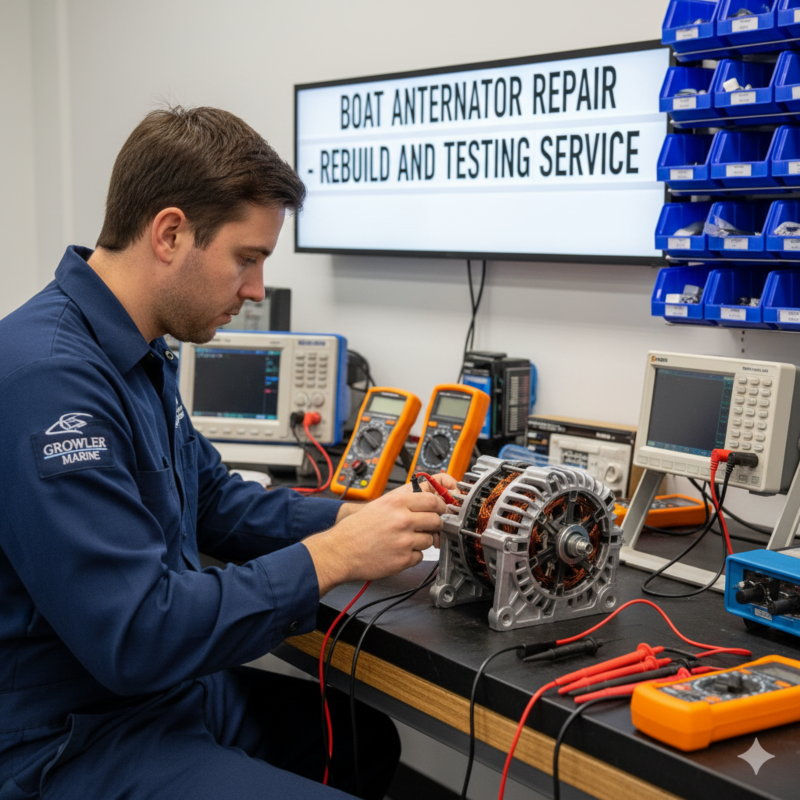
Voltage regulator testing by a technician goes beyond a single meter reading. It includes checking voltage at the alternator and at the battery to spot voltage drop in the wiring, measuring charging output in amps under load, checking the sense and field circuits, and on outboards testing the stator and the rectifier separately. For internal regulators, the alternator is often removed and bench tested, and the regulator is replaced as part of marine alternator repair. For external units, a new regulator can be installed and programmed for the battery chemistry aboard.
An outboard charging system is tested differently from an inboard alternator. The stator's AC output is measured first, then the rectifier-regulator's DC output, to see which component has failed.
Repair or replace?
Many regulators are sealed units that are replaced rather than repaired. Voltage regulator replacement is often far less expensive than a new alternator, and it protects the much more costly batteries and electronics. When replacing, it is a good time to consider whether a multi-stage external regulator would suit your battery bank better. You can read how we test and replace regulators on our marine voltage regulator testing and replacement page.
Voltage regulator FAQ
What voltage is too high for boat batteries?
Anything consistently above about 14.8 volts for lead-acid or AGM batteries is a concern. Lithium systems have their own limits set by the battery manufacturer.
Can a bad regulator kill a new battery?
Yes. Overcharging can ruin a new battery quickly, so replace the faulty regulator before fitting new batteries.
Is a flickering light always the regulator?
No. Loose connections and poor grounds cause flicker too, so check wiring before assuming the regulator has failed.


