

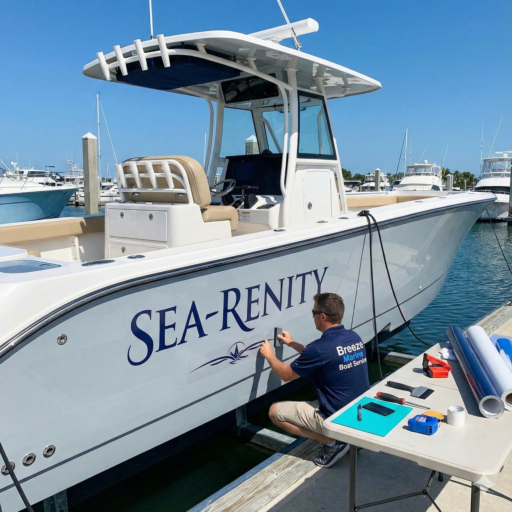
A new name is often the first thing an owner wants after buying a boat, and faded or peeling lettering is one of the quickest ways to make a well-kept boat look neglected. Getting it right involves more than picking a font. Registration numbers have rules, documented vessels have their own marking requirements, and vinyl that looks fine on a car can fail in a single season on a hull.
Registration numbers: the part that is not optional
State-registered boats must display boat registration numbers on both sides of the forward half of the hull. The general federal standard, which states follow, calls for plain vertical block characters at least three inches high, in a color that contrasts with the hull, reading from left to right. The letter and number groups are separated by a space or hyphen equal in width to a letter, for example CF 1234 AB. Script fonts, outlines that reduce legibility and characters placed on a curve that distorts them are common reasons numbers are not acceptable.
California also requires a current registration sticker near the numbers, so leave room for it in the layout. Check the current state boating rules before ordering, since the details are enforced on the water, not at the print shop.
Documented vessels and hailing ports
Boats documented with the Coast Guard follow different rules. The official number is marked inside the hull on a permanent structural part, and the name and hailing port are displayed on the exterior. For recreational documented vessels, the name and hailing port are typically shown together on the stern, in letters at least four inches high. Hailing port decals usually include the city and state, and they look best when they match the style and color of the name above them.
Choosing a name that works on the water
Custom boat names should be easy to read and easy to say on the radio. A name that is clear in a hailing call avoids confusion in busy harbors. Very long names or intricate scripts can also become hard to read at a distance or when scaled to fit a narrow transom. Ask for a mockup on a photo of your actual hull color before committing, and view it at the size it will really be installed.
Materials: why marine vinyl is different
Most vinyl boat graphics are cut from sheet vinyl, and the type matters:
- Cast vinyl is thin, conforms to curves and resists shrinking. It is the usual choice for custom hull graphics and lettering that wraps around compound curves.
- Calendered vinyl is cheaper and stiffer, and it tends to shrink and crack sooner in strong sun, which suits temporary or flat applications better.
- Laminates over printed graphics protect inks from UV fading and fuel or cleaner splashes.
Adhesive matters too. Marine environments bring constant moisture, salt and hull flex, so the adhesive must hold on gelcoat or paint without lifting at the edges.
Removing old lettering
Old vinyl usually leaves a ghost image where the gelcoat around it has faded or oxidized while the area beneath stayed protected. Careful removal with gentle heat and plastic tools, then adhesive cleanup and a compound and polish, reduces that shadow. On heavily oxidized hulls the ghost may never fully disappear, which is one reason new custom boat lettering is often sized to cover the old footprint.
Installation basics
Good marine boat lettering is applied to a surface that is clean, dewaxed and dry, in shade and at a moderate temperature. Wet application with a proper solution allows positioning on large pieces, while small letters are often applied dry. Edges are pressed down firmly and the boat should not be washed with pressure for a few days while the adhesive cures. Straight alignment matters more than most people expect: lettering that follows the waterline rather than a level line can look crooked from the dock.
Beyond the name
Boat graphics also include boot stripes, accent stripes, logos and full hull wraps. Custom boat decals for tournament numbers, club flags or safety labels follow the same material rules. Well-chosen marine graphics can modernize an older hull for far less than a repaint, and they can be removed later if tastes change.
For design, mockups and installation of names, numbers and stripes, see custom boat lettering and vinyl graphics from Breeze Marine.
Boat lettering FAQ
How long does marine vinyl lettering last?
Quality cast vinyl typically lasts several years on a boat, depending on sun exposure, cleaning products and whether the boat is covered. Dark colors and horizontal surfaces fade faster.
Can I use script fonts for registration numbers?
No. Registration numbers must be plain block characters that contrast with the hull. Script is fine for the boat name, not for the numbers.
Is there a rule about renaming a boat?
Legally you update the registration or documentation records. Many owners also hold a traditional renaming ceremony, which is optional but popular.


