

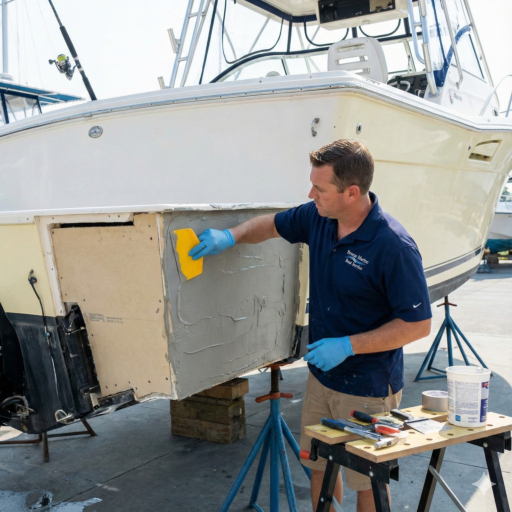
The transom is the flat back wall of the hull, and on most outboard and sterndrive boats it carries the full weight and thrust of the engine. When it weakens, the problem rarely shows up all at once: water can seep into the core for years before the first crack or wobble appears. This guide explains how transom rot starts, what you can check on your own and what a real repair involves.
How a Transom Is Built
Many fiberglass boats use a sandwich transom: an outer fiberglass skin, a thick plywood core and an inner skin. The fiberglass forms the shell, while the plywood supplies the stiffness that keeps the engine mount from moving. As long as the core stays dry, that sandwich can last for decades. Once water reaches the wood, it softens, loses its bond to the skins and eventually rots.
Where the Water Gets In
Transom rot almost always starts at a hole. Every fastener through the transom becomes a leak path once its sealant ages:
- Engine mounting bolts and the outboard bracket or sterndrive assembly
- Drain plug tubes and bilge pump outlets
- Transducer, trim tab and swim ladder screws
- Rod holders, tie-down eyes and accessories added over the years
Holes drilled into plywood without sealing the exposed end grain are the usual culprit, and rainwater pooling in the splashwell can wick in through cracks in the gelcoat.
Warning Signs You Can Check Yourself
None of these checks needs special tools.
Stress Cracks in the Gelcoat
The most common early warning is transom stress cracks: fine spider-web or parallel lines in the gelcoat, most often at the inside corners and around the engine mount. A lone scratch is cosmetic, but cracks that radiate from load points, especially with brown or rusty streaks below bolts and drain fittings, suggest the laminate is moving and the core behind it is wet.
The Transom Tap Test
For a transom tap test, work across the whole panel with the handle of a small hammer or a plastic mallet. Solid laminate gives a crisp, sharp sound. A dull thud, especially around fasteners and near the bottom edge, marks an area where the core may have softened or separated from the skin. Mark the dull spots with painter's tape so a technician can see the pattern.
The Flex Check
With the engine trimmed down, have someone lift and push on the lower unit while you watch the top of the transom and the inside corners. Any visible movement is transom flex, and it means the core no longer holds the two skins together as one stiff panel. A soft transom that moves under this kind of load should not be run hard until it has been inspected.
Why Injecting Resin Is Rarely a Real Fix
Injection and pour-in products promise to stiffen a transom without cutting the boat open, but resin needs a clean, dry surface to bond to. A rotten core is wet and crumbly, so new material either traps moisture or ends up glued to wood that keeps breaking down. Pourable compounds only make sense after every bit of old wood has been dug out and the cavity is dry. A rotten transom repair lasts only when the damaged wood comes out.
What a Proper Transom Rebuild Involves
A full transom rebuild is structural fiberglass boat repair, not a cosmetic patch. The typical sequence looks like this:
- Strip the transom. The engine, bracket and all hardware come off.
- Open the inner skin. The inner fiberglass is cut away from inside the boat, so the outer gelcoat and hull shape stay intact.
- Remove the rot. All decayed core is dug out and the outer skin is ground back to sound laminate.
- Fit a new core. A new panel is cut to shape and bedded in thickened epoxy with no air pockets.
- Laminate and tie in. Fiberglass cloth goes over the new core and laps onto the hull sides so loads spread through the structure.
- Drill, seal and rehang. Hardware holes are drilled and sealed, and the engine goes back on.
Soft stringers or knees that tie into the transom need the same attention, or the new transom will still move. If your tap test or flex check turned up problems, a transom structural repair and reinforcement evaluation is the sensible next step.
Coosa Board or Plywood Core?
Marine plywood is strong, but it is still wood and will rot again if water gets back in. Composite panels such as Coosa board are made from high-density foam reinforced with fiberglass, so they do not absorb water or decay. A Coosa board transom is also lighter than a comparable plywood core, and it removes the very material that failed in the first place.
Keeping the New Transom Dry
A rebuilt transom stays healthy only if every future hole is sealed properly. A common method is to drill the hole oversize, fill it with thickened epoxy and drill the final hole through the cured plug, so the core never meets water. Bed all hardware in marine sealant and repeat the tap test once a year; catching a small wet spot early is far easier than another boat transom repair.
Transom Repair FAQ
Is it safe to keep using a boat with transom flex?
Visible flex means the structure carrying the engine is failing. Speed and rough water add load to a weak area, and in the worst case the engine mount can tear loose. Limit use and have it inspected first.
Does every gelcoat crack mean the transom is rotten?
No. Gelcoat can crack from impacts, thick buildup or age. Cracks that cluster around the engine mount and corners, combined with stains, a dull sound when tapped or visible movement, are what point to a wet core.


