
Boat Alternator Repair
Boat alternator and voltage regulator repair in Long Beach and San Pedro: output tests, rebuilds and high-output upgrades for lithium banks. Get a quote.
- 3 services
- Labor $150/hr
- Trip fee from $30
- At your slip or in the shop


Boat Alternator Repair in Long Beach and San Pedro
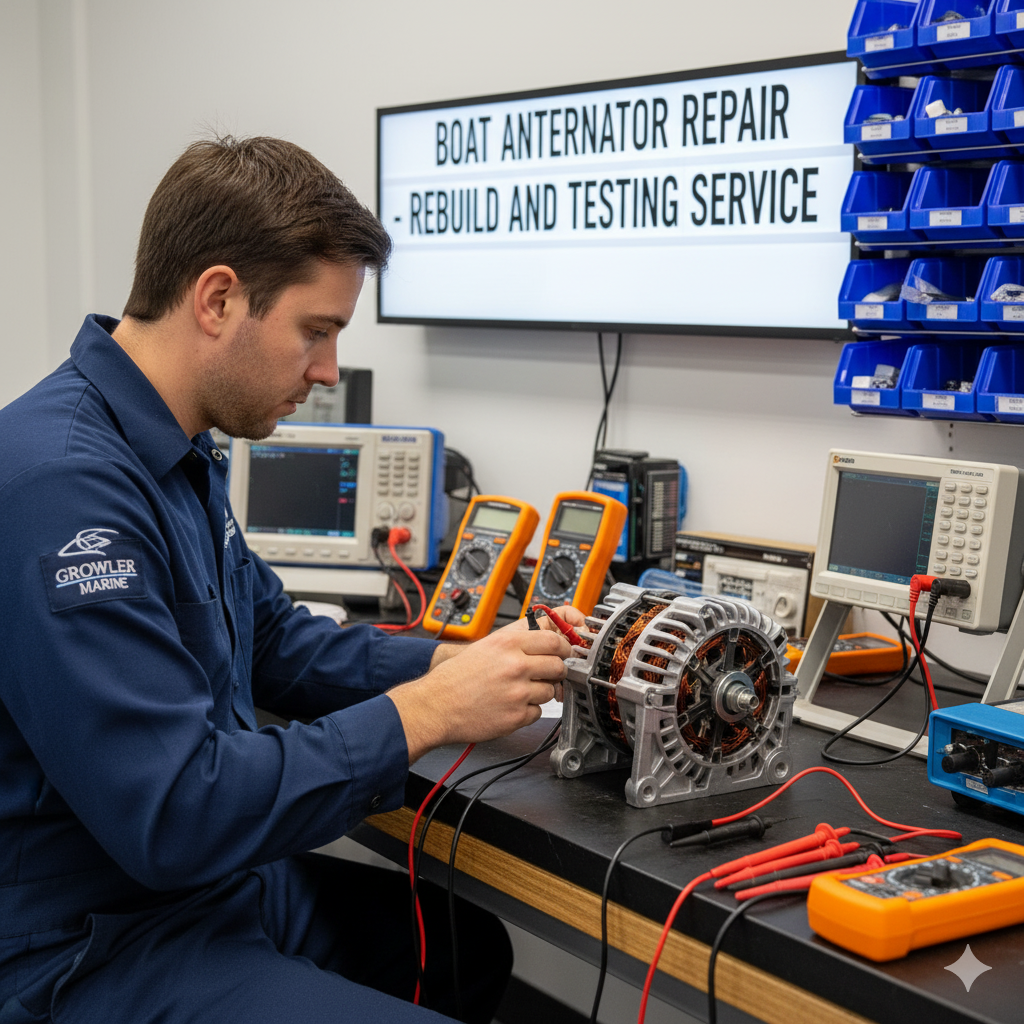
We test, rebuild and upgrade marine alternators and voltage regulators at your slip, dock or storage yard from Marina del Rey to Newport Beach, or at our San Pedro shop. When batteries keep running low, we find out whether the alternator, the regulator or the wiring is at fault.
What the work covers
- Marine alternator rebuild and high-output upgrades: output testing on the engine, then a rebuild with new brushes, bearings or diodes as needed, or a higher-output unit.
- Voltage regulator testing and replacement: a regulator that undercharges leaves batteries flat, and one that overcharges can cook them.
- High-output alternator upgrades for lithium banks: matching the alternator and its regulator to a LiFePO4 battery bank.
We also check the belt, pulleys, cables and grounds, because a slipping belt or a corroded connection can look like a failing alternator on the gauge. Parts are quoted with the job. Battery and charger work is part of marine electrical repair.
Signs of a charging problem
- Batteries that are low after a day of running
- A voltmeter that reads low, reads high or jumps around
- A charging warning light or alarm
- Lights that dim at idle and brighten with throttle
- Hot batteries, a rotten-egg smell or batteries that need water often
- A whine in the stereo that rises with engine speed
Questions about boat alternator repair
Can I use a car alternator on my boat?
On gasoline inboards and sterndrives, the alternator must be ignition protected so it cannot spark fuel vapor, and car alternators are not built that way. Marine alternators are also built with salt air in mind.
Do lithium batteries need a new alternator?
Sometimes. A lithium bank can pull more current than a standard alternator is built to give for long periods, and the heat shortens its life. Some setups only need regulator changes, while larger banks often need a high-output alternator with a regulator that watches its temperature.
Book a visit: submit a ticket with the boat, the engine, where it is kept and what the batteries or voltmeter are doing, or call (562) 542-7296.
If your boat's alternator isn't charging properly, it can be hard to diagnose without a clear picture of what you're seeing. Send us photos of the voltage gauge or battery monitor on your dashboard, and we'll use that information along with our testing equipment to determine whether the problem is in the alternator itself, its wiring, or the regulator it's connected to.
Send Us Photos: FAQ
What if I send you a photo but you still need more info from me before diagnosing the problem?
We may ask for additional photos of the alternator itself, your battery setup, or other relevant components. This helps us pinpoint the root cause and ensures we bring the right tools and parts to the job.
Can I send photos of my alternator instead of bringing it in for a diagnosis?
Yes, but keep in mind that our technicians prefer to see the unit in person before deciding on repair or replacement. A photo can give us a good starting point, but we may still need to inspect the alternator and its connections at your slip or dock to get an accurate assessment of what's needed.
-

#894 Common question asks
Do you provide warranty and post-installation testing?
-
Yes. Alternators and regulators carry their manufacturer's warranty, and our workmanship is warranted for 90 days from the invoice date. After installation we load-test the system, check alternator temperature and confirm the charging profile, and you get documentation of the settings for your lithium bank.
-
-
#892 Common question asks
Will a high-output alternator improve charging at idle or low RPM?
-
Usually, yes. A high-output alternator with the right pulley ratio makes more current at low engine speeds than a stock unit, though output at idle is always lower than at cruising RPM. Long periods of idling just to charge are hard on a diesel engine.
-
-
#890 Common question asks
Can you integrate the alternator with my existing BMS and monitoring system?
-
Often, yes. Regulators such as the Wakespeed WS500 can communicate with many lithium BMS brands, and we wire in your shunt and monitoring display so charging follows the battery's limits and stops when the BMS calls for it. We check that your BMS is compatible before we quote.
-
-
#888 Common question asks
Is an external voltage regulator required for lithium banks?
-
Yes, in most cases an external lithium-compatible voltage regulator is essential. It controls charging stages, protects the alternator from thermal overload, and ensures the lithium batteries receive the correct voltage and current limits.
-
-
#886 Common question asks
What is included in a high-output alternator upgrade?
-
The upgrade includes alternator replacement, proper pulley sizing, heavy-duty wiring upgrades, lithium-compatible external voltage regulator installation, and full system testing. We also verify belt alignment and cooling to ensure long-term reliability.
-
-
#884 Common question asks
Can my stock alternator damage lithium batteries?
-
It can, but the bigger risk is usually to the alternator: a lithium bank can make a stock alternator run flat out until it overheats. A stock regulator also has no lithium charging profile, and if the battery's BMS disconnects while charging, the voltage spike can damage the alternator. We install external regulators set to your battery maker's charging profile.
-
-
#882 Common question asks
Why do I need a high-output alternator for a lithium battery bank?
-
You may not. A lithium bank has very low resistance, so it takes as much current as the alternator can make for as long as it charges, and a stock alternator then runs flat out and can overheat. The answer is either a DC-DC charger that limits the current from your stock alternator, which suits smaller banks, or a high-output alternator with an external regulator that watches alternator temperature, for faster charging of larger banks.
-
-
#880 Common question asks
How often should the voltage regulator be inspected?
-
We check the charging voltage at every routine engine service, on the engine maker's schedule, and whenever charging problems appear. Boats with high electrical loads or several batteries benefit from more frequent checks.
-
-
#878 Common question asks
Is voltage regulator replacement covered by any warranty?
-
Yes. Replacement regulators carry their manufacturer's warranty, and our workmanship is warranted for 90 days from the invoice date.
-
-
#876 Common question asks
Do you replace voltage regulators for inboard and outboard engines?
-
Yes, we service voltage regulators for inboard, outboard, sterndrive, and marine generator charging systems. We use marine-grade OEM or equivalent components designed for harsh saltwater environments.
-